
Introduction
You know the feeling, you sit down to write a report, and five minutes in, Slack pings. You answer it quick, just this once. Then an email shows up, and sure, why not, you glance at that too. Next thing you know, twenty minutes have gone by and you’ve written… two sentences.
That’s not bad luck. It’s not you being lazy either, no matter how much it feels that way at 4 p.m. on a Thursday. It’s just how attention works, and it’s a huge part of why multitasking is quietly wrecking your productivity, more than most of us ever stop to notice.
We love to think of multitasking as a skill. Something sharp, ambitious people are just naturally better at. I used to believe that too, honestly. Then I actually read the research on it, and yeah it’s a lot less flattering than we like to pretend.
What “Multitasking” Actually Means

Ask ten people and you’ll get ten different definitions, but most land near the same idea: doing two or more things at once. Replying to emails on a call. Writing a doc while half-watching a group chat.
Cognitive scientists split hairs on this a bit more than the rest of us do, though. True multitasking your brain handling two complex things at the exact same instant is rare. Almost a myth, really.
What feels like multitasking is usually your brain flipping back and forth, fast. Sounds like a small difference. It’s not. That flipping isn’t free it costs you something every time, even when it happens too quickly for you to notice.
Why We Keep Doing It Anyway
Most people don’t multitask because they ran the math and decided it’s efficient. They do it because sitting still with one task, no distractions, feels almost uncomfortable now. We’ve built our whole world around pings.
There’s a reward loop buried in there too. A new message gives you a tiny hit of novelty, and researchers think this trains your brain over time to actually want the interruption, rather than fight it off.
Open offices don’t help. A group chat that never sleeps doesn’t help. A manager expecting a reply in five minutes definitely doesn’t help. In that kind of setup, just doing one thing at a time can start to feel irresponsible, even though ironically. It’s usually the faster way to actually get something done.
What’s Really Going On In Your Brain
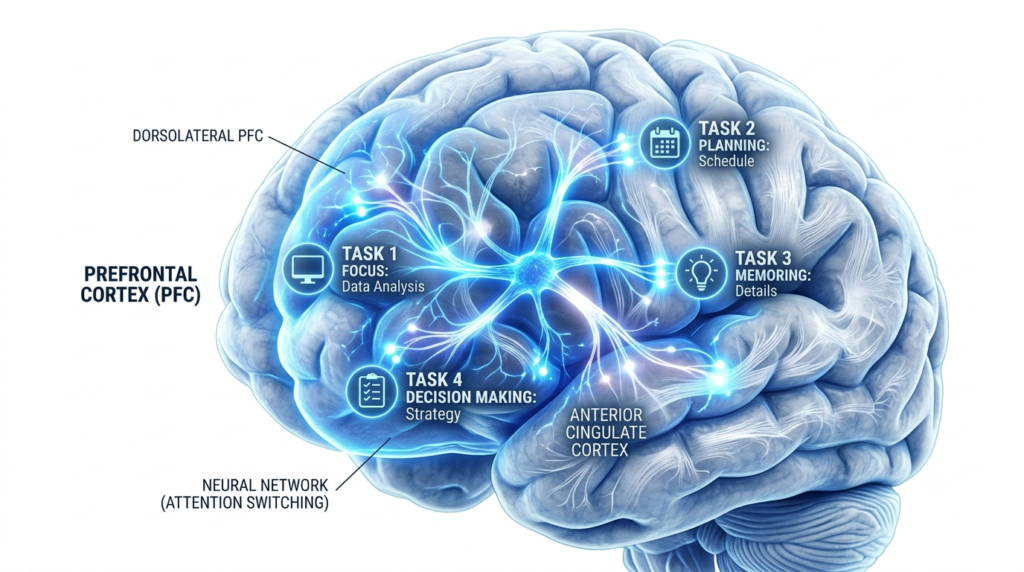
Your brain has a limited amount of attention and working memory to hand out, and demanding tasks fight hard for that same small pool.
Studies on task switching show people can really only focus on one demanding task at a time. Doesn’t matter how fast they think they’re bouncing back and forth. The prefrontal cortex your brain’s planning-and-decisions center has to fully drop one task before it can pick up the next.
That handoff takes a beat. It’s not instant, and it’s not made up either. Researchers at Wake Forest ran fMRI and EEG scans and watched the frontal and parietal regions light up every single time. Someone switched tasks, or even just repeated one they’d already been doing.
What Switching Actually Costs You
There’s a name for this: switch cost. It’s the time and accuracy penalty you pay every time you jump from one task to another. On its own, sounds like nothing half a second, maybe less.
But stack that across a full workday of tiny interruptions and it adds up fast. One study clocked people at 95% slower and 120% more error-prone while multitasking, compared to doing the same work one thing at a time.
Didn’t matter how old they were or how educated. The gap stayed put. That’s not a rounding error.
What the Research Actually Found

The most cited study in this space came out of Stanford, and it’s worth knowing. Psychologist Clifford Nass and his team split college students into heavy and light media multitaskers. Expecting the heavy group to reveal some hidden strength. Better filtering, maybe, Faster switching.
They found the opposite. Nearly every cognitive test told the same story the heavy multitaskers did worse, across the board. Nass didn’t sugarcoat it. He said they were bad at basically every skill multitasking actually requires.
Ten years later, a follow-up review out of Stanford’s Memory Lab found the same thing held up. People who juggle a lot of media streams performed noticeably worse on basic memory tests than people who didn’t.
Myths That Refuse To Die
“Some people are just naturally good multitaskers.” Not really. Heavy multitaskers show no advantage if anything they score worse on focus and memory.
“Multitasking saves time.” It doesn’t, not once you factor in the errors and the switching costs.
“Younger people are better at it.” Age shifts the numbers slightly, sure. But nobody’s immune.
“It only messes up unimportant work.” Wrong direction, actually complex or unfamiliar tasks take the biggest hit, since they eat up more working memory to begin with.
The Loss You Don’t Even Notice
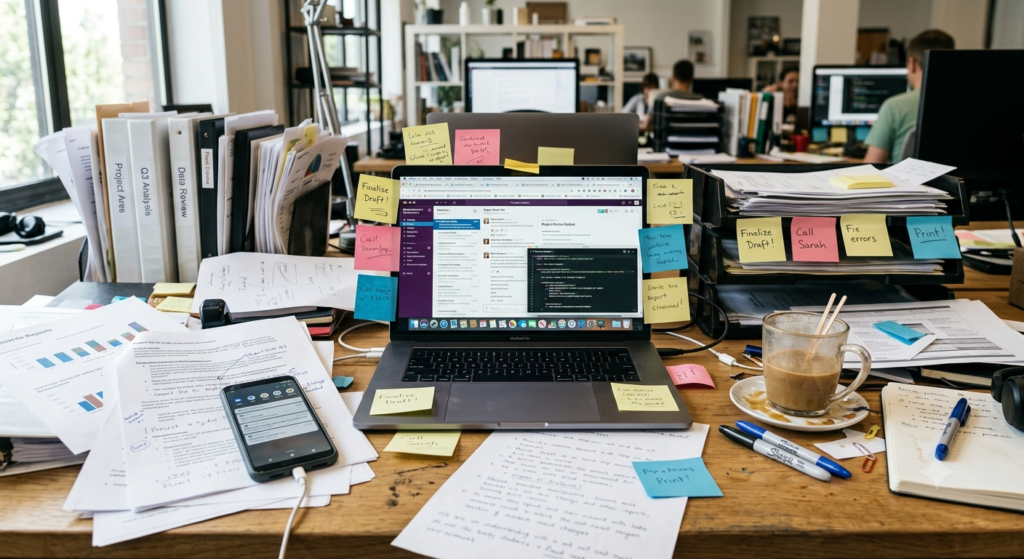
The real cost of multitasking rarely shows up as one big, obvious screwup. A report that should’ve taken ninety minutes eats up three hours instead. A proposal goes out with a couple of typos a focused mind would’ve caught without even trying.
A meeting you nodded along to the whole way through, then couldn’t explain to a coworker afterward. Researchers at UC Irvine found it takes over 23 minutes, on average, to fully refocus after a digital interruption. Most people get interrupted a lot more than once a day.
The same research also found people rarely go straight back to what they were doing before the interruption. Usually a couple other things get handled first. Then, eventually, the original task.
What It Does To Your Memory
Multitasking doesn’t just slow you down while it’s happening it also messes with what actually sticks afterward. Which, honestly, might be the more annoying part.
Stanford’s decade-long review found a pretty consistent link between heavy multitasking. Worse performance on basic memory tasks, and that held even in situations that had nothing to do with work.
Makes sense once you think about how memory actually forms. Getting something into long-term memory takes sustained attention. If your attention keeps getting yanked away mid-thought, the information never gets processed deeply enough to stay.
The Part Nobody Talks About: Stress
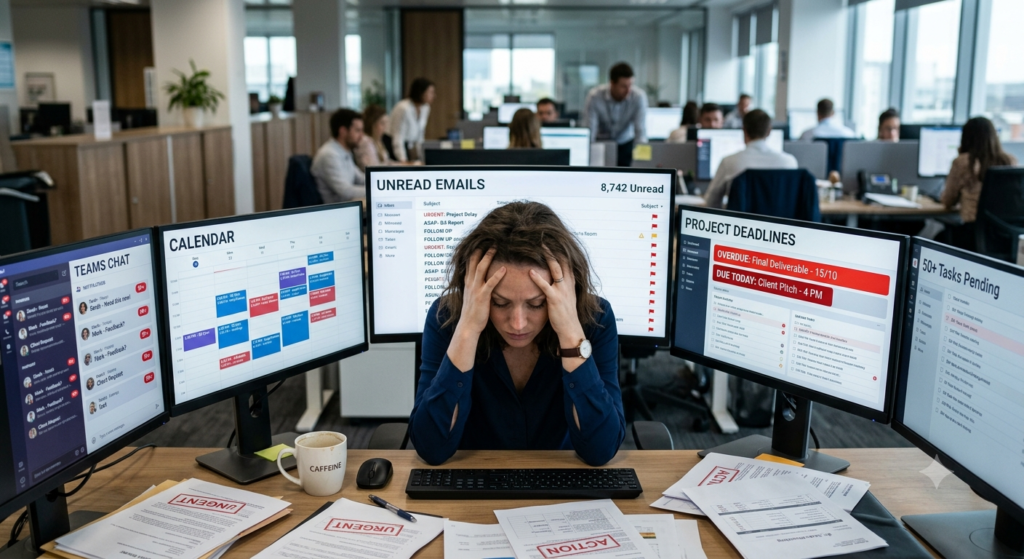
Beyond the memory hit and the errors, there’s an emotional cost too, one that’s easy to overlook. Gloria Mark’s research at UC Irvine links frequent interruptions to noticeably higher stress, frustration, and mental workload compared to uninterrupted work.
Which, honestly, just confirms what most of us already know without needing a study to say it. A day full of switching leaves you drained in a way a focused day doesn’t, even when the hours on the clock are exactly the same.
Constantly reloading your mental context wears you down. And there’s a quieter frustration too the one that comes from never quite finishing anything cleanly. Which has nothing to do with how hard the work actually was.
Why Single-Tasking Just Works Better
Single-tasking sometimes dressed up as “deep work” just means giving one thing your full attention for a set stretch before moving on. Not complicated, and the appeal isn’t just a vibe, either. It lines up exactly with how switch costs work.
If switching is what drains your time and accuracy, cutting down on switches is the most direct fix there is. No app required.
People who protect real blocks of single-task time tend to say they finish faster. Make fewer mistakes, and feel less fried by the end of the day. Which tracks it’s exactly what you’d expect once you understand what switch cost is doing to you in the background.
| Multitasking | Single-Tasking |
|---|---|
| Frequent attention switches | Sustained attention on one task |
| Higher error rates on complex work | Lower error rates, especially on complex work |
| Slower overall completion time | Faster completion for most task types |
| Weaker memory retention | Stronger memory retention |
| Higher reported stress | Lower reported stress during focused blocks |
How To Actually Focus Better
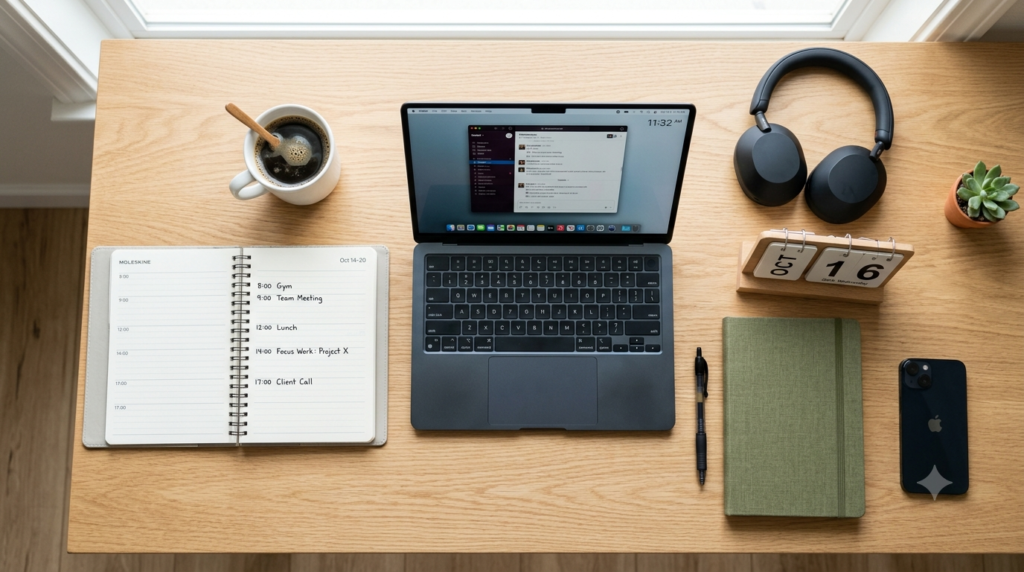
This isn’t about gritting your teeth and forcing concentration. A few things keep showing up, both in the research and in how people who actually finish things tend to operate:
Batch similar tasks. Answer emails in one sitting instead of trickling replies out all day. Fewer switches, less drag.
Kill notifications during focus blocks. Even a silenced phone sitting face-up on your desk pulls at you just by being there. Get it out of sight, not just off.
Try time blocking. Assign real hours to real tasks, and treat those blocks like fixed appointments, not gentle suggestions.
Close the tabs you’re not using. Visual clutter pulls at your attention the same way a notification does. It’s just quieter.
Take breaks on purpose. A five-minute breather between blocks resets you without triggering the full 23-minute recovery penalty.
Mistakes Worth Avoiding
Keeping every notification on “just in case,” when almost nothing actually needs your attention that fast.
Confusing a busy day with a productive one. A packed, switch-heavy day frequently produces less finished work than a boring, focused one. Annoying, but true.
Multitasking while trying to learn something. Studying or reading while distracted wrecks memory formation more than most people expect.
Back-to-back meetings with zero buffer. Without a gap, the mental leftovers from one meeting bleed straight into the next.
Assuming you’re the exception. Every study on heavy multitaskers finds the same thing no real advantage for the people who’re sure they’re unusually good at it. Sorry.
Real Life Examples
Microsoft Japan Improved Productivity by Reducing Distractions
In 2019, Microsoft Japan launched its “Work-Life Choice Challenge” to explore whether employees could become more productive by working fewer hours and focusing on high-value tasks instead of constantly switching between emails, meetings, and other interruptions.
The company introduced a four-day workweek, shortened meetings to 30 minutes, encouraged online collaboration, and promoted uninterrupted focus time.
Stanford Researchers Found Heavy Multitaskers Perform Worse
A landmark study led by psychologist Clifford Nass at Stanford University challenged the common belief that frequent multitaskers become better at handling multiple tasks.
Researchers compared heavy media multitaskers with people who rarely multitasked, testing their ability to focus, remember information, and ignore distractions. Surprisingly, heavy multitaskers consistently performed worse across nearly every cognitive test.
Frequently Asked Questions
Does multitasking actually reduce productivity?
Pretty much, yeah. Switching adds time and increases errors compared to doing things one at a time, and it gets worse the more complex the work is.
Can some people multitask better than others?
Not really, based on what the data shows. Heavy multitaskers haven’t shown a consistent edge if anything, they tend to score worse on focus and filtering.
What’s task-switching cost, exactly?
The time and accuracy penalty your brain pays each time it jumps tasks, since it has to fully drop one set of mental rules before loading a totally different one.
Can you train yourself to get better at it?
You can build some flexibility with practice. But the switch cost itself never really goes away which is why cutting down how often you switch helps more than trying to get faster at switching.
Final Thoughts
Multitasking feels productive because it keeps you moving, and motion’s easy to mistake for progress on a busy day. But the research keeps landing in the same spot. Switching costs time, adds mistakes, weakens memory, and raises stress even when each switch feels far too small to matter.
None of this means you need some rigid, no-notifications, monk-in-a-cave lifestyle. That’s overkill for basically anyone.
It just means giving your hardest work a real, uninterrupted stretch of time instead of splitting your attention and hoping it all somehow works out. Try one task at a time tomorrow morning, before the notifications start piling up, and see how much of the day is actually still left when you’re done.
Leave a Reply