Category: Personal Development

  • Why Multitasking Is Quietly Wrecking Your Productivity

    Why Multitasking Is Quietly Wrecking Your Productivity

    Introduction

    You know the feeling, you sit down to write a report, and five minutes in, Slack pings. You answer it quick, just this once. Then an email shows up, and sure, why not, you glance at that too. Next thing you know, twenty minutes have gone by and you’ve written… two sentences.

    That’s not bad luck. It’s not you being lazy either, no matter how much it feels that way at 4 p.m. on a Thursday. It’s just how attention works, and it’s a huge part of why multitasking is quietly wrecking your productivity, more than most of us ever stop to notice.

    We love to think of multitasking as a skill. Something sharp, ambitious people are just naturally better at. I used to believe that too, honestly. Then I actually read the research on it, and yeah it’s a lot less flattering than we like to pretend.

    What “Multitasking” Actually Means

    Ask ten people and you’ll get ten different definitions, but most land near the same idea: doing two or more things at once. Replying to emails on a call. Writing a doc while half-watching a group chat.

    Cognitive scientists split hairs on this a bit more than the rest of us do, though. True multitasking your brain handling two complex things at the exact same instant is rare. Almost a myth, really.

    What feels like multitasking is usually your brain flipping back and forth, fast. Sounds like a small difference. It’s not. That flipping isn’t free it costs you something every time, even when it happens too quickly for you to notice.

    Why We Keep Doing It Anyway

    Most people don’t multitask because they ran the math and decided it’s efficient. They do it because sitting still with one task, no distractions, feels almost uncomfortable now. We’ve built our whole world around pings.

    There’s a reward loop buried in there too. A new message gives you a tiny hit of novelty, and researchers think this trains your brain over time to actually want the interruption, rather than fight it off.

    Open offices don’t help. A group chat that never sleeps doesn’t help. A manager expecting a reply in five minutes definitely doesn’t help. In that kind of setup, just doing one thing at a time can start to feel irresponsible, even though ironically. It’s usually the faster way to actually get something done.

    What’s Really Going On In Your Brain
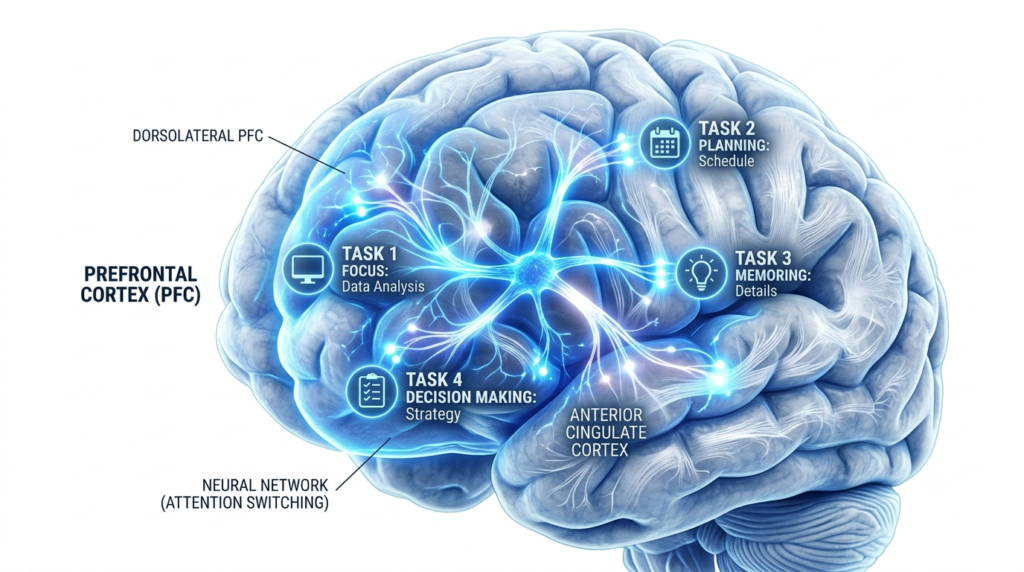
    Your brain has a limited amount of attention and working memory to hand out, and demanding tasks fight hard for that same small pool.

    Studies on task switching show people can really only focus on one demanding task at a time. Doesn’t matter how fast they think they’re bouncing back and forth. The prefrontal cortex your brain’s planning-and-decisions center has to fully drop one task before it can pick up the next.

    That handoff takes a beat. It’s not instant, and it’s not made up either. Researchers at Wake Forest ran fMRI and EEG scans and watched the frontal and parietal regions light up every single time. Someone switched tasks, or even just repeated one they’d already been doing.

    What Switching Actually Costs You

    There’s a name for this: switch cost. It’s the time and accuracy penalty you pay every time you jump from one task to another. On its own, sounds like nothing half a second, maybe less.

    But stack that across a full workday of tiny interruptions and it adds up fast. One study clocked people at 95% slower and 120% more error-prone while multitasking, compared to doing the same work one thing at a time.

    Didn’t matter how old they were or how educated. The gap stayed put. That’s not a rounding error.

    What the Research Actually Found

    The most cited study in this space came out of Stanford, and it’s worth knowing. Psychologist Clifford Nass and his team split college students into heavy and light media multitaskers. Expecting the heavy group to reveal some hidden strength. Better filtering, maybe, Faster switching.

    They found the opposite. Nearly every cognitive test told the same story the heavy multitaskers did worse, across the board. Nass didn’t sugarcoat it. He said they were bad at basically every skill multitasking actually requires.

    Ten years later, a follow-up review out of Stanford’s Memory Lab found the same thing held up. People who juggle a lot of media streams performed noticeably worse on basic memory tests than people who didn’t.

    Myths That Refuse To Die

    “Some people are just naturally good multitaskers.” Not really. Heavy multitaskers show no advantage if anything they score worse on focus and memory.

    “Multitasking saves time.” It doesn’t, not once you factor in the errors and the switching costs.

    “Younger people are better at it.” Age shifts the numbers slightly, sure. But nobody’s immune.

    “It only messes up unimportant work.” Wrong direction, actually complex or unfamiliar tasks take the biggest hit, since they eat up more working memory to begin with.

    The Loss You Don’t Even Notice

    The real cost of multitasking rarely shows up as one big, obvious screwup. A report that should’ve taken ninety minutes eats up three hours instead. A proposal goes out with a couple of typos a focused mind would’ve caught without even trying.

    A meeting you nodded along to the whole way through, then couldn’t explain to a coworker afterward. Researchers at UC Irvine found it takes over 23 minutes, on average, to fully refocus after a digital interruption. Most people get interrupted a lot more than once a day.

    The same research also found people rarely go straight back to what they were doing before the interruption. Usually a couple other things get handled first. Then, eventually, the original task.

    What It Does To Your Memory

    Multitasking doesn’t just slow you down while it’s happening it also messes with what actually sticks afterward. Which, honestly, might be the more annoying part.

    Stanford’s decade-long review found a pretty consistent link between heavy multitasking. Worse performance on basic memory tasks, and that held even in situations that had nothing to do with work.

    Makes sense once you think about how memory actually forms. Getting something into long-term memory takes sustained attention. If your attention keeps getting yanked away mid-thought, the information never gets processed deeply enough to stay.

    The Part Nobody Talks About: Stress

    Beyond the memory hit and the errors, there’s an emotional cost too, one that’s easy to overlook. Gloria Mark’s research at UC Irvine links frequent interruptions to noticeably higher stress, frustration, and mental workload compared to uninterrupted work.

    Which, honestly, just confirms what most of us already know without needing a study to say it. A day full of switching leaves you drained in a way a focused day doesn’t, even when the hours on the clock are exactly the same.

    Constantly reloading your mental context wears you down. And there’s a quieter frustration too the one that comes from never quite finishing anything cleanly. Which has nothing to do with how hard the work actually was.

    Why Single-Tasking Just Works Better

    Single-tasking sometimes dressed up as “deep work” just means giving one thing your full attention for a set stretch before moving on. Not complicated, and the appeal isn’t just a vibe, either. It lines up exactly with how switch costs work.

    If switching is what drains your time and accuracy, cutting down on switches is the most direct fix there is. No app required.

    People who protect real blocks of single-task time tend to say they finish faster. Make fewer mistakes, and feel less fried by the end of the day. Which tracks it’s exactly what you’d expect once you understand what switch cost is doing to you in the background.

    MultitaskingSingle-Tasking
    Frequent attention switchesSustained attention on one task
    Higher error rates on complex workLower error rates, especially on complex work
    Slower overall completion timeFaster completion for most task types
    Weaker memory retentionStronger memory retention
    Higher reported stressLower reported stress during focused blocks

    How To Actually Focus Better

    This isn’t about gritting your teeth and forcing concentration. A few things keep showing up, both in the research and in how people who actually finish things tend to operate:

    Batch similar tasks. Answer emails in one sitting instead of trickling replies out all day. Fewer switches, less drag.

    Kill notifications during focus blocks. Even a silenced phone sitting face-up on your desk pulls at you just by being there. Get it out of sight, not just off.

    Try time blocking. Assign real hours to real tasks, and treat those blocks like fixed appointments, not gentle suggestions.

    Close the tabs you’re not using. Visual clutter pulls at your attention the same way a notification does. It’s just quieter.

    Take breaks on purpose. A five-minute breather between blocks resets you without triggering the full 23-minute recovery penalty.

    Mistakes Worth Avoiding

    Keeping every notification on “just in case,” when almost nothing actually needs your attention that fast.

    Confusing a busy day with a productive one. A packed, switch-heavy day frequently produces less finished work than a boring, focused one. Annoying, but true.

    Multitasking while trying to learn something. Studying or reading while distracted wrecks memory formation more than most people expect.

    Back-to-back meetings with zero buffer. Without a gap, the mental leftovers from one meeting bleed straight into the next.

    Assuming you’re the exception. Every study on heavy multitaskers finds the same thing no real advantage for the people who’re sure they’re unusually good at it. Sorry.

    Real Life Examples

    Microsoft Japan Improved Productivity by Reducing Distractions

    In 2019, Microsoft Japan launched its “Work-Life Choice Challenge” to explore whether employees could become more productive by working fewer hours and focusing on high-value tasks instead of constantly switching between emails, meetings, and other interruptions.

    The company introduced a four-day workweek, shortened meetings to 30 minutes, encouraged online collaboration, and promoted uninterrupted focus time.

    Stanford Researchers Found Heavy Multitaskers Perform Worse

    A landmark study led by psychologist Clifford Nass at Stanford University challenged the common belief that frequent multitaskers become better at handling multiple tasks.

    Researchers compared heavy media multitaskers with people who rarely multitasked, testing their ability to focus, remember information, and ignore distractions. Surprisingly, heavy multitaskers consistently performed worse across nearly every cognitive test.

    Frequently Asked Questions

    Does multitasking actually reduce productivity?

    Pretty much, yeah. Switching adds time and increases errors compared to doing things one at a time, and it gets worse the more complex the work is.

    Can some people multitask better than others?

    Not really, based on what the data shows. Heavy multitaskers haven’t shown a consistent edge if anything, they tend to score worse on focus and filtering.

    What’s task-switching cost, exactly?

    The time and accuracy penalty your brain pays each time it jumps tasks, since it has to fully drop one set of mental rules before loading a totally different one.

    Can you train yourself to get better at it?

    You can build some flexibility with practice. But the switch cost itself never really goes away which is why cutting down how often you switch helps more than trying to get faster at switching.

    Final Thoughts

    Multitasking feels productive because it keeps you moving, and motion’s easy to mistake for progress on a busy day. But the research keeps landing in the same spot. Switching costs time, adds mistakes, weakens memory, and raises stress even when each switch feels far too small to matter.

    None of this means you need some rigid, no-notifications, monk-in-a-cave lifestyle. That’s overkill for basically anyone.

    It just means giving your hardest work a real, uninterrupted stretch of time instead of splitting your attention and hoping it all somehow works out. Try one task at a time tomorrow morning, before the notifications start piling up, and see how much of the day is actually still left when you’re done.


  • The Power of Imagination: How Creative Thinking Shapes Your Success

    The Power of Imagination: How Creative Thinking Shapes Your Success

    Introduction

    While you are daydreaming at your desk, you are not wasting time. It could well be the most productive activity you will do all day.

    Think about the last time you actually got ahead at something a promotion, a project that clicked. A business idea that worked when it had no business working. Now think about how you explained it afterward.

    Here’s the thing if you actually watch how people solve hard problems. Not the polished version they tell later, the real messy version, imagination is doing way more of the work than anyone gives it credit for. I got curious why we’re so weird about admitting that.

    Okay, But What Even Is Imagination

    Not dragons, not spaceships. It’s much more boring than that, honestly and way more useful. Imagination is just the ability to hold. A picture of something that doesn’t exist yet, clear enough that you can start walking toward it.

    A product nobody’s built. A version of your career you haven’t lived yet. A fix for something everyone else already gave up on. Creativity is the next part. The doing part.

    And success most of the time comes down to believing in an outcome before there’s any proof it’ll happen. Nobody likes betting on something invisible.

    Why Creativity Matters More Than Ever

    Even CEOs, of all people, seem to get this. A 2010 IBM survey of over 1,500 of them ranked creativity. As the single most important leadership trait for navigating a messy business world. The World Economic Forum has said something similar since: as routine work gets automated away.

    What’s left is the stuff a machine can’t fake judgment, imagination, noticing a connection nobody else noticed yet.

    Does This Actually Predict Success, or Are We Just Telling Ourselves a Nice Story

    Fair question. Honestly, “creativity matters” is one of those phrases that sounds true and means basically nothing at the same time. So let’s actually look.

    An Adobe-backed survey found 85% of college-educated professionals think imaginative thinking is crucial to solving problems at work. A good chunk of them also said they wish school had actually taught them how to do it, instead of just repeating that it mattered every year.

    The Workplace Creativity Gap

    The academic side adds some actual nuance, which I appreciate, because “creativity equals success” is a little too clean to just swallow whole.

    A 2021 study in Sustainability looked at 200 professionals managers, entrepreneurs, regular employees. A real mix and found the ones who scored high on both creativity and resilience were the most likely to report success. Both kinds.

    The kind you can measure, like income and promotions. The kind you feel, like actually caring about the work. Notice that word “and” doing some heavy lifting there. It wasn’t creativity by itself. It was creativity plus the stubbornness to keep going after something flopped.

    Large-Scale Research Strengthens the Evidence

    Then there’s a study that genuinely stopped me mid-scroll: a 2024 genetic study in Communications Biology. Covering over 200,000 people, found a measurable link between occupational creativity. Career outcomes like income and job satisfaction.

    That’s not something you’d hang in a break room as motivation. It showing up at a population-wide, genetic level. Which tells you this isn’t just a comforting story people repeat to feel better about their hobbies. Something’s actually there.

    Why Your Best Ideas Show Up in the Shower

    This is my favorite bit, because it explains something basically everyone’s felt and nobody’s really questioned. Why do good ideas always show up at the worst possible time? Mid-shower. On a walk. Right as you’re falling asleep.

    Almost never while you’re sitting at your desk actively trying to have one. A well-known 2014 study by psychologist Scott Barry Kaufman found that most people report having creative insights during low-effort, semi-automatic tasks showering being the classic example.

    The theory is your mind is relaxed enough to wander into weird, unexpected connections. But not so checked out that it drifts off completely.

    Researchers at the University of British Columbia found something similar with mind-wandering and daydreaming. Stepping away from a problem doesn’t mean you’ve stopped working on it.

    The Gap Between What Companies Say and What They Actually Do

    This is the part that makes me a little cynical, not going to lie. Every company says it “values innovation.” It’s in the mission statement, right next to a stock photo of people high-fiving over a laptop. Fewer companies actually build room for it.

    Gallup’s workplace research keeps finding the same gap, over and over. Leaders say creativity matters, but a lot of employees say they rarely feel free to actually be creative on the job.

    Google’s “20% time” policy got famous specifically because it’s rare. Engineers getting a real chunk of their week for self-directed projects, credited with producing things like Gmail.

    If that were normal, nobody would still be name-dropping it fifteen years later. It’s famous because almost nobody else actually does it.

    Myths That Sound True but Really Aren’t

    What people usually assumeWhat the evidence actually shows
    Creativity is a talent — you have it or you don’tIt’s trainable, through practice, new experiences, and actually giving your brain time to sit with a problem
    Creative people are scattered or undisciplinedThe research pairs creativity with resilience, not chaos — they tend to travel together
    Good ideas come from grinding harderStepping away from a problem often beats pushing through it
    Imagination only matters in “creative” jobsLeaders across finance, logistics, and manufacturing rank it as a top skill too

    A Few Things That Actually Help

    You don’t need to become a different person to think more imaginatively. A handful of small habits, decently backed by research, go further than you’d guess:

    • Protect the boring moments. Walks, commutes, chores. That’s where incubation happens. Try not to fill every gap with a podcast or your phone.
    • Write the half-baked stuff down. Most of it goes nowhere, sure. But you can’t choose from ideas you never wrote down in the first place.
    • Steal from fields that aren’t yours. A lot of “original” ideas are really just a solution borrowed from somewhere unrelated and dropped somewhere new.
    • Don’t judge an idea the second it’s born. Judging too early kills weak-but-promising ideas before they’ve had a chance to grow up. Generate first. Judge later. Keep the two apart.
    • Trade “is this possible” for “what would need to be true.” Small shift. But it opens up way more room to actually think, instead of shutting things down before you’ve looked at them.

    The Small Stuff That Quietly Kills Imagination

    Even people who genuinely care about being creative sabotage it without noticing. Treating every idle minute like it’s wasted. Showing a half-formed idea to someone for approval way too early.

    Optimizing so hard for efficiency there’s no room left to explore anything. Only hanging around people who already think exactly like you do. None of it looks dramatic in the moment. Which is exactly why it’s worth watching for.

    Real Life Example

    IBM’s Creativity Research

    Creativity has been named by over 1,500 CEOs in IBM’s groundbreaking, worldwide CEO research as the number one leadership attribute needed to address the growing complexity and uncertainty.

    Experts also noted that imaginative thinking is the ability that best enables organizations to identify solutions for new problems. Work through change, not just efficiency or technical expertise.

    IDEO’s Human-Centered Design

    The best-performing organizations in the design and creativity behaviors categories experienced nearly three times. The revenue growth, nearly double the customer growth and billions of dollars in annual profit compared to average companies, according to the IDEO IQ Report.

    Questions People Actually Ask About This

    Is imagination the same as creativity?

    Not quite. Imagination is picturing something that doesn’t exist yet. Creativity is what happens when you actually try to make it real.

    Can adults get better at this, or is it just fixed?

    It’s trainable. Practice, new experiences, and giving your brain real time to sit with things all seem to help. It’s not something you’re stuck with.

    Does more free time automatically mean more creativity?

    Not automatically. It’s specifically the unstructured, low-stimulation kind walking, showering, chores not passive downtime like scrolling.

    Why do companies talk about valuing creativity but not really act like it?

    Because approval processes and tight schedules quietly crowd out the freedom creativity actually needs. Workplace research keeps finding this same gap, again and again.

    Is daydreaming actually useful, or just an excuse to avoid working?

    Structured daydreaming stepping away from one specific problem. Not just zoning out indefinitely genuinely seems to help with creative problem-solving.

    Where This Leaves You

    Imagination isn’t some rare gift reserved for artists and inventors. It’s more like a muscle most workplaces quietly let go soft. The people, and the companies, who treat it like a real resource worth protecting, instead of a luxury for slow weeks.

    They tend to be the ones still solving new problems while everyone else is stuck recycling the same old answers. So maybe the real question isn’t whether you’re “creative enough.” Maybe it’s just: when’s the last time you actually let your mind wander before asking it to perform?


  • How to Develop a Growth Mindset and Overcome Self-Doubt

    How to Develop a Growth Mindset and Overcome Self-Doubt

    Introduction

    Okay so, real talk for a second. For most of my twenties I genuinely believed talent was something you either had or didn’t. Math people existed, art people existed.

    I was neither, and honestly I’d made peace with that story way too early. Like somewhere around ninth grade after a particularly brutal algebra test I still remember getting a 61 on.Then a friend recommended Carol Dweck’s book to me at a coffee shop, half as a joke.

    It annoyed me more than it inspired me at first because it meant. I couldn’t blame genetics anymore for stuff I was just avoiding. That’s kind of the whole deal with learning how to develop a growth mindset.

    What Does “Growth Mindset” Even Mean, Practically Speaking?

    Let’s not overcomplicate this. A growth mindset isn’t just positive thinking with a fancier name. Carol Dweck, the Stanford psychologist behind the term. Basically found that people fall somewhere on a spectrum between believing their abilities are fixed. Versus believing they can be developed through effort.

    Most People Have a Mix of Both Mindsets

    Most of us aren’t purely one or the other, by the way. I’m growth-minded about writing and embarrassingly fixed-minded about anything involving a spreadsheet, if I’m being honest.

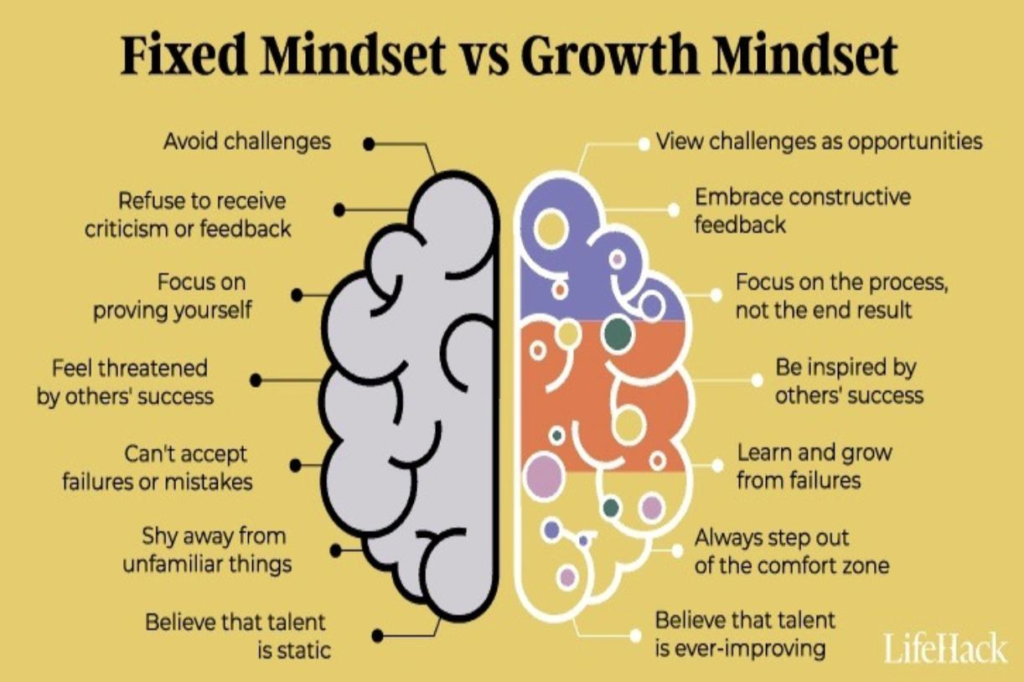
    A fixed mindset says your intelligence and talent got locked in early and that’s basically that. A growth mindset says no, actually, effort and strategy move the needle, sometimes a lot. Which one sounds more useful to believe, even if you’re not sure it’s true yet?

    Fixed MindsetGrowth Mindset
    “I’m bad at this”“I’m not good at this yet”
    Avoids challengesLeans into them, reluctantly sometimes
    Effort feels like proof you’re not talentedEffort is just the process
    Feedback stings and gets ignoredFeedback stings but gets used anyway

    I’ll be straight with you I don’t sit at 100% growth mindset all day. Nobody does, no matter what their LinkedIn bio says. I still catch myself thinking “I’m just not a numbers person” more often than I’d like. The point isn’t erasing that voice completely. It’s noticing it faster than you used to.

    Does Any of This Actually Matter, or Is It Corporate Fluff?

    I was skeptical of this part too, not gonna lie. A lot of “mindset” talk online feels like it’s selling something. But then I looked at the actual numbers, and okay, fine, they’re hard to dismiss. Forbes covered a TalentLMS study where 80% of senior execs said employee growth mindsets directly move revenue.

    The Link Between Growth Mindset, Trust, and Success

    Nearly nine out of ten called it important for long-term success. A majority also reported real productivity gains but only once companies actually built it into daily habits. Instead of slapping it on a values poster in the breakroom that nobody reads past week one.

    There’s a trust piece too that caught me off guard. People at growth-mindset companies were way more likely to describe their coworkers as trustworthy. And more likely to feel like their workplace actually tolerated risk instead of quietly punishing every failed attempt six months later during review season.

    Look, the stats are nice. But here’s the honest version: a fixed mindset is just tiring. You spend so much energy protecting your ego that there’s barely anything left over to actually improve at the thing.

    So How Do You Actually Build a Growth Mindset? (The Non-Vague Version)

    Most articles get real fuzzy right about here. Let’s not do that.

    1. Catch the word “can’t.” Every time “I can’t do this” shows up in your head, tack on one word yet. Feels small, almost dumb honestly, the first dozen times. Keep doing it anyway. The language shift does something to your brain that logic alone doesn’t.

    2. Stop treating failure like a courtroom verdict. A bad attempt isn’t a permanent ruling on who you are. It’s just data. Annoying, embarrassing data sometimes, but data. Ask what it taught you, not what it proves about you.

    3. Ask for feedback before you feel ready. This is the hardest one for me, still. Old me avoided feedback like it was going to hurt physically. These days I ask anyway, even though some small part of me still braces for it every single time.

    4. Watch what you’re praising. If you only celebrate wins, you’ll start quietly avoiding anything you’re not guaranteed to win. Praise the messy attempt instead. Praise the part where you looked kind of clueless but kept going.

    5. Pick your circle carefully. Mindsets are contagious whether you like it or not. If everyone around you treats trying hard as embarrassing, that rubs off eventually, even on people who think they’re immune to peer pressure.

    A handful of small habits that actually stuck for me:

    • Jotting down one mistake each night, with a lesson attached, even a dumb one
    • Asking one honest person for feedback every week, even when I don’t want to
    • Trying something I’m bad at once a month, just to stay okay with feeling incompetent
    • Saying “yet” out loud, which felt ridiculous for about two weeks and then stopped feeling ridiculous

    A Small, Slightly Embarrassing Story

    A few years back I signed up for a beginner guitar class on a Tuesday night. Mostly on a dare from a friend named Priya who plays way better than me and still does, honestly.

    I was bad, like, genuinely bad my fingers wouldn’t cooperate, chord changes took forever, and the instructor had to slow the whole group down twice because of me in one class alone. Old me would’ve quit by week two and told everyone “guitar just isn’t my thing,” case closed.

    Small, Consistent Adjustments Beat Natural Talent

    Instead I started keeping this dumb little notebook, not for songs, just for mistakes. Every practice session I’d scribble down one thing that went wrong and one tiny adjustment for next time.

    Sounds almost too simple to actually work. But three months in, chord changes that used to eat up a full second happened almost automatically. Nobody handed me talent overnight. I just stopped treating every wrong note as final proof I didn’t belong there.

    Growth Comes From Staying in the Game After Setbacks

    That’s really the whole idea, once you strip away the psychology jargon. You’re not chasing some permanent, unshakable confidence that never wobbles. You’re just getting slightly better at staying in the room after things go wrong, over and over, until it’s not such a big deal anymore.

    Where People Usually Mess This Up

    Not sugarcoating this part:

    • Grinding harder without ever changing your approach isn’t growth, it’s just stubbornness with extra steps
    • Treating a growth mindset like forced positivity instead of honest self-reflection
    • Quitting after one rough attempt and deciding that proves the whole thing “doesn’t work”
    • Comparing your messy day-one self to somebody else’s polished year-five self

    None of this means you’re failing at this. It just means you’re human, and honestly, this takes way longer than a weekend to actually settle in.

    Real Case Studies

    Microsoft’s Growth Mindset Transformation

    A popular example of this is from Microsoft. As CEO since 2014, Satya Nadella has placed great emphasis on the “culture change” from “know-it-alls” to “learn-it-alls” in the company. Fostering curiosity, learning and experimentation as opposed to always having the right answers.

    TalentLMS Workplace Survey

    According to a TalentLMS survey of managers and executives, there was a high level of support for growth mindset in the workplace:

    Almost 90% felt it was critical for long-term success in the organisation. Approximately 80% felt it makes an immediate impact on revenue. Many also noted improved productivity once learning was embedded in the culture of the company.

    FAQs

    How long does developing a growth mindset actually take?

    Honestly, there’s no clean timeline. Some people notice small shifts within a few weeks. Deeper, long-held beliefs about ability usually take months of steady, sometimes boring, repetition.

    Can adults really change their mindset, or is this really just a school thing?

    Adults can, yes. Neuroplasticity confirms your brain stays adaptable well into old age. Age isn’t the real obstacle here consistency is, and consistency is annoying, which is probably why so few people stick with it.

    Isn’t a growth mindset basically the same as optimism?

    Not really, and this trips a lot of people up. Optimism expects good outcomes. A growth mindset just believes you can improve through effort, whatever the outcome ends up being.

    What’s the fastest way to actually start?

    Pick one recurring negative thought, something like “I’m bad at this,” and catch it every time it shows up for one week straight. Small, repeated corrections beat one big motivational Monday-morning push, every time.

    Can someone with a lifelong fixed mindset really flip to a growth mindset?

    Mostly, yeah, though it’s rarely some permanent finished state you arrive at. Even people who’ve worked on this for years slip back under stress.

    Does this help with anxiety or self-doubt at all?

    Indirectly, often yes. When failure stops feeling like a personal verdict, a chunk of performance-related anxiety tends to ease up too.

    Last Thought

    Developing a growth mindset isn’t something you flip on once and forget about. It’s a habit you keep rebuilding, especially on the days it feels pointless or fake. I still slip back into old thinking sometimes, probably will forever if I’m honest.

    But catching it faster? That part does get easier, slowly, in a way that’s hard to notice until you look back six months later.So pick one thought today. Add “yet” to the end of it. Then just see what happens.

  • Why Emotional Intelligence Matters More Than IQ

    Why Emotional Intelligence Matters More Than IQ

    Introduction

    So there was this guy at my old job, Daniyal, ridiculously smart. Like, could-do-calculus-in-his-head smart. He’d finish a report in the time it took me to find the right Excel tab.

    Meanwhile a guy from the sales team, average grades by his own admission, just… got it. Read the room every single time. Walked right past Daniyal into the manager’s chair.

    That bugged me for years, not gonna lie. Still does a little.Eventually I figured out why, or at least I think I did. Emotional intelligence matters more than IQ in most situations that actually decide how far you go and nobody really teaches you.

    Let’s get into what emotional intelligence actually is, why it tends to beat raw IQ, and what you can actually do about building more of it.

    What Is Emotional Intelligence, Exactly?

    Emotional intelligence EQ, emotional quotient, whatever you want to call.It is basically the skill of understanding emotions. Yours. Other people’s. Both.

    Wikipedia’s version is drier: the capacity to identify and regulate emotional information to guide thinking and behavior. Just not how a human being would explain it to a friend.

    Here’s how I’d put it instead: it’s not letting your feelings drive the car. But also not locking them in the trunk and pretending they’re not there.

    How Is Emotional Intelligence Different From IQ?

    IQ’s a different animal completely. Logic, memory, pattern recognition, that kind of processing speed stuff.

    Genuinely usefu, I’m not knocking it. But IQ tests were never built to predict how you’ll handle a tense meeting. A coworker who’s clearly having a rough week, or your own temper. When a project falls apart at 5pm on a Friday, again, for the third week running.

    IQEmotional Intelligence
    Measures logic and memoryMeasures self-awareness and empathy
    Mostly set early in lifeKeeps developing as you live
    Predicts test scoresPredicts how well you lead and connect
    Hard to shift muchActually responds to practice

    So when people throw around the phrase “emotional intelligence matters more than IQ,”. They’re not saying smarts are useless. They’re saying something a bit more specific than that.

    Being smart gets your foot in the door. What happens after that is a whole different skill set.

    Why Does EQ Actually Beat IQ in Real Life?

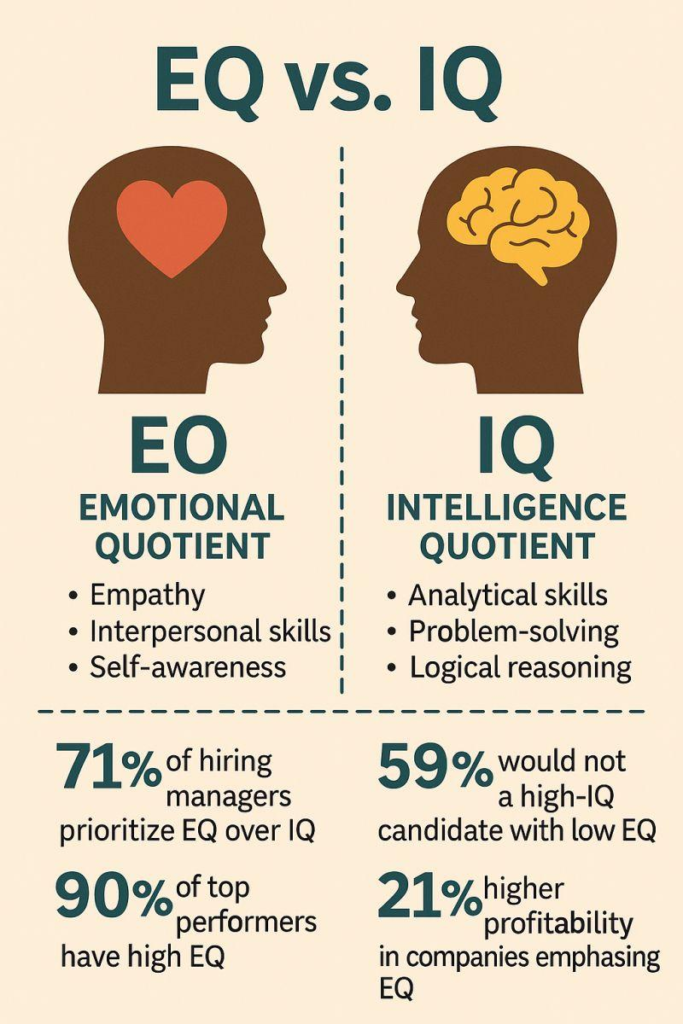
    Here’s the part that convinced me, honestly. Emotional intelligence apparently accounts for something like 58% of job performance across a huge range of roles. That’s not a rounding error.

    And about 90% of top performers, the actual standout employees, score high on emotional intelligence tests. Ninety percent,That’s a pretty loud signal if you ask me.

    Leadership is where it gets almost unfair. EQ is reportedly around four times more predictive of leadership success than IQ alone.

    There’s a money angle too, which I’ll admit got my attention faster than the psychology did. People with strong EQ tend to out-earn low-EQ peers by something like $29,000 a year. Mostly because they’re just better at conflict, negotiation, and building actual trust.

    MetricWhat Research Shows
    Job performance tied to EQ58%
    Top performers with high EQ90%
    EQ’s edge over IQ in leadership~4x
    Yearly earnings gap~$29,000

    None of this means IQ stopped mattering, to be clear. It just stops being the deciding factor pretty early on. After that, EQ takes over the driver’s seat.

    The Five Pieces Goleman Talks About

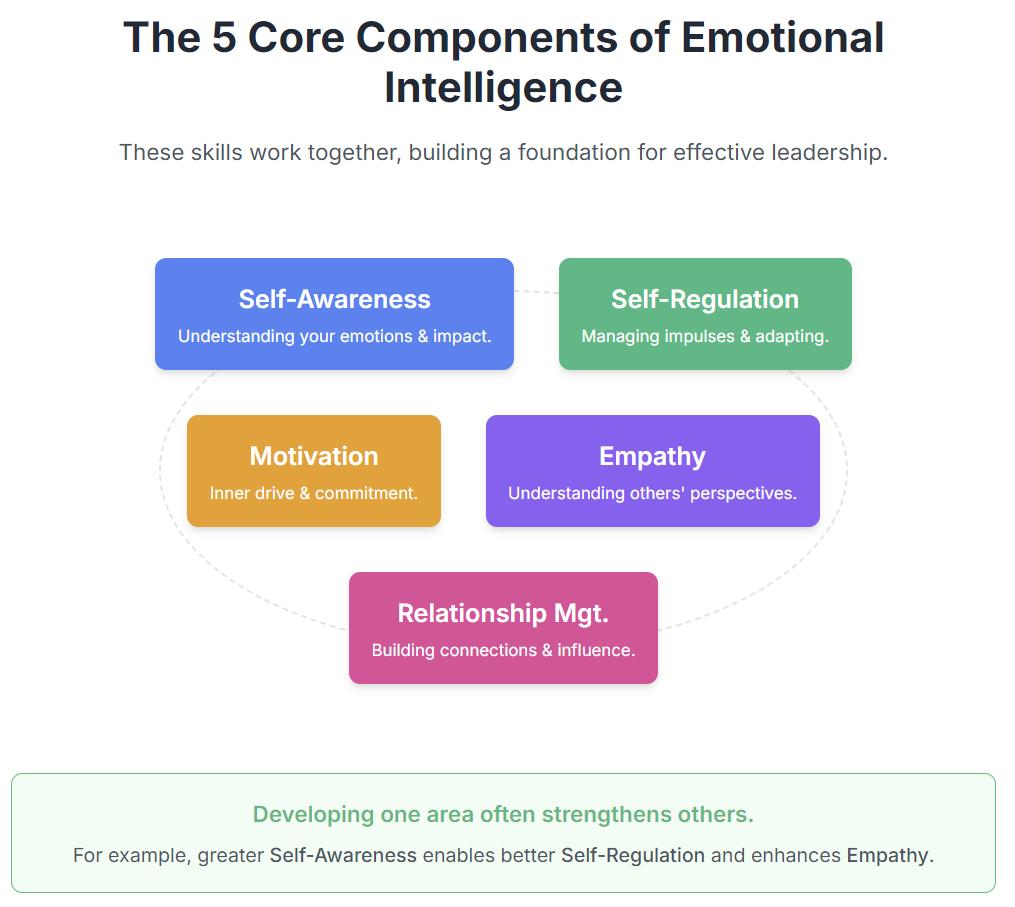
    Goleman’s framework splits emotional intelligence into five parts, more or less. Worth knowing, since they quietly show up everywhere above.

    • Self-awareness is just noticing what you’re feeling while you’re feeling it, not three hours later in the shower.
    • Self-regulation is what you do with that feeling once you’ve noticed it — managing it instead of it managing you.
    • Motivation, in this context, means chasing goals for reasons that aren’t just money or a title.
    • Empathy is reading what someone else is actually feeling, accurately, instead of just assuming.
    • And social skills tie the whole thing together — handling conflict, building rapport, all of that.

    Okay, So How Do You Actually Build This?

    Emotional intelligence isn’t something you’re stuck with from birth, thankfully.

    Goleman’s whole argument was that it’s learnable. Not fixed, like your eye color or your height.

    1. Get specific about what you’re feeling. “I’m annoyed” is a start, sure, but “I’m annoyed because I feel unheard in meetings” tells you something you can actually act on.

    2. Just… pause. For a second. Sounds obvious, I know, everyone says this. But five real seconds before responding to something frustrating genuinely changes how the conversation goes.

    3. Ask instead of guessing. When a coworker seems off, ask them. You’ll be wrong about your guess more often than you’d want to admit.

    4. Let feedback sit before you defend yourself. Your gut reaction to criticism is almost always to explain yourself immediately. Don’t. Just listen for thirty seconds first.

    5. Mind your tone, not just your words. People forget what you said way faster than they forget how you made them feel. Especially mid-argument.

    A few small habits that helped me, at least

    HabitWhy It Helps
    Writing down one emotional trigger each nightBuilds self-awareness, slowly
    One real conversation a day, actually listeningStrengthens empathy
    Naming feelings specifically instead of “fine” or “bad”Improves regulation
    Asking “what did I miss?” after a disagreementBuilds social awareness

    What People Actually Say on Reddit and Quora

    I’ve read way too many threads on this, probably an unhealthy amount honestly. One pattern keeps showing up though.

    Almost nobody credits a book for their EQ growth. It’s usually a person a manager who stayed calm during chaos. A breakup that forced them to actually sit with feelings instead of numbing out.

    A surprising number of posters also admit being smart made them kind of arrogant in their twenties. It took an emotional gut-punch, not an academic one, to knock that out of them.

    Which, honestly, tracks with everything else here. EQ seems to grow through getting knocked around a bit, not through reading about it in theory.

    There’s a Mental Health Angle Too

    Worth mentioning people with stronger self-awareness tend to handle stress noticeably better. Not perfectly, Just better.

    Some training programs report real drops in burnout after a few months of consistent practice. Makes sense when you think about it. If you can name what you’re feeling, you stop getting ambushed by it constantly.

    A Few Myths Worth Killing

    • High EQ doesn’t mean you’re always calm or agreeable it means you recover faster
    • It’s not some vague, unmeasurable soft skill, there are actual validated tests for it
    • It’s not fixed at birth the way a lot of IQ seems to be
    • Being “nice” and being emotionally intelligent are genuinely not the same thing

    Case Studies

    L’Oréal – Emotional Intelligence Predicted Sales Success

    According to the EI Consortium’s research on The Business Case for Emotional Intelligence, when global cosmetics company L’Oréal hired sales representatives.Researchers found that employees selected for their emotional intelligence competencies consistently outperformed those chosen through traditional hiring methods.

    Leadership at Nearly 200 Global Companies

    Research published in Harvard Business Review examined leadership competencies across nearly 200 large global companies in achieving long-term leadership success.

    Key Questions Answered

    Does emotional intelligence really outweigh IQ?

    For real-world outcomes leadership, relationships, career growth yeah, quite often. IQ still matters for technical work, but past a certain baseline, EQ tends to take over as the bigger factor.

    Isn’t emotional intelligence just being nice?

    Not really. Nice is about being pleasant. EQ is about reading emotional situations accurately and responding well.

    Can low EQ actually improve, or is it kind of fixed?

    It improves. That’s honestly the good news here unlike IQ, which barely budges over a lifetime, EQ responds to practice and honest feedback.

    Does EQ matter more than IQ for every job out there?

    Not every single one very technical, isolated roles might lean harder on raw cognitive ability. But anything involving people or pressure, EQ usually wins out.

    Last Thought

    Emotional intelligence matters more than IQ, not because being smart is useless. It’s because most of life runs on relationships, not test scores. Daniyal’s brilliance never went anywhere, by the way. It just wasn’t the whole answer.

    The people who actually go the distance are usually the ones who got decent at sitting with discomfort and responding instead of just reacting.So, start with one thing today. Notice a feeling. Name it properly. See what happens.

  • Why People Fear Change and How to Embrace It

    Why People Fear Change and How to Embrace It


    Introduction

    Okay, quick question before we start. Remember the last time your routine got completely flipped a new job, a breakup, moving to a city you’d literally never set foot in before? Your stomach probably dropped a little right before it got exciting.

    Mine did. Last time I switched careers I told myself, for months, that I was “just weighing my options.” I wasn’t. I was scared and calling it strategy.That’s basically what fear of change feels like from the inside, if I’m being honest.

    It’s one of the most common emotional reactions people go through, and almost nobody gets out of it clean. Doesn’t matter if the change got forced on you or you picked it yourself the nervous system reacts first and asks questions later.

    That’s just how the wiring works, for pretty much everyone, whether they’ll admit it or not.

    What Is the Fear of Change?

    Fear of change metathesiophobia, if you want the ten-dollar clinical word is basically discomfort or anxiety around anything unfamiliar. Sometimes it’s loud. A knot in your stomach the night before a big decision.

    Sometimes it’s tiny, barely there, just a flicker when a coworker suggests doing something slightly different than usual. Here’s what most people don’t realize: a bit of hesitation isn’t a flaw. It’s your brain doing its job a little too well, honestly.


    When Fear of Change Turns Into Avoidance

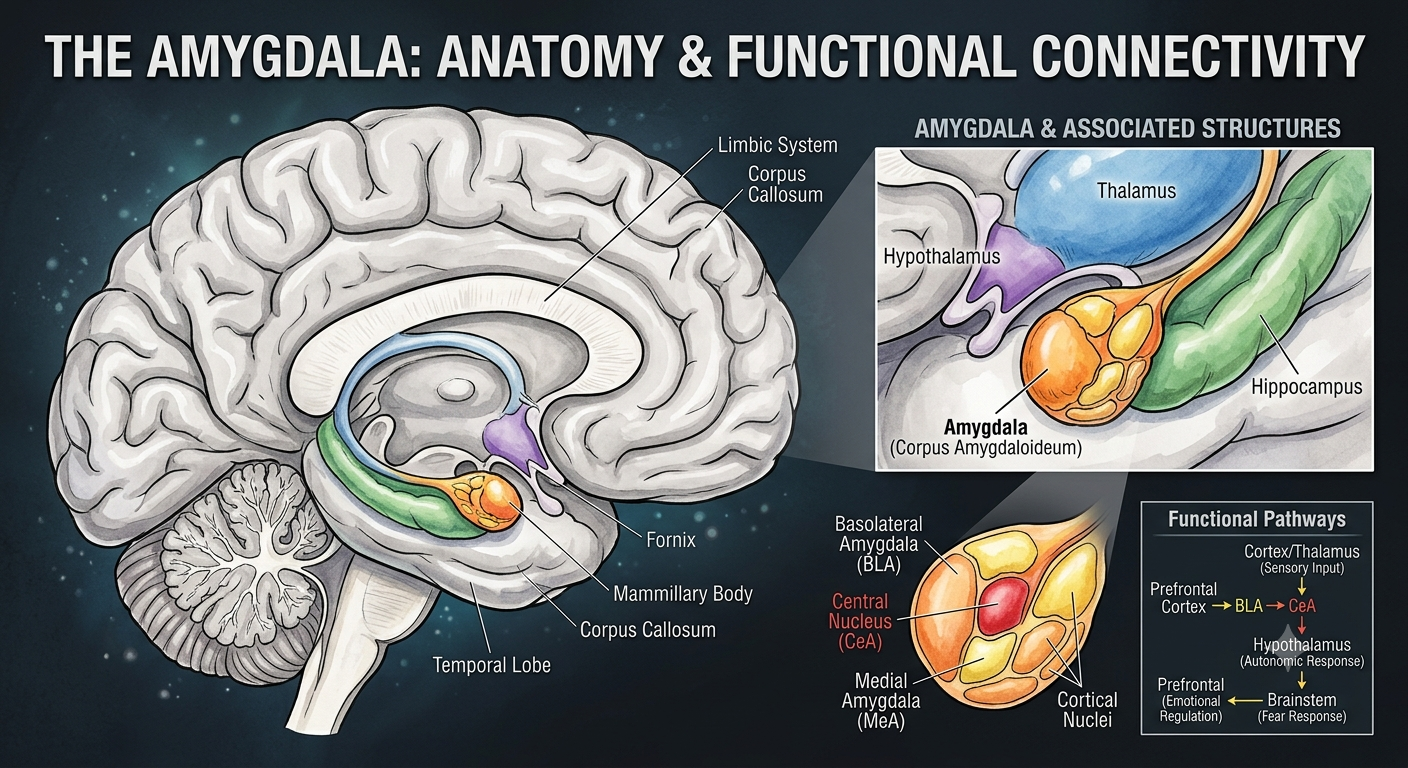
    Something new shows up, and the amygdala brain’s alarm system. Roughly speaking flags it as a potential threat before your rational mind even gets a vote.

    That’s the whole reason an exciting opportunity can still feel, physically, like a siren going off behind your ribs. Annoying, but that’s the mechanism.

    It becomes an actual problem once hesitation turns into avoidance. Once you start skipping real chances just to stay comfortable.

    There’s a genuine line between healthy caution the kind that helps you plan properly. And the kind of fear that just keeps you circling the same spot for years, going nowhere.

    Is Fear of Change Normal?

    More normal than people say out loud, if we’re being real. Almost everyone resists a little when their environment shifts, because the brain defaults toward familiar it’s cheaper, energy-wise, than processing something brand new.

    So if you’ve hesitated before a big decision? You’re not broken, You’re just a person with a brain. That said normal doesn’t mean you’re supposed to stay stuck there. Those are two different things, and people mix them up constantly.

    Why Do People Fear Change?

    It’s usually a mess of psychology, past experience, and plain biology, tangled together and most of us are carrying a bit of all three without ever clocking it.

    Fear of the Unknown

    Uncertainty is just uncomfortable. When you don’t know what’s coming, your brain fills the blanks in for you, And it almost always reaches for the worst version because that’s the version that keeps you alive if it turns out true.

    Add a loss of control on top, and the discomfort compounds fast. Behavioral economists actually have a term for part of this: loss aversion.

    Feeling a potential loss way more sharply than an equivalent gain feels good. Change gets mislabeled as loss constantly, even when it isn’t one.

    Fear of Failure

    Nobody likes mistakes. Especially the expensive kind money gone, time gone, a hard-won shot wasted. This fear is a big reason good ideas just sit in someone’s notes app for years, untested, going nowhere.

    Fear of Judgment

    A surprising number of people stay stuck not because the change scares them, exactly, but because they’re bracing for what everyone else is going to say about it. Family. Coworkers. That one relative who’s got an opinion on absolutely everything. Social media doesn’t help.

    Comfort Zones Feel Safe (Even When They Really Aren’t)

    Routine equals predictable, and predictable reads as safe to your brain, whether or not it’s actually good for you. A miserable-but-familiar routine can genuinely feel safer than an unfamiliar one. Weird trick, if you sit with it long enough.

    Past Negative Experiences

    If a previous change went badly failed business, a layoff nobody saw coming. A breakup that hurt more than you expected it to your brain files that away. Remembers it.

    Treats similar-looking situations as threats going forward, even years later. Even when the new thing barely resembles the old one. Fear of change tends to get stronger after one bad experience, not weaker.

    Worth sitting with, next time you catch yourself hesitating for a reason you can’t quite name.

    Signs You Are Afraid of Change

    Sometimes it’s obvious. Other times it hides behind words like “practical” or “just being careful” which, to be fair, is sometimes true. And sometimes just fear wearing a disguise. A few common tells:

    • Overthinking every decision, even the ones that genuinely don’t matter
    • Avoiding new opportunities without a real reason why
    • Procrastinating on things you actually want to do
    • Asking everyone around you for reassurance before you’ll act
    • Feeling anxious the second the future turns even slightly uncertain
    • Staying in situations that clearly aren’t working, purely because they’re familiar
    Fear-Driven BehaviorGrowth-Driven Behavior
    Waits for certainty before actingActs on partial information
    Asks everyone for approval firstTrusts their own judgment
    Avoids new opportunities entirelyTests small opportunities first
    Stays in bad situations out of habitLeaves once something stops working

    How Fear of Change Affects Your Life

    Left alone, this fear doesn’t just sit quietly somewhere in the background. It shapes real outcomes, slowly, over years the kind you usually only notice in hindsight.

    Career-wise, people pass on promotions they were genuinely qualified for. They stay in jobs that stopped fitting years ago, because the role at least feels known.

    Mentally, constant resistance to change wears you down in a way that’s hard to explain unless you’ve actually lived it. Shows up as stress. A slow erosion of confidence you don’t notice until it’s mostly gone.

    And on the personal-growth side, missed chances just pile up quietly. Regret, more often than failure, tends to be what people report feeling when they look back on it all years later.

    How to Embrace Change

    So how do you actually move past fear of change. Instead of just nodding along while reading an article about it? Start small. Genuinely small smaller than feels reasonable.

    None of this asks you to feel brave first. You act, and the confidence shows up a little after, not before. Which is annoying, honestly, but it’s kind of the whole trick.

    Take Small Steps Instead of Big Leaps

    Accept that change is inevitable fighting the inevitable just burns energy you could’ve spent adapting instead. You don’t need to overhaul your whole life this weekend, just pick one action and do it this week, that’s genuinely it.

    Focus on what you can control, because outcomes were never really yours to control anyway effort, attitude, and preparation are. When your brain jumps straight to the worst-case scenario, pause and ask whether that’s actually likely.

    Just fear narrating the same story it always tells. Treat failure as information instead of proof you shouldn’t have tried, then keep going anyway.

    Celebrate Small Wins

    Try to build something closer to a growth mindset people who see abilities as things they can develop tend to handle change noticeably better than people who treat them as fixed.

    And celebrate the small wins, actually celebrate them. Sent that application? Had the hard conversation you’d been putting off? That counts. Momentum builds confidence, and confidence is what slowly wears fear of change down, one small win at a time.

    Real-Life Examples of Embracing Change

    • Changing careers after a decade in something totally unrelated
    • Starting a business with zero guarantee it’ll work
    • Moving to another city for a real, honest fresh start
    • Learning a new skill later in life, just because it sounded fun
    • Recovering after failure and trying again, a little wiser

    Benefits of Embracing Change

    ChangeBenefit
    New SkillsPersonal Growth
    Career ChangeBetter Opportunities
    Healthy HabitsBetter Health
    New RelationshipsStronger Connections
    Taking RisksGreater Confidence

    Common Myths About Change

    MythReality
    Change always ends badlyMost changes end up neutral or genuinely positive
    Successful people aren’t afraidMost of them were afraid too — they just acted anyway
    It’s too late to changeGrowth doesn’t come with an expiration date
    Confidence comes before actionConfidence usually shows up after the action

    Key Takeaways

    • Fear of change is a natural, near-universal response, not a personal weakness.
    • The brain defaults to familiarity because it’s simply less energy-intensive.
    • Small, consistent action beats waiting around for confidence to show up first.
    • Growth almost always asks for a bit of discomfort somewhere along the way.
    • Confidence tends to follow action, not the other way around, no matter how much we wish it worked differently.
    • One bad experience can quietly amplify fear of change for years if it’s never examined.

    Real Case Studies

    IBM – Hardware se Services Shift (Early 2000s)

    IBM ko jab hardware business se services business ki taraf move karna pada, to employees mein bada resistance tha. Company ne transparent communication aur extensive training dekar employees ka fear kam kiya.

    Barclays – LIBOR Crisis ke baad Trust Rebuild

    Barclays changed its culture from performance-driven to customer-service-focused after the LIBOR scandal. Job losses and branch closures affected employee morale, but the transformation led to an 8% increase in the share price.

    Is fear of change a mental illness?

    Not usually. A mild version is just a normal response to uncertainty nothing wrong with you. It only crosses into clinical territory, sometimes labeled metathesiophobia, when it’s severe enough to actually get in the way of daily life.

    Can fear of change be overcome?

    Yes, though it’s rarely one big dramatic breakthrough like in the movies. It’s more like repeated exposure. Small steps, over and over, until the fear becomes… manageable. Not gone, necessarily. Just manageable.

    How long does it take to adapt to change?

    Depends on the person and the situation, honestly. Most people start settling in within a few weeks of consistent exposure to whatever the new normal turns out to be.

    What is the first step toward embracing change?

    Go smaller than feels necessary. Almost embarrassingly small. One low-risk action builds just enough confidence for the next one — that’s really the whole engine behind all of it.

    Conclusion

    Change is uncomfortable. It probably always will be, at least a little, no matter how many times you go through it. But avoiding it doesn’t make the discomfort disappear it just delays whatever growth was waiting on the other side.

    Every achievement you’ve ever admired in someone else started with them stepping into some kind of uncertainty anyway, usually without feeling fully ready for it.

    You don’t need to feel ready either. You just need one small step, even with fear of change sitting right there next to you the whole time, not going anywhere.