Introduction
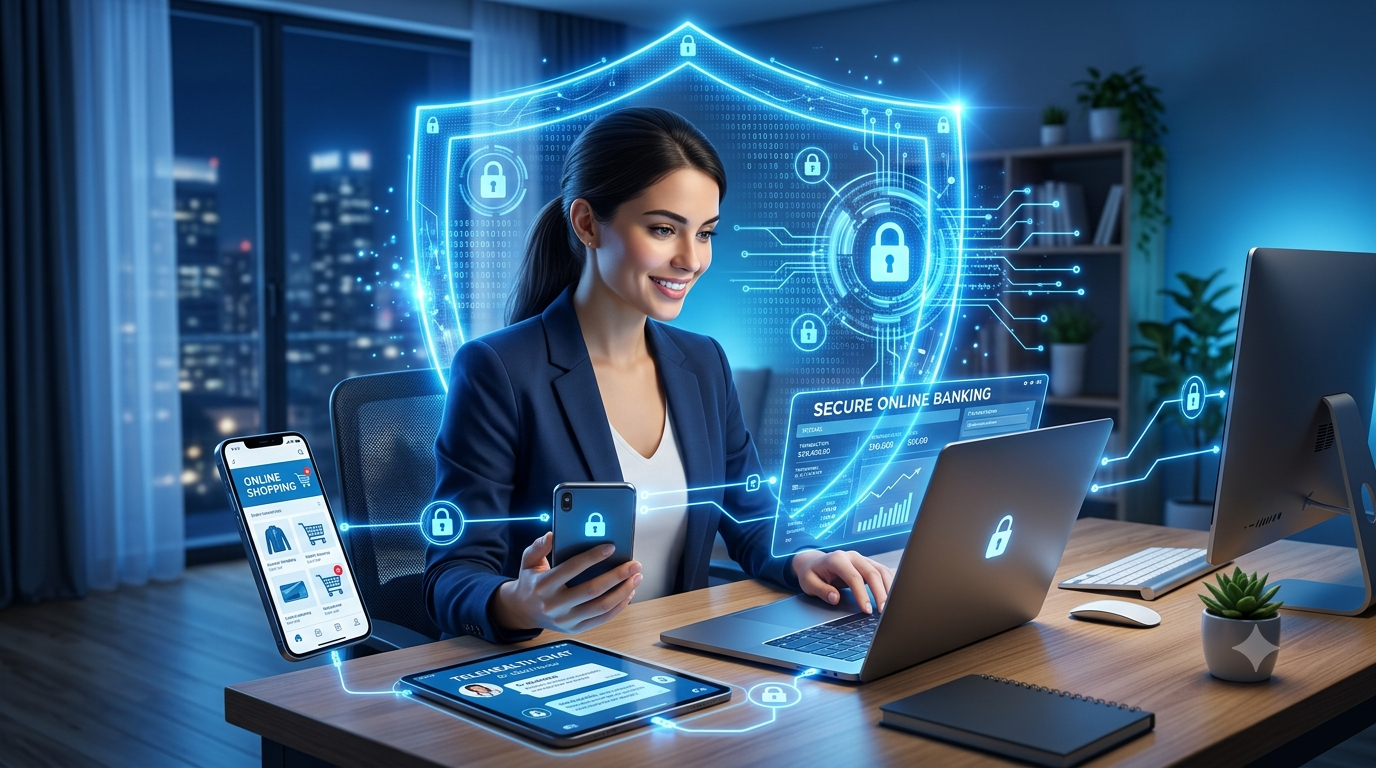
Picture this: you check your bank balance during your lunch break, order groceries on an app. Message your doctor about a prescription refill all before 1 pm, without thinking twice about any of it.
None of that would feel safe, or even work at all, without something quietly running in the background to keep it that way. That something’s cybersecurity, whether you ever notice it or not.
Technology’s made life genuinely easier, no argument there. Banking, shopping, learning, healthcare, running a business it’s all a few taps away now.
So let’s actually get into it what cybersecurity is, why it matters more than most people realize. What the real threats look like in practice.
What Cybersecurity Actually Is
NIST the National Institute of Standards and Technology. If you want the full name defines cybersecurity as the discipline of protecting systems, networks, and data from digital attacks. That’s the official version.
In plain terms? It’s the habits, tools, and policies that keep your stuff from getting stolen, broken, or held hostage online. Think of it like an immune system for your digital life, honestly, that’s the easiest way to picture it. Just like your body spots and fights off pathogens before they do real damage good.
Cybersecurity catches threats malware, mostly before they wreck your data or hijack your device entirely. Malware covers a lot of ground: viruses, worms, spyware, and a handful of nastier variants nobody wants to meet.
Most of it gets in the same boring, unglamorous way someone clicks a link they really shouldn’t have. That’s the whole reason good cybersecurity isn’t about reacting after the damage is done. It’s about staying ahead of that click before it ever happens.
The Three Pillars: Confidentiality, Integrity, Availability
Data protection usually boils down to three ideas, often bundled together as the CIA triad. No relation to the actual CIA, just an unfortunate coincidence in acronyms that trips people up constantly.
Confidentiality means only the right people can see your information. Your bank statement shouldn’t be readable by some stranger three desks over, obviously.
Integrity means your data stays exactly as it should be. Nobody’s quietly editing your numbers or swapping details behind your back while you’re not looking.
Availability means your system’s there when you actually need it not conveniently down for maintenance the one moment it matters most.
Organizations lean on firewalls, antivirus software, and encryption to hold all three together at once. When your bank shows you your balance, and only your balance. That’s the CIA triad quietly doing its job in the background, no fanfare, no notice.
Why This Actually Matters to You
It’s easy to treat cybersecurity as someone else’s problem an IT department’s headache, not yours to worry about. That’s a mistake, and a pretty common one, even among people who really should know better.
Good cybersecurity protects your personal and financial information from people who’d genuinely love to get their hands on it. It stops unauthorized changes to your accounts, prevents the kind of financial loss that comes from one careless click.
And for businesses especially it builds the customer trust that keeps people coming back instead of walking away for good. There’s a bigger picture too, one people don’t think about until it’s already too late.
Beyond individuals, cybersecurity protects national infrastructure: power grids, hospitals, water systems, the stuff that genuinely can’t afford to go down for even an hour. When that fails, it’s not an inconvenience. It’s a crisis, full stop.
Phishing: The Oldest Trick That Still Works
Phishing’s been around forever at this point, and somehow it still works embarrassingly well. Scammers send fake emails or spin up fake websites dressed up to look exactly like your bank. Your workplace, or a delivery company you actually use every week.
The email asks you to “verify your account” or “confirm your password,” usually with some urgent subject line designed to make you panic a little. You click, you type your info into what looks like a totally legitimate login page.
Just like that someone else has your credentials. No real hacking required. Just a convincing disguise and one moment of not looking closely enough.
| Threat Type | How It Works | Common Warning Sign |
|---|---|---|
| Phishing | Fake emails or websites mimic real ones to steal credentials | Urgent tone, mismatched sender address |
| Ransomware | Malware locks your files until you pay to unlock them | Sudden inability to open files, ransom note pop-up |
| Social Engineering | Manipulates people directly instead of hacking systems | Unsolicited calls asking for OTPs or passwords |
Ransomware: When Your Own Data Gets Held Hostage
Ransomware takes it a step further, and honestly it’s the scarier of the two. Instead of just stealing your information, it locks it your files, your website, your company’s entire database. And demands payment to hand back the keys.
Picture a mid-sized company showing up one Monday morning to find every file encrypted. A ransom note sitting on every screen in the office. Nothing works. Orders can’t be processed, records can’t be pulled up, and the business just… stops.
Someone pays or manages to claw everything back from backups that, fingers crossed, actually worked. It’s not some rare, once-a-decade event either. It happens to companies every single week, and most of them never make the news.
Social Engineering: Hacking the Person, Not the System
Here’s the one that catches even genuinely careful people off guard. Social engineering skips the technical hacking part entirely and goes straight for manipulation. Instead of breaking into a system, attackers convince a real, actual person to just hand over access willingly.
Classic version of it: someone calls, claims they’re from your bank, says your account’s been flagged, and asks you to read out your one-time password to “unlock” it. You read it out, trying to be helpful. That’s it game over, just like that.
They didn’t need to hack a single thing. You handed them the key yourself, because the whole call sounded urgent and official enough to short-circuit your usual caution. Broadly speaking, social engineering is any attempt to pressure someone into an action that benefits the attacker.
leaking information, approving a fraudulent transfer, granting access they really shouldn’t. Reports from 2019 and 2020 flagged it as one of the fastest-growing threats companies were dealing with at the time, and if anything, that trend’s only picked up speed since.
Who Actually Gets Hurt
Individuals end up paying the steepest personal price, in a lot of ways. Once your information’s out there, attackers can use it to pressure you, threaten to leak private details. It’s not purely financial either there’s a real emotional weight to realizing your privacy just got compromised by a stranger.
Organizations face a different flavor of damage. Beyond the direct financial hit, there’s legal exposure if customer data wasn’t properly protected, and regulators genuinely don’t go easy on that anymore. Add in the reputational damage once customers hear their information wasn’t safe.
That’s why companies invest in layered defenses: strong security policies, regular staff training that actually sticks, and multi-factor authentication. A second lock on the door, even if someone’s already got the first key in hand.
Building Better Habits
None of this requires a computer science degree, for what it’s worth. A handful of consistent habits go a surprisingly long way:
- Update your software regularly those “annoying” update prompts usually patch real security holes, not just add features nobody asked for
- Use strong, unique passwords instead of recycling the same one across five different accounts
- Turn on multi-factor authentication wherever it’s offered, even if it feels like one extra annoying step
- Pause before clicking links in unexpected emails, even the ones that look totally official
- Never, ever read out an OTP to someone who called you first — banks don’t ask for that, period
Where the Legal Side Fits In
Governments have started taking this seriously too, not just individual companies scrambling on their own. Frameworks like the EU’s GDPR require businesses to handle personal data responsibly — collecting only what they actually need.
Staying transparent about how it gets used, and getting real, informed consent before using it for anything. Ignoring these rules isn’t just risky from a security angle.
It’s expensive, plain and simple. Violations can trigger fines large enough to genuinely hurt a company’s bottom line, stacked right on top of whatever damage the original breach already caused.
The Bottom Line
Cybersecurity isn’t some optional extra bolted onto modern life as an afterthought. At this point, it’s one of the things quietly holding everything else together banking, healthcare, business. Even the basic trust that your information actually stays yours.
As technology keeps making life easier, the threats riding alongside it aren’t slowing down anytime soon. Here’s the good news, though: you don’t need to become a security expert to stay reasonably safe.
A little awareness, a few consistent habits, and a healthy dose of skepticism toward “urgent” emails and calls go a long way toward keeping your digital life exactly that yours, and nobody else’s.
Research Spotlight
MGM Resorts Cyberattack (2023)
In September 2023, MGM Resorts International experienced a massive cyber attack affecting casino operations, payment systems, digital room keys and hotel reservations.
The company subsequently revealed that the attack cost the company about $100 million. The attackers say that they’re doing social engineering, which can be more effective as an attack than going after the technology itself.
Frequently Asked Questions
What are the legal requirements for data protection?
Governments worldwide enforce data protection frameworks like the EU’s GDPR, which require businesses to minimize the data they collect.
What are the top modern cyber threats?
Phishing tricks people into handing over login details through fake messages that look almost too convincing. Ransomware locks up files until a ransom gets paid, no exceptions.
Why does legal compliance actually matter?
Because the penalties are real, not just theoretical. Laws like GDPR exist to force companies to take data protection seriously.
Conclusion
Nowadays, cybersecurity is no longer an IT issue, it’s a lifestyle one. Whether your business or you’re at your bank, shopping online or working from home, your personal and financial information depends on digital security.
Cyber attacks are becoming ever more complex with phishing, ransomware and social engineering just a few of the ever more common attacks that are a growing threat, so awareness is as important as technology. The bright side is it isn’t rocket science to stay safe online.
To reduce risk, simple security measures such as the use of strong, unique passwords, multi-factor authentication. Software updates and refraining from clicking on links from unknown sources can help.
In the end, cybersecurity is a matter of cultivating savvy, consistent practices that will keep your digital persona safe now. Safeguard you for the future as the world continues to become increasingly digital.
Leave a Reply