Introduction
A few years back I couldn’t stop thinking about an email I’d sent. Not a bad one, really. I’d written “regards” instead of “best.” And for some reason my brain decided this was a five-alarm crisis. I checked my sent folder maybe fifteen times that day.
Reread it, cringed, closed the laptop, opened it again ten minutes later. My partner asked what was wrong and I said “nothing,” which was a lie. Because clearly something was very wrong with how much space one word was taking up in my head.
That’s obsession. Not the dramatic movie version nobody’s stalking anyone, no one’s building a shrine. Just your brain, latching onto something small and refusing, flatly refusing, to let it go.
We throw the word around casually. “I’m obsessed with this show.” “My uncle’s obsessed with his lawn.” Usually that’s fine, even kind of charming enthusiasm wearing a bigger word than it needs.
What actually counts as obsession

My rough definition, after living with this stuff and reading way too much about it: obsession is a thought, image, or urge that keeps coming back, usually against your will. Passion pulls you toward something you’re choosing it. Obsession traps you inside it.
There’s no choosing involved. You’re just stuck, running the same lap, over and over, wondering when the track’s going to end. There are two rough categories here. Everyday obsessive thinking worrying a decision into the ground.
Replaying an awkward conversation on loop, fixating on a goal until it swallows the rest of your thoughts. Uncomfortable, sure, but it tends to fade. Sleep helps, so does time.
If you’ve ever lain awake wondering whether your racing thoughts are “just stress” or something bigger. Here’s roughly where professionals draw the line: is it actually interfering with your life, and is it paired with compulsions? That’s usually the marker.
Where this comes from
There’s rarely one clean cause. It’s more like a few things stacking on top of each other.
Brain chemistry’s involved research ties obsessive thinking and OCD to how the brain manages serotonin, and to circuits involved in decisions and habits. Basically, the “okay, done, you can relax” signal misfires. So nothing ever fully resolves.
Which is exhausting in a way that’s genuinely hard to describe to someone who hasn’t felt it. Anxiety usually fuels it from underneath. The two feed each other more anxious, more searching for something to fix or pin down.
Fixating can feel like control. It isn’t, not really, but it feels like it in the moment, and that’s often enough to keep the loop going.
What Causes Obsessive Thoughts and Behaviors?
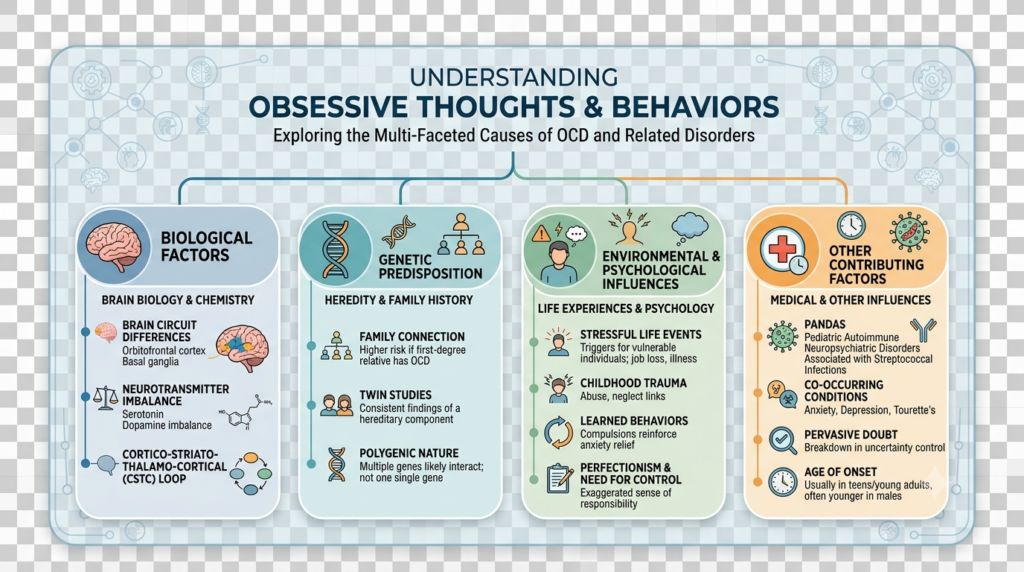
Personality and upbringing play a part too. Lean toward perfectionism, or grow up somewhere mistakes felt genuinely dangerous. Rather than just embarrassing, and obsessive patterns show up more later.
Punish uncertainty enough as a kid, and certainty becomes the thing you chase forever as an adult even though. Let’s be honest, certainty is mostly a myth we tell ourselves. Stress and life changes matter too.
A new job, a scary appointment these rattle your sense of safety. Sometimes the mind grabs onto a thought it can “control” as a kind of anchor. Even when that anchor is the thing hurting you.
What it feels like from inside it
Mentally: intrusive thoughts that show up uninvited, sitting there in the middle of an otherwise ordinary Tuesday. Rumination replaying the same scene hoping it lands differently this time. It won’t. It never does, and some part of you knows that, and you try anyway.
Trouble focusing on anything else. A nagging itch that something’s unfinished, even when you can’t say what. Physically: shoulders creeping up toward your ears, a jaw that’s aching by dinner and you don’t even remember clenching it.
Trouble sleeping because the brain won’t power down. A restlessness with nowhere to go like sitting still takes more effort than it should. Some people notice their heart rate ticking up just from the thought alone, body bracing for a threat that isn’t actually in the room.
Common Signs and Symptoms of Obsessive Thoughts
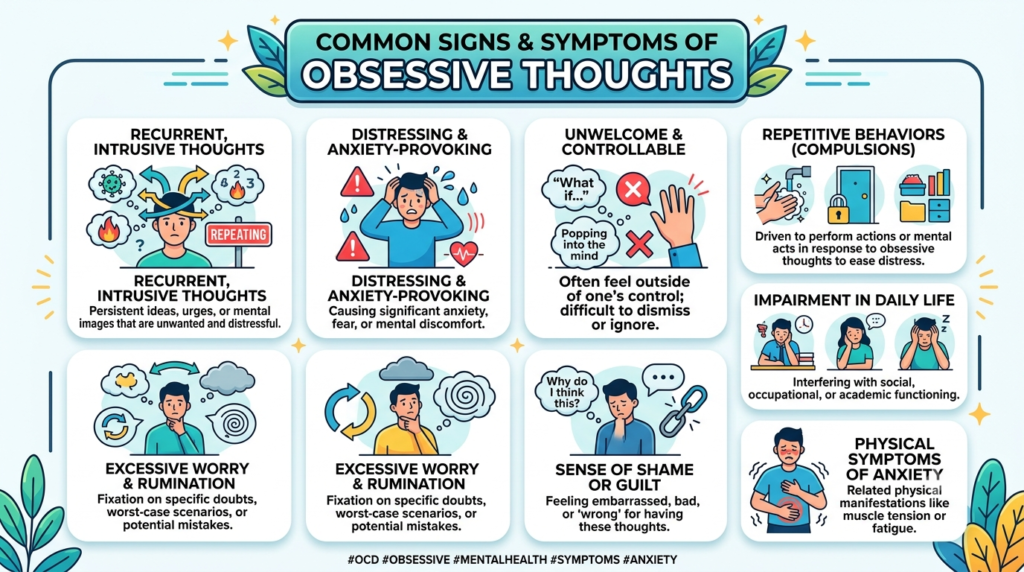
Behaviorally, it’s usually checking. Rereading a text five times before hitting send. Walking back to check the door third time now. Googling a symptom at 1 a.m., closing the tab out of embarrassment, opening it again four minutes later.
These give relief, briefly, and the window shrinks each time, until the thought’s back before you’ve even set the phone down. A friend once described her version of this obsessing over a work mistake as “a browser tab open in my head I couldn’t close.”
I’ve thought about that line more times than I’d like to admit. Quiet background noise, draining the battery the whole time, while you try to focus on literally anything else.
How you actually cope with it
Here’s the part people don’t want to hear: you can’t usually think your way out of obsession by trying harder not to think about it. That backfires almost every time. Try not thinking about a pink elephant for ten seconds. Go on, See what happens.
What tends to help is changing your relationship to the thought, rather than fighting the thought head-on. Name it instead of wrestling it. Even something small “ah, there’s the loop again” creates a little gap between you and the thought. That gap is where you get some control back.
Try a worry window, Ten minutes a day where the thought’s allowed to be as loud as it wants. Write it down, sit with it, no holding back.
Healthy Ways to Cope with Obsessive Thoughts
Move your body if you can. Obsession lives mostly in the head, and a walk, a stretch, even just doing dishes, tends to loosen its grip more than you’d expect going in.
If you’re a checker, delay the check. Five minutes first. You’re teaching your nervous system, slowly. That the anxious feeling fades on its own it just takes longer than the ritual promises.
Talk to someone, if it’s gotten that far. Sometimes this is manageable solo. Sometimes it isn’t, and that’s not failure, just information.
If obsessive thoughts are messing with work, relationships, or sleep for weeks running. A therapist trained in CBT or ERP (Exposure and Response Prevention) helps in ways white-knuckling alone usually can’t. Easy to say, harder to believe at 2 a.m. I know.
The thought isn’t actually the enemy

Obsessive thoughts, by themselves, aren’t dangerous. What hurts is the fight against them the constant shoving away. Which somehow makes them come back louder. The goal was never a silent mind, Nobody has that.
The real goal is a thought showing up, getting its moment, and moving on through, without hijacking the whole day. So if it’s 2 a.m, and you’re replaying something that doesn’t deserve this much of your night you’re not broken.
Not alone in it either, even if it feels that way in that particular kind of quiet. Just a very human pattern, one that gets quieter over time, with a little patience toward yourself. That last part’s actually true, even at 2 a.m., even when it doesn’t feel like it.
Real Life Examples
How ERP Helped Reduce Obsessive Checking
One of the most famous examples involved Exposure and Response Prevention (ERP), a kind of cognitive behavioral therapy for an OCD treatment. A young adult with a history of checking locks, appliances and work emails reported that he practiced rituals for several hours every day in a published case report.
Research Insight
According to a large clinical review published by the American Psychiatric Association, OCD is a condition that affects around 2–3% of people in their lifetime.
CBT, especially ERP, is consistently found to be the first-line psychological treatment. If required, some antidepressant drugs (SSRIs) can also help to further reduce symptoms. While intrusive thoughts may not completely go away, many people do see a marked improvement with proper treatment.
Frequently Asked Questions (FAQs)
What is the difference between obsession and passion?
Passion is an activity that you do because you like it or have a reason for doing it. Obsession is involuntary and disturbing. It doesn’t motivate you, it makes you feel anxious and unable to concentrate on anything else.
Have obsessive thoughts?
Yes. At some point in our lives, we all have unwanted intrusive thoughts. They are a problem when they are frequent, distressing, difficult to control, and start to interfere with work, relationships, sleep, or daily activities.
Do I have OCD if I have obsessive thoughts?
Not necessarily. Obsessive thoughts do not necessarily indicate OCD. OCD typically is diagnosed when the intrusive thoughts are accompanied by compulsive behaviors or mental rituals.
Do obsessive thoughts get worse when stressed?
Absolutely, anxiety can be heightened by stress, significant life changes, illness and uncertainty, which can make obsessive thoughts more frequent and intense. People often find that their symptoms get better when they decrease the stress.
What is the best treatment for obsessive thoughts?
Treatment will vary depending on the cause, but there is good scientific evidence that Exposure and Response Prevention (ERP)
Conclusion
Obsession isn’t simply caring too much about something. It’s the sense that you’re in a vicious cycle. You can’t get out of, even though you know that the thought isn’t helpful. For others, it’s reliving experiences.
The positive thing is that obsessive thoughts don’t have to consume your life. The cycle can be broken over time by learning to identify it, reducing compulsive behaviors, stress management, and professional assistance as needed.
Typically, it’s not a big change, it’s a small change, such as not doing that one thing you were tempted to do. Not reacting to that one uncomfortable thought.
Leave a Reply