Introduction

You open your phone to check one notification. Forty minutes later you’re three AI chat tabs deep, half-reading some summarized news feed. You genuinely cannot remember what you opened the phone for in the first place.
I’ve done this more times than I want to admit. That’s not a willpower problem. Really it’s just what living inside an attention economy that now runs partly on AI does to a completely normal brain.
Digital minimalism in the AI era isn’t about quitting technology. Nobody’s asking you to do that. Honestly it wouldn’t even be realistic anymore for most people.
It’s about being deliberate with a much noisier. Much smarter set of tools than the ones the original digital minimalism movement was ever built to handle. That distinction matters more than it sounds like it should.
What Digital Minimalism Actually Means
Cal Newport, who popularized the term, defined it as a philosophy. Where you focus your online time on a small number of activities that genuinely support your values. Skip the rest without feeling guilty about it. Not “less tech for the sake of less tech.”
More like: fewer tools, used on purpose, used well.The core idea is that clutter has a cost even the digital kind you don’t consciously notice piling up. Every app, every feed, every open tab is quietly competing for the same limited resource.
That idea landed hard back in 2019. It lands even harder now, and honestly it’s kind of wild it took this long to catch on more broadly.
Why the AI Era Changes the Equation
Here’s the actual shift. Old-school digital distraction was mostly human-curated other people’s posts. Other people’s opinions, algorithms just sorting content that other humans made. Annoying, sure. But it had a ceiling, at least.
AI-generated content doesn’t really have that ceiling anymore. Feeds can be filled endlessly now, personalized in real time. Tuned moment to moment for whatever keeps you scrolling five more minutes.
Chatbots are available for basically anything, at any hour of the night. Which sounds convenient right up until you realize you’ve quietly swapped out boredom actual. Productive boredom for a conversation partner that never gets tired and never logs off first.
Practicing digital minimalism in the AI era means dealing with tools that are, frankly. Better at holding your attention than anything Newport was writing about back then. The attention economy didn’t go anywhere. It just got a serious upgrade.
The Real Cost of Constant Digital Noise
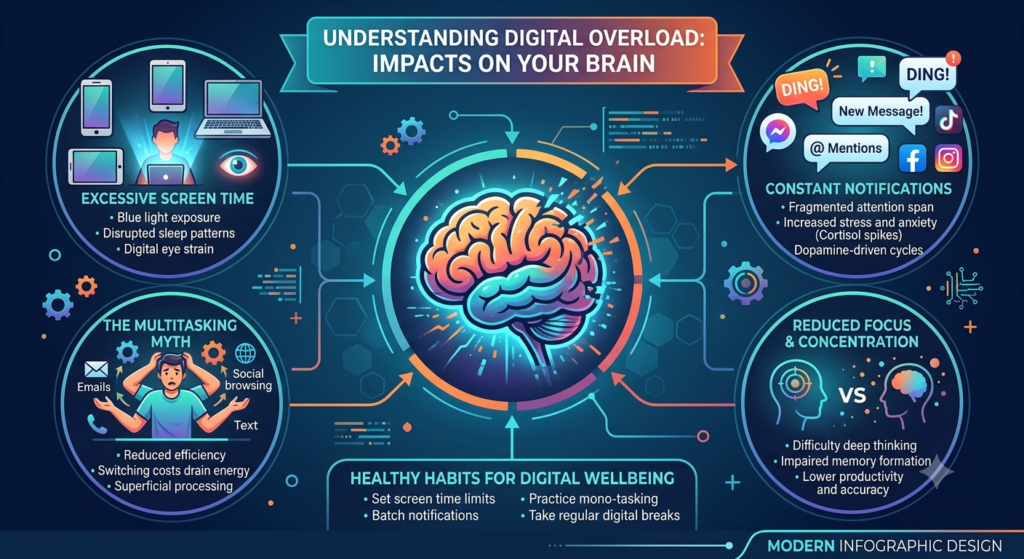
This isn’t just a vibes-based complaint, for what it’s worth. Attention researcher Gloria Mark, who’s been tracking screen behavior since 2004, found that average focus time on a single screen has dropped. From roughly two and a half minutes back then to under a minute today.
Why Modern Apps Are So Hard to Resist
Global device use now sits close to seven hours a day on average, according to recent tracking data. That’s before you even count the AI tools layered on top of everything else. None of that’s really about laziness, despite how it gets framed sometimes.
It’s what happens when every app, feed, and assistant is engineered, deliberately, by genuinely smart people. To be a little more compelling than whatever you were actually trying to do in the first place.
The Hidden Cost of Constant Digital Distraction
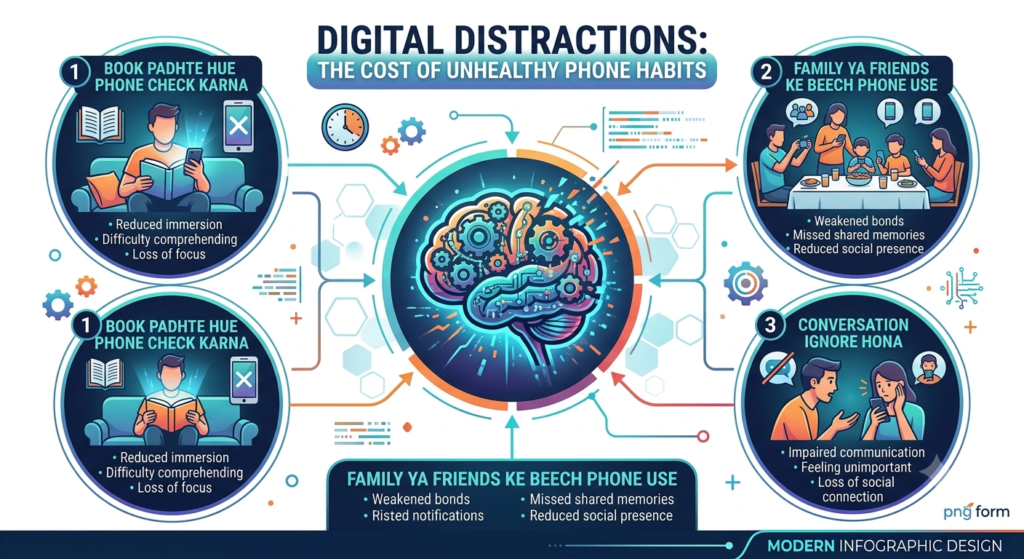
The cost shows up small at first. Trouble finishing a book you actually like. Reaching for your phone mid-sentence of a real conversation without even deciding to.
A vague, low-grade restlessness the second nothing’s demanding your attention. Give it enough time and it adds up to something bigger less deep work, less real rest. A harder time just sitting with your own thoughts for five minutes.
Core Principles of Digital Minimalism in the AI Era

A few ideas carry straight over from Newport’s original framework. Just updated for what’s actually competing for your attention now.
Intentionality beats access, basically every time. Just because a tool exists doesn’t mean it earns a slot in your day. Worth asking what it’s actually replacing usually it’s silence, boredom, or a moment of real thought, not “wasted time” like it feels in the moment.
Master a Few AI Tools Instead of Chasing Every New One
Fewer tools, used deeper, tends to beat dabbling with every new AI app that launches this month. Pick the handful that genuinely earn a place and actually get good at them. Depth wins over breadth here, pretty much every single time I’ve seen it play out.
Unstructured time needs protecting on purpose, because AI tools are excellent almost too excellent at filling every gap instantly.
That’s exactly why some gaps need to stay empty. Walking without a podcast. Waiting in line without scrolling. Thinking a thought all the way through without a chatbot finishing it for you. And convenience deserves a little suspicion, honestly.
Not everything that saves you time is actually serving you. Sometimes friction is the whole point it’s what makes a thing feel worth doing at all.
A Practical Starting Framework
You don’t need a dramatic 30-day digital detox to feel a difference here. Though Newport’s original version is still solid if you want to go all in. A lighter version works fine too, and it’s a lot easier to actually stick with.
Start with a week of just noticing. Track, without judging yourself for it. Which apps or AI tools you reach for automatically almost before you’ve decided to. Most people are genuinely surprised by the pattern once they actually look at it in writing.
Then pick one category to trim first. Probably whichever one feels the most automatic and the least intentional. Cut it for a week, not forever, just long enough to notice what naturally fills that space instead.
Last step reintroduce tools one at a time, and ask yourself one plain question before letting each back in. Does this genuinely serve something I care about, or am I just used to having it around? That one question does more work than any app-blocker I’ve ever tried.
Common Mistakes People Make
The biggest one, by far, is treating this as all-or-nothing. Digital minimalism in the AI era isn’t about deleting every app and going off-grid somewhere. It’s about intentional use, and intentional use can absolutely include AI tools when they’re actually earning their spot.
Another one that trips people up focusing only on time spent and ignoring how a tool leaves you feeling afterward. Twenty minutes on one app might leave you sharper.
Twenty minutes on another might leave you foggy and a little irritable for no clear reason. Time alone doesn’t tell you the whole story.A lot of people also skip the reflection step entirely.
Cut something out, feel better for a week, then slide right back into the old pattern without ever really asking. Why the tool had that much pull in the first place. Understanding the pull matters just as much as resisting it maybe more.
Research Spotlight
Microsoft Workplace Attention Study
Microsoft Research and the University of California researchers studied information workers over the course of a few days to gain insight into the dynamic nature of attention throughout the working day.
They discovered that sustained focus was strongly associated with context. And that regular use of the internet and interruptions affected sustained focus.
Reclaiming Time Through Digital Minimalism
Cal Newport, computer science professor, tells the tale of readers who went through a 30-day digital declutter in Digital Minimalism. One participant, known as “Robert,” was changing the way he used his smartphone by using a basic phone, setting time limits on internet use by parents.
The experiment emphasizes that careful and planned technology use (and not the outright ban on technology) can have a profound impact on attention and happiness.
Conclusion
Digital minimalism in the AI era isn’t a rejection of technology, and it was never meant to be. It’s a recognition that the tools got sharper, faster, and considerably better at holding onto your attention than they were even a few years back
Its means “just use more willpower” was never going to cut it on its own. Pick one thing from this article. Maybe a week of noticing, maybe protecting one unstructured hour a day. Start there. Let the rest follow whenever it’s ready to.
Frequently Asked Questions
Is digital minimalism in the AI era just about using less AI?
Not exactly. It’s about using AI tools intentionally, for things that genuinely add value, rather than reaching for them out of habit or plain boredom.
Do I need to quit social media to actually practice this?
No. Some people do cut it entirely, sure, but the core idea is intentional use, not total elimination. What matters more is whether a tool is actually serving you or not.
How long before I notice a difference?
Most people notice something within the first week, even with a partial digital declutter usually less restlessness, and a bit more patience for unstructured time than they had before.
Is this basically the same as a dopamine detox?
Related, but not quite the same thing. Digital minimalism leans more toward long-term intentional habits; a dopamine detox is usually more of a short-term reset. Honestly, they work pretty well together.
Can AI tools actually support digital minimalism instead of undermining it?
Yes when used deliberately. A single well-chosen AI tool used with a clear purpose looks nothing like a dozen apps all competing for your attention at once.
Leave a Reply