Introduction
I still remember the exact question. A college junior, career fair, holding a stack of resumes printed on the wrong paper stock, asked me: “What should I actually study if I want a job that still exists in ten years?”
I gave her some watered-down version of “follow your interests, the market sorts itself out.” Which, honestly? Kind of a cop-out. I’ve thought about that conversation more than I’d like to admit. Mostly because I think I owed her a better answer than I had at the time.
This piece covers the careers actually positioned to grow by 2030, why, roughly what they pay, what skills matter. Maybe most usefully how to start preparing now, whether you’re a student, mid-career and itching for something different.
Why the Future Job Market Is Changing

It’s never one thing. That’s the part that makes this hard to talk about simply there are three or four forces pulling at once, and they don’t always point the same direction.
The AI Revolution Is Changing Careers Faster Than Ever
AI and automation get the most airtime, for obvious reasons. They’re eating into routine cognitive work the kind of task-based labor that used to be how entry-level jobs worked.
McKinsey’s research puts the potential displacement in the tens of millions globally by decade’s end. That sounds bad until you read further and see the same research projecting new categories of work opening up nearly as fast.
An Aging Population Is Driving Long-Term Job Demand
Then there’s demographics, which gets way less attention than it deserves given how big a deal it actually is. Populations across the developed world are aging fast, and the U.S. Bureau of Labor Statistics keeps flagging healthcare support roles as some of the fastest-growing job categories in the country.
The Clean Energy Transition Is Creating Millions of New Job
Climate’s the third piece,money is pouring into renewable energy and climate infrastructure at a scale that would’ve sounded implausible a decade ago.
The International Labour Organization projects meaningful net job growth from the clean energy transition yes. Even after subtracting the fossil fuel jobs that go away.
Key Trends Shaping Careers by 2030

Some patterns that keep showing up no matter whose report I’m reading:
- Employers want hybrid people now. A nurse who’s fine with data dashboards. A marketer who can actually direct an AI tool instead of being scared of it.
- Remote and hybrid work stuck. Microsoft’s Work Trend Index keeps confirming this isn’t a pandemic hangover it’s just how a lot of work happens now, full stop.
- Green skills went mainstream, used to be a niche specialty. Not anymore, not even close.
- Soft skills matter more, not less, which surprises people who assume “the future is technical.” LinkedIn’s data keeps ranking communication and adaptability near the top, even in deeply technical fields.
- Careers stopped being straight lines. People switch industries more than once now sometimes more than once a decade and it’s stopped being seen as flaky. It’s just normal now.
Top Careers That Will Be in High Demand by 2030
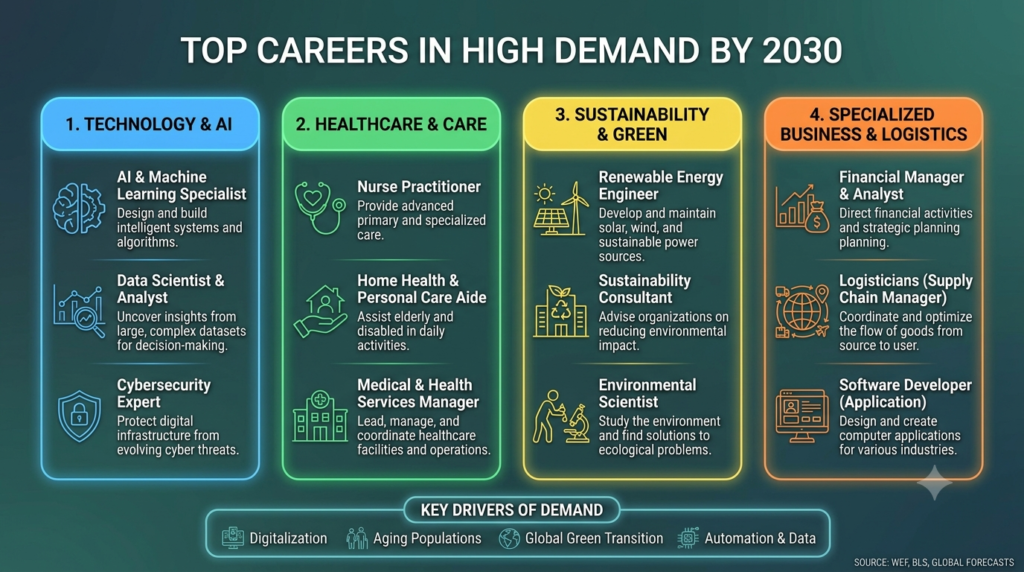
Loosely grouped below. Notice how much they overlap, though that’s kind of the whole point of this list.
Artificial Intelligence Engineer
These are the people building and training the models companies. Now lean on for everything from fraud detection to the chatbot that argued with you about a refund last week.
Demand is outpacing supply badly enough that good engineers get recruited before they’ve finished job hunting. I’ve heard this from three separate people now. You’ll need solid Python, comfort with TensorFlow or PyTorch, real statistics chop
Increasingly some grip on AI ethics, since companies are getting nervous about deploying models blind. Most roles want a computer science degree at minimum; senior roles lean harder toward a master’s. Pay’s in the $110,000–$180,000+ range in mature markets, sometimes well past that.
Machine Learning Engineer
Close cousin to the AI engineer role, but heavier on getting a model to actually survive contact with real users at scale. Rather than just working in a research notebook.
Software engineering fundamentals, cloud experience, MLOps tooling that’s the core toolkit. Salaries land around $115,000–$175,000+. Suits people who’d rather build the plumbing than chase pure research.
Cybersecurity Analyst
Attacks have gotten more frequent and more expensive, and most companies are still short-staffed on defense. That gap alone explains why this shows up on basically every high-demand list from here to the BLS.
You’ll want network security knowledge, threat analysis skills. A Security+ or CISSP certification often does more for your resume than a degree would. Pay usually runs $85,000–$140,000+.
Good for detail-obsessed people who function fine under pressure. Less good if 2 a.m. incident calls sound like a nightmare to you, because they happen.
Cloud Computing Specialist
Nearly everything’s moved to the cloud or is midway through moving there, and somebody has to keep it running and not bleeding money. AWS, Azure, or GCP certifications matter a lot here sometimes more than the degree does.
Expect $100,000–$160,000+. Great for people who like systems thinking and troubleshooting, though be ready to keep re-certifying as the platforms shift under you.
Data Scientist
Every company generating data which by now is pretty much all of them wants someone who can turn it into decisions instead of noise.
Python or R, SQL, statistics, visualization. Bachelor’s is the floor, master’s is increasingly expected for the competitive roles. Salaries run $95,000–$155,000+.
Ideal for curious people who like a good numeric story, though nobody warns you how much of the job is just cleaning garbage data before the “fun” part even starts.
Renewable Energy Engineer
Global investment in solar and wind keeps climbing as countries chase climate targets. Which means steady demand for the engineers designing and improving these systems.
Engineering degree mechanical or electrical usually plus increasingly some software and data skills for grid work. $75,000–$130,000+.
Great if you want your day job tied to something bigger than a quarterly earnings call. Though opportunities cluster depending on local energy policy, so location matters more here than in most tech fields.
Robotics Engineer
Automation’s crept past factory floors into warehouses, hospitals, even farms, and robotics engineers build the physical systems making that possible. Mechanical and electrical engineering fundamentals, programming, systems integration. $85,000–$140,000+.
Hands-on path for people who want to build physical things, not purely digital ones. Training often needs lab access and specialized equipment, which can be a real hurdle depending on where you study.
Careers That May Decline by 2030
I want to be careful here, because this section gets misused a lot for fear-mongering, and that’s not what I’m going for. The honest version: roles built around repetitive, predictable tasks are the most exposed.
Basic bookkeeping. Certain customer service functions. Chunks of manufacturing assembly. But here’s the part that gets lost it’s rarely that an entire profession disappears overnight.
More often, the repetitive slice of the job gets automated while the judgment-heavy, relationship-heavy parts stay stubbornly human. A bookkeeper who only enters numbers is exposed. One who also advises clients on financial decisions, less so.
Skills That Will Matter Most by 2030
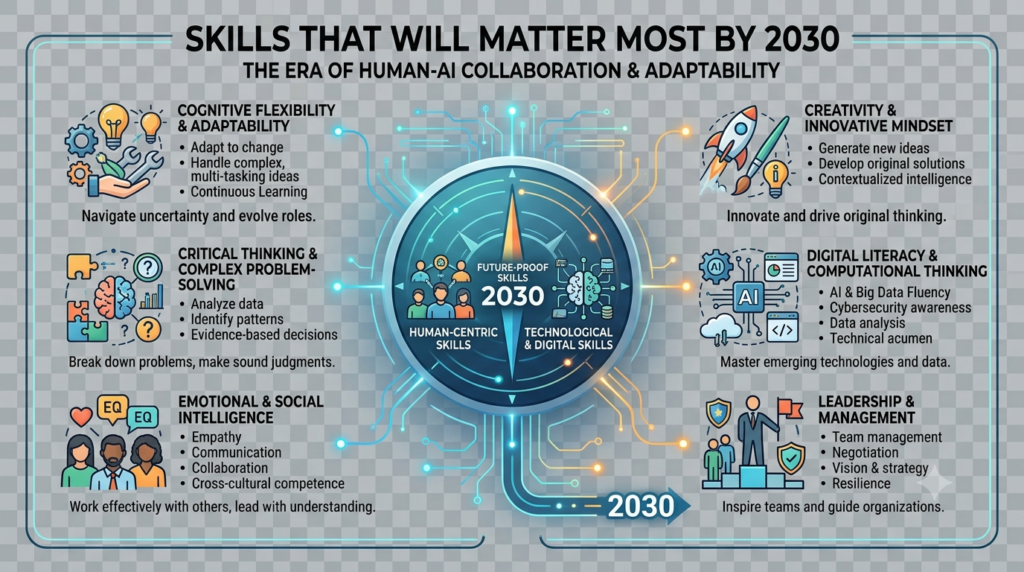
I’ve gone through reports from WEF, LinkedIn, Deloitte, PwC the same handful of skills keep showing up, no matter the industry:
- Communication — explaining things clearly, in writing and out loud
- Critical thinking — evaluating information instead of just absorbing it
- Creativity — coming up with things AI genuinely can’t originate on its own
- AI literacy — actually knowing how to use these tools well, not avoiding them out of anxiety
- Digital skills — basic technical comfort, whatever your field
- Leadership — guiding people and projects, even without a title yet
- Adaptability — real comfort with ambiguity, not just tolerating it
- Problem solving — the thing underneath nearly every job on this list
- Emotional intelligence — the one thing that’s stayed stubbornly, reliably human
One thing a lot of people get wrong: your technical skills get you the interview. These are what actually get you promoted.
How Students Can Prepare Today
You don’t need your whole career figured out at nineteen. Nobody actually does, no matter what people’s LinkedIn bios imply. A few things genuinely help, though:
- Take one technical elective outside your major. A coding class, a data course, anything that builds real digital fluency.
- Get comfortable with AI tools now as a collaborator, not a way to skip your own thinking entirely.
- Chase internships early, even the short or unpaid ones. The real-world context matters more than it seems like it will at the time.
- Build a portfolio, not just a transcript. Projects, writing, code these speak louder than GPA in a lot of fields now.
- Actually talk to people working in the field you’re eyeing. Job titles change faster than the online descriptions of them do.
- Stay open to trades and vocational paths. A four-year degree isn’t the only way into something stable anymore, and treating it like the only option just closes doors you didn’t need to close.
Comparison Table: Careers at a Glance
| Career | Expected Demand | Average Salary | Difficulty | AI Risk |
|---|---|---|---|---|
| AI Engineer | Very High | $110K–$180K+ | High | Low |
| Cybersecurity Analyst | Very High | $85K–$140K+ | Medium-High | Low |
| Data Scientist | High | $95K–$155K+ | High | Low-Medium |
| Healthcare Professional | Very High | $65K–$130K+ | Medium-High | Very Low |
| Renewable Energy Engineer | High | $75K–$130K+ | Medium-High | Low |
| UX/UI Designer | Moderate-High | $75K–$120K+ | Medium | Medium |
| Skilled Trades | Very High | $55K–$95K+ | Medium | Very Low |
| Digital Marketing Specialist | Moderate | $55K–$100K+ | Medium | Medium |
| Mental Health Counselor | High | $55K–$90K+ | Medium-High | Very Low |
| Blockchain Developer | Moderate | $90K–$150K+ | High | Low |
Research Spotlight
Backlinko’s Google Ranking Factors Study
Backlinko analyzed millions of results from Google and discovered that top-ranked web pages generally meet search intent. Provide complete answers and generate backlinks by delivering real value and not overstuffing with keywords.
The study confirms that articles focusing merely on keyword placement are not quite as effective as articles that present original insights, provide practical examples and target the reader’s needs.
Semrush on Search Intent
Semrush’s guide to Search Intent says that it’s more important to understand the intent behind a person’s search than to hit the exact keyword phrase.
Pages that answer follow-up questions, offer comparisons, give actionable tips and answer the user’s entire problem will tend to rank more consistently. This is an ideal use of my experience of making an article better, not longer.
Frequently Asked Questions
Is keyword density important at all?
Yes, but in moderation. Today’s search engines have a better sense of context and semantic meaning, so you shouldn’t be repeating the same phrase or key word in your search copy.
What is the difference between an article that is ranked for years and for weeks?
Long-lasting content tends to have a strong focus on search intent, be original, be experiential, include internal linking, and feature updated information.
Is there a relationship between article length and performance
No. A short article that is able to answer 100% of the reader’s problem can, in many ways, outperform a much longer article that contains redundant or needless information.
What is the importance of internal linking?
Internal links can help search engines navigate your site and can direct your readers to other relevant resources on your site and external links. They also spread out the power in your pages and enhance the overall user experience.
What is the biggest SEO error made by the newbies?
A lot of newbies write for the algorithms, not humans. They pay close attention to the keywords they’re targeting, and ignore the things that really matter like readability, search intent and original content.
Final Thoughts
I’ve seen dozens of articles written saying that some secret formula exists to get good rankings. I’ve come to understand that there is no such thing as SEO; it is actually about being helpful.
Optimization tools, internal links, headings and keywords have a role to play, but they are just tools. The actual purpose of your article is to assist the other individual who clicked your article to find the answer they were seeking.
The more I took the time to think “How do I make this genuinely helpful?” instead of “How do I rank this?” the better my results were. This will be my rule from now on: In all my articles, I will produce a piece that is both informative and entertaining.
Leave a Reply