Category: Career

  • Careers That Will Be in High Demand by 2030


    Introduction

    I still remember the exact question. A college junior, career fair, holding a stack of resumes printed on the wrong paper stock, asked me: “What should I actually study if I want a job that still exists in ten years?”

    I gave her some watered-down version of “follow your interests, the market sorts itself out.” Which, honestly? Kind of a cop-out. I’ve thought about that conversation more than I’d like to admit. Mostly because I think I owed her a better answer than I had at the time.

    This piece covers the careers actually positioned to grow by 2030, why, roughly what they pay, what skills matter. Maybe most usefully how to start preparing now, whether you’re a student, mid-career and itching for something different.

    Why the Future Job Market Is Changing

    It’s never one thing. That’s the part that makes this hard to talk about simply there are three or four forces pulling at once, and they don’t always point the same direction.

    The AI Revolution Is Changing Careers Faster Than Ever

    AI and automation get the most airtime, for obvious reasons. They’re eating into routine cognitive work the kind of task-based labor that used to be how entry-level jobs worked.

    McKinsey’s research puts the potential displacement in the tens of millions globally by decade’s end. That sounds bad until you read further and see the same research projecting new categories of work opening up nearly as fast.

    An Aging Population Is Driving Long-Term Job Demand

    Then there’s demographics, which gets way less attention than it deserves given how big a deal it actually is. Populations across the developed world are aging fast, and the U.S. Bureau of Labor Statistics keeps flagging healthcare support roles as some of the fastest-growing job categories in the country.

    The Clean Energy Transition Is Creating Millions of New Job

    Climate’s the third piece,money is pouring into renewable energy and climate infrastructure at a scale that would’ve sounded implausible a decade ago.

    The International Labour Organization projects meaningful net job growth from the clean energy transition yes. Even after subtracting the fossil fuel jobs that go away.

    Key Trends Shaping Careers by 2030
    Some patterns that keep showing up no matter whose report I’m reading:

    • Employers want hybrid people now. A nurse who’s fine with data dashboards. A marketer who can actually direct an AI tool instead of being scared of it.
    • Remote and hybrid work stuck. Microsoft’s Work Trend Index keeps confirming this isn’t a pandemic hangover it’s just how a lot of work happens now, full stop.
    • Green skills went mainstream, used to be a niche specialty. Not anymore, not even close.
    • Soft skills matter more, not less, which surprises people who assume “the future is technical.” LinkedIn’s data keeps ranking communication and adaptability near the top, even in deeply technical fields.
    • Careers stopped being straight lines. People switch industries more than once now sometimes more than once a decade and it’s stopped being seen as flaky. It’s just normal now.

    Top Careers That Will Be in High Demand by 2030
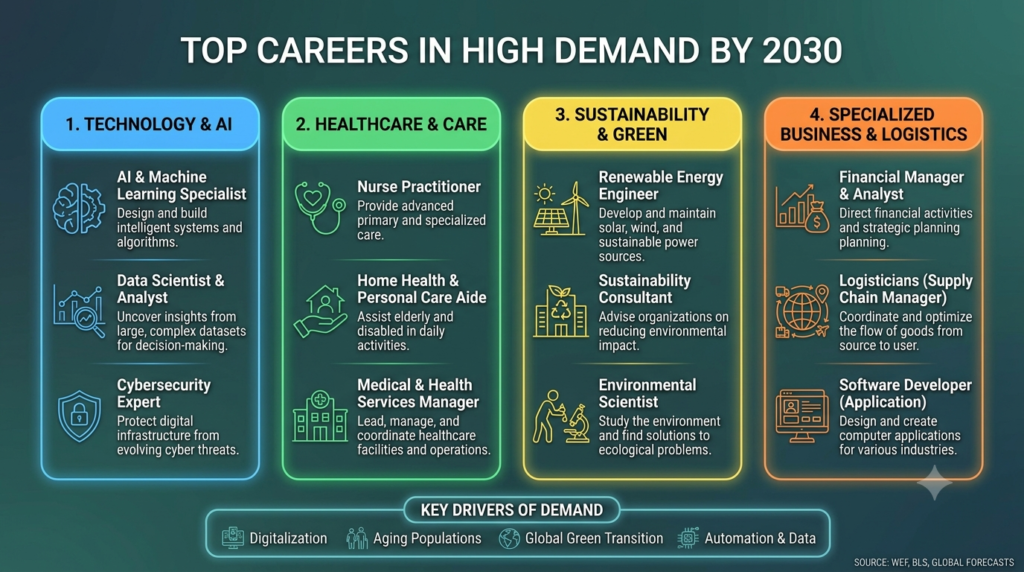
    Loosely grouped below. Notice how much they overlap, though that’s kind of the whole point of this list.

    Artificial Intelligence Engineer

    These are the people building and training the models companies. Now lean on for everything from fraud detection to the chatbot that argued with you about a refund last week.

    Demand is outpacing supply badly enough that good engineers get recruited before they’ve finished job hunting. I’ve heard this from three separate people now. You’ll need solid Python, comfort with TensorFlow or PyTorch, real statistics chop

    Increasingly some grip on AI ethics, since companies are getting nervous about deploying models blind. Most roles want a computer science degree at minimum; senior roles lean harder toward a master’s. Pay’s in the $110,000–$180,000+ range in mature markets, sometimes well past that.

    Machine Learning Engineer

    Close cousin to the AI engineer role, but heavier on getting a model to actually survive contact with real users at scale. Rather than just working in a research notebook.

    Software engineering fundamentals, cloud experience, MLOps tooling that’s the core toolkit. Salaries land around $115,000–$175,000+. Suits people who’d rather build the plumbing than chase pure research.

    Cybersecurity Analyst

    Attacks have gotten more frequent and more expensive, and most companies are still short-staffed on defense. That gap alone explains why this shows up on basically every high-demand list from here to the BLS.

    You’ll want network security knowledge, threat analysis skills. A Security+ or CISSP certification often does more for your resume than a degree would. Pay usually runs $85,000–$140,000+.

    Good for detail-obsessed people who function fine under pressure. Less good if 2 a.m. incident calls sound like a nightmare to you, because they happen.

    Cloud Computing Specialist

    Nearly everything’s moved to the cloud or is midway through moving there, and somebody has to keep it running and not bleeding money. AWS, Azure, or GCP certifications matter a lot here sometimes more than the degree does.

    Expect $100,000–$160,000+. Great for people who like systems thinking and troubleshooting, though be ready to keep re-certifying as the platforms shift under you.

    Data Scientist

    Every company generating data which by now is pretty much all of them wants someone who can turn it into decisions instead of noise.

    Python or R, SQL, statistics, visualization. Bachelor’s is the floor, master’s is increasingly expected for the competitive roles. Salaries run $95,000–$155,000+.

    Ideal for curious people who like a good numeric story, though nobody warns you how much of the job is just cleaning garbage data before the “fun” part even starts.

    Renewable Energy Engineer

    Global investment in solar and wind keeps climbing as countries chase climate targets. Which means steady demand for the engineers designing and improving these systems.

    Engineering degree mechanical or electrical usually plus increasingly some software and data skills for grid work. $75,000–$130,000+.

    Great if you want your day job tied to something bigger than a quarterly earnings call. Though opportunities cluster depending on local energy policy, so location matters more here than in most tech fields.

    Robotics Engineer

    Automation’s crept past factory floors into warehouses, hospitals, even farms, and robotics engineers build the physical systems making that possible. Mechanical and electrical engineering fundamentals, programming, systems integration. $85,000–$140,000+.

    Hands-on path for people who want to build physical things, not purely digital ones. Training often needs lab access and specialized equipment, which can be a real hurdle depending on where you study.

    Careers That May Decline by 2030

    I want to be careful here, because this section gets misused a lot for fear-mongering, and that’s not what I’m going for. The honest version: roles built around repetitive, predictable tasks are the most exposed.

    Basic bookkeeping. Certain customer service functions. Chunks of manufacturing assembly. But here’s the part that gets lost it’s rarely that an entire profession disappears overnight.

    More often, the repetitive slice of the job gets automated while the judgment-heavy, relationship-heavy parts stay stubbornly human. A bookkeeper who only enters numbers is exposed. One who also advises clients on financial decisions, less so.

    Skills That Will Matter Most by 2030
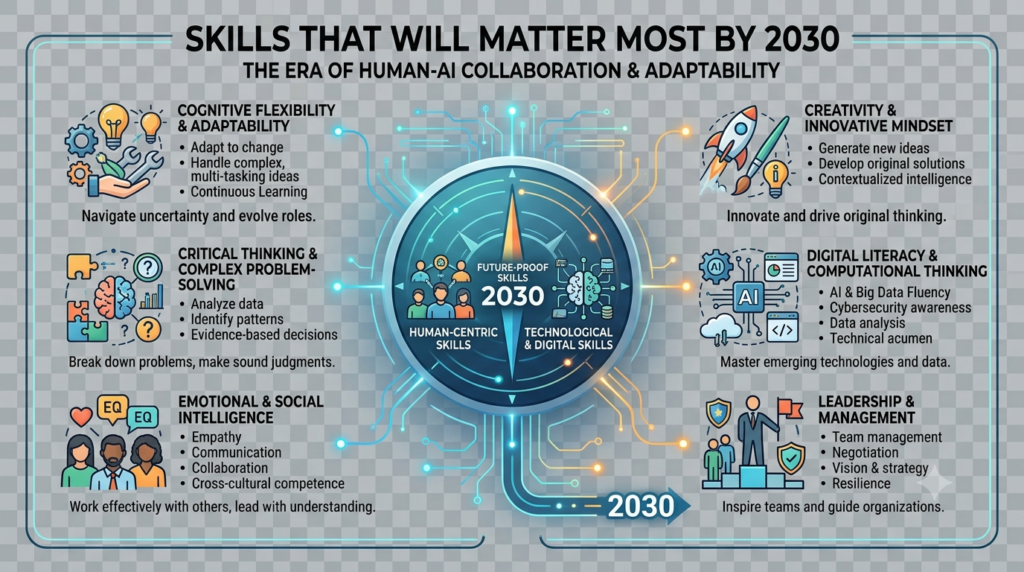
    I’ve gone through reports from WEF, LinkedIn, Deloitte, PwC the same handful of skills keep showing up, no matter the industry:

    • Communication — explaining things clearly, in writing and out loud
    • Critical thinking — evaluating information instead of just absorbing it
    • Creativity — coming up with things AI genuinely can’t originate on its own
    • AI literacy — actually knowing how to use these tools well, not avoiding them out of anxiety
    • Digital skills — basic technical comfort, whatever your field
    • Leadership — guiding people and projects, even without a title yet
    • Adaptability — real comfort with ambiguity, not just tolerating it
    • Problem solving — the thing underneath nearly every job on this list
    • Emotional intelligence — the one thing that’s stayed stubbornly, reliably human

    One thing a lot of people get wrong: your technical skills get you the interview. These are what actually get you promoted.

    How Students Can Prepare Today

    You don’t need your whole career figured out at nineteen. Nobody actually does, no matter what people’s LinkedIn bios imply. A few things genuinely help, though:

    • Take one technical elective outside your major. A coding class, a data course, anything that builds real digital fluency.
    • Get comfortable with AI tools now as a collaborator, not a way to skip your own thinking entirely.
    • Chase internships early, even the short or unpaid ones. The real-world context matters more than it seems like it will at the time.
    • Build a portfolio, not just a transcript. Projects, writing, code these speak louder than GPA in a lot of fields now.
    • Actually talk to people working in the field you’re eyeing. Job titles change faster than the online descriptions of them do.
    • Stay open to trades and vocational paths. A four-year degree isn’t the only way into something stable anymore, and treating it like the only option just closes doors you didn’t need to close.

    Comparison Table: Careers at a Glance

    CareerExpected DemandAverage SalaryDifficultyAI Risk
    AI EngineerVery High$110K–$180K+HighLow
    Cybersecurity AnalystVery High$85K–$140K+Medium-HighLow
    Data ScientistHigh$95K–$155K+HighLow-Medium
    Healthcare ProfessionalVery High$65K–$130K+Medium-HighVery Low
    Renewable Energy EngineerHigh$75K–$130K+Medium-HighLow
    UX/UI DesignerModerate-High$75K–$120K+MediumMedium
    Skilled TradesVery High$55K–$95K+MediumVery Low
    Digital Marketing SpecialistModerate$55K–$100K+MediumMedium
    Mental Health CounselorHigh$55K–$90K+Medium-HighVery Low
    Blockchain DeveloperModerate$90K–$150K+HighLow

    Research Spotlight

    Backlinko’s Google Ranking Factors Study

    Backlinko analyzed millions of results from Google and discovered that top-ranked web pages generally meet search intent. Provide complete answers and generate backlinks by delivering real value and not overstuffing with keywords.

    The study confirms that articles focusing merely on keyword placement are not quite as effective as articles that present original insights, provide practical examples and target the reader’s needs.

    Semrush on Search Intent

    Semrush’s guide to Search Intent says that it’s more important to understand the intent behind a person’s search than to hit the exact keyword phrase.

    Pages that answer follow-up questions, offer comparisons, give actionable tips and answer the user’s entire problem will tend to rank more consistently. This is an ideal use of my experience of making an article better, not longer.

    Frequently Asked Questions

    Is keyword density important at all?

    Yes, but in moderation. Today’s search engines have a better sense of context and semantic meaning, so you shouldn’t be repeating the same phrase or key word in your search copy.

    What is the difference between an article that is ranked for years and for weeks?

    Long-lasting content tends to have a strong focus on search intent, be original, be experiential, include internal linking, and feature updated information.

    Is there a relationship between article length and performance

    No. A short article that is able to answer 100% of the reader’s problem can, in many ways, outperform a much longer article that contains redundant or needless information.

    What is the importance of internal linking?

    Internal links can help search engines navigate your site and can direct your readers to other relevant resources on your site and external links. They also spread out the power in your pages and enhance the overall user experience.

    What is the biggest SEO error made by the newbies?

    A lot of newbies write for the algorithms, not humans. They pay close attention to the keywords they’re targeting, and ignore the things that really matter like readability, search intent and original content.

    Final Thoughts

    I’ve seen dozens of articles written saying that some secret formula exists to get good rankings. I’ve come to understand that there is no such thing as SEO; it is actually about being helpful.

    Optimization tools, internal links, headings and keywords have a role to play, but they are just tools. The actual purpose of your article is to assist the other individual who clicked your article to find the answer they were seeking.

    The more I took the time to think “How do I make this genuinely helpful?” instead of “How do I rank this?” the better my results were. This will be my rule from now on: In all my articles, I will produce a piece that is both informative and entertaining.


  • Why Your Daily Work Choices Matter More Than Your Job Title

    Why Your Daily Work Choices Matter More Than Your Job Title

    Introduction

    Your calendar says something else entirely and honestly, the calendar is the one telling the truth. That’s the whole idea behind daily work choices mattering more than the title printed under your name.

    Most of us spend years chasing a bigger title, assuming “Senior This” or “Director of That” will finally make the job feel different. Then it arrives, and… Monday still feels like Monday. What actually shifts things is smaller and less flattering to talk about: which email you answer first.

    Whether you protect two hours for real work instead of letting your calendar eat them, how you handle it when a coworker drops the ball. There’s research behind this too one workplace study found people credited. Roughly twice as much of their career success to habits as they did to individual decisions or raw talent.

    What “Daily Work Choices” Actually Means

    Nobody’s talking about grand gestures here. Daily work choices are the boring stuff whether you read the whole email before firing back a reply. Whether you say the awkward thing in a meeting instead of letting it slide.

    None of that shows up on an org chart, and none of it feels like a big deal in the moment. But a study of more than 1,800 employees found habits the routine. Repeated stuff outweighed both decision-making and natural talent as the biggest driver of career success.

    People attributed close to 46% of their success to habits, versus about 22% to individual decisions. Your title tells people what you’re technically allowed to do. Your daily choices show what you actually do with that permission .

    The Data: Titles Don’t Predict Engagement, Behavior Does

    If titles really drove workplace success, you’d expect engagement scores to rise with every promotion. Gallup’s 2026 State of the Global Workplace report puts global engagement at around 20%, with 64% of employees not engaged and another 16% actively checked out.

    The that pattern holds across seniority levels, not just at the bottom. Managers, in fact, report more stress, anger, sadness, and loneliness than the people they manage despite outranking them on paper.

    A bigger title doesn’t seem to buy anyone a better Tuesday. What actually correlates with better outcomes is behavior. Gallup’s research shows managers account for roughly 70% of the variance. How engaged their teams are, which is a statement about what people do, not what’s on their badge.

    Even something as simple as where people work shows this Gallup data puts engagement. About 20% for on-site employees versus 29% for remote workers and 21% for hybrid a pattern shaped by daily structure and habits, not job titles.

    The Research World Agrees: “Success” Has Quietly Been Redefined

    Organizational psychologists have been circling this for a while now. A 2025 review of career-success research points out that while salary, title, and promotions still matter. They no longer fully capture what people actually mean when they say their career is going well

    Another major review, published in the Annual Review of Organizational Psychology and Organizational Behavior, found the traits most consistently linked to career success weren’t grand strategic plans at all.

    They were things like a proactive personality, being politically savvy, having a real network, and staying adaptable. Interestingly, rigid long-term career planning showed up as less consistently important than expected.

    None of those winning traits are titles. They’re daily behaviors, repeated so often they start to look like personality.

    A Few Stories That Make This Concrete

    The “junior” who quietly out-performed the senior hire. A mid-sized marketing agency brought in someone with an impressive title from a competitor, expecting an instant lift.

    Six months later, that hire’s campaigns were underperforming not from lack of skill, but from small gaps: missed check-ins, feedback that arrived a week too late.

    Meanwhile, a junior associate on the same team had built a quiet reputation around three habits daily client updates. Same-day revisions, flagging risks before they became fires. That associate ended up running the agency’s biggest account. Title didn’t predict the outcome. Discipline did.

    The engineer everyone trusted, with no “lead” in his title. At a distributed software company. One engineer became the person everyone routed the hardest problems to, despite having no formal authority.

    His habit was almost embarrassingly simple: he closed every open conversation before the end of his day and wrote things down so nobody had to ask twice. When a lead role opened up, he was the obvious pick not because he’d campaigned for it, but because his behavior had already made the case.

    The director who had the title but lost the team. A newly appointed director inherited a strong team, then rarely showed up for one-on-ones. Let messages sit for days, skipped retros when things got busy. Within a year, three top performers had left.

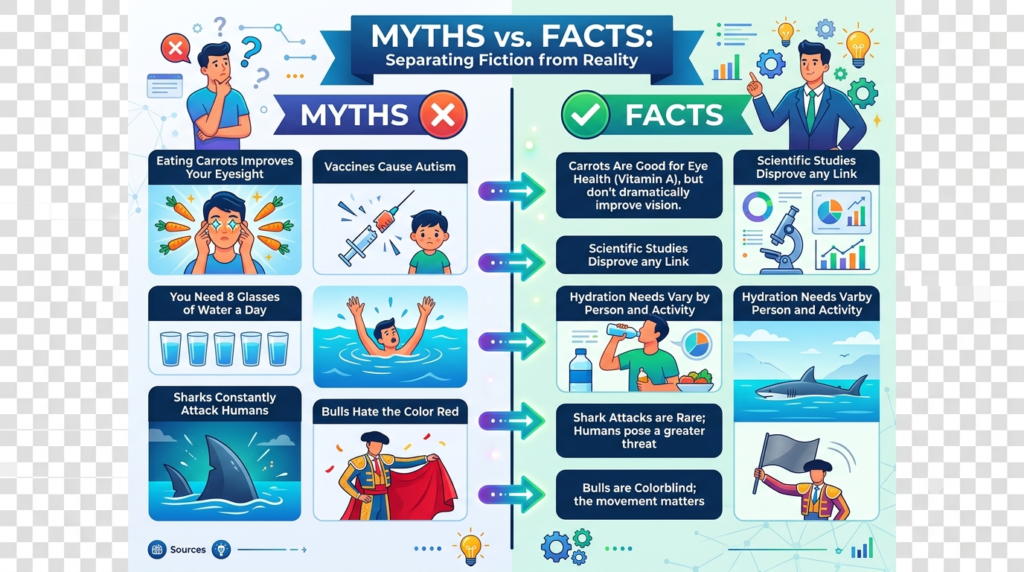
    Myths vs. Facts

    MythFact
    A senior title automatically earns respectRespect tends to follow consistent, reliable behavior over time, not rank
    Career success mostly comes down to a few big decisionsHabits appear to outweigh individual decisions as a predictor of success
    Remote workers are less engaged without office visibilitySome engagement data shows remote workers reporting higher engagement than on-site staff
    Once you hit a senior title, the hard part is overHigher-ranking employees often report more stress and lower wellbeing, not less

    Small Daily Choices Worth Making on Purpose

    • Protect one real focus block a day. Even 60 uninterrupted minutes, done consistently, tends to beat the occasional all-nighter.
    • Close the loop before opening a new one. Half-finished things quietly chip away at trust; finished ones build it back up.
    • Ask the clarifying question before you assume. It’s a two-minute conversation that saves an afternoon of rework.
    • Give feedback the same week, not the same quarter. Being timely matters more than being polished.
    • Say what you’re going to do, then just… do that. Reliability is built one kept promise at a time, nothing flashier than that.

    A Few Traps Worth Avoiding

    1. Waiting for a title change before you let yourself change your behavior.
    2. Mistaking busyness for follow-through they’re not the same thing.
    3. Assuming visibility to leadership matters more than reliability to the people beside you.
    4. Letting communication slide “because it’s not urgent yet” until it is.
    5. Measuring your week by hours logged instead of promises kept.

    Research Spotlight

    Microsoft’s Growth Mindset Transformation

    The transformation of Microsoft under Satya Nadella, who was named CEO in 2014, didn’t start with new titles or reorganized departments. It kept leading instead by altering commonplace actions.

    They promoted the adoption of a learn-it-all, not a know-it-all mindset and working across teams, plus more questions asked instead of solutions sought, and life-long learning.

    Toyota Production System

    Through Kaize continuous improvement Toyota earned a position as one of the most respected manufacturers in the world. In the day to day work every employee not just management is empowered to find and suggest solutions for inefficiencies.

    Instead of depending entirely upon high-level management to rectify issues, Toyota gives authority to employees on the work floor to halt manufacture if they identify quality problems.

    Questions People Actually Ask

    Does a job title matter at all?

    Sure, for the outside world pay bands, hiring decisions, how you show up in a LinkedIn search. But day-to-day, the trust and influence you actually feel at work comes from behavior, not the label on your badge.

    Can habits really outweigh talent?

    The research suggests habits are a steadier, more consistent predictor of career outcomes than raw talent or big decisions mostly because habits happen every day, while decisions happen occasionally.

    Why do people with senior titles sometimes seem more stressed, not less?

    Higher-ranking roles usually come with more responsibility and visibility, which can raise stress even as authority goes up. Title and wellbeing just aren’t tracking the same thing.

    How do I actually start changing my daily choices without overhauling my whole routine?

    Pick one thing — say, closing communication loops the same day they open — and stick with it for two weeks before adding anything else. Small and sustained beats big and short-lived.

    Does working remotely hurt engagement?

    Not necessarily. Some data shows remote employees reporting engagement on par with, or even higher than, in-office peers, depending on the company.

    Is it still worth planning my career if habits matter more?

    Yes just hold the plan loosely. It’s more of a compass than a guarantee. The research points to adaptability and daily behavior mattering more consistently than the plan itself.

    What’s the fastest way to build trust at work?

    Consistency on small stuff. Trust almost never comes from one big win it comes from a lot of kept promises nobody was really watching for.

    Conclusion

    Nobody remembers a coworker for their job title. They remember whether that person showed up, followed through. And made the people around them a little better at their own jobs.

    Daily work choices are the whole film. If you want next year’s career story to read differently, the fastest rewrite probably isn’t a promotion it’s picking one small daily habit worth repeating and actually starting it today. So, what’s the one thing you’ll do differently tomorrow morning?


  • How to Build a Personal Brand: A Real Beginner’s Guide

    How to Build a Personal Brand: A Real Beginner’s Guide

    Introduction

    Someone asked me this a couple weeks ago, actually why bother figuring out. How to build a personal brand when their job’s fine and they’re not trying to be an influencer. Good question, here’s the thing I told them: your brand exists whether you build it on purpose or not.

    Someone forms an opinion of you off your LinkedIn photo, whatever you last posted (or didn’t). And whatever pops up when a client Googles your name five minutes before a call. You don’t get to opt out of that. The only real choice is whether you shape it or just… let it happen.

    That’s really what learning how to build a personal brand comes down to. Not becoming a LinkedIn influencer, not posting a motivational quote every Monday morning. Just making sure the version of you that shows up online is actually the one doing you justice.

    Why Bother Learning How to Build a Personal Brand in 2026

    I’ll just say it: the timing matters more now than it did three or four years ago. Search has quietly changed underneath everyone. A huge chunk of Google searches now end without a single click. Because an AI summary just answers the question right there on the results page.

    Which changes things. Existing online isn’t enough anymore you need to be known for something specific, so when someone (or, weirdly, some AI model crawling the web) is trying to figure out who’s actually credible in your space, your name is one of the ones that comes up.

    Build Trust with an Authentic Personal Brand

    There’s a trust piece too, and it’s not small. People trust other people even total strangers more than they trust a company’s messaging. That’s not fading either; if anything it’s getting stronger, mostly because feeds are filling up with content.

    Funny enough, the more automated everything gets.The more an actual human voice sticks out.None of that means posting five times a day.

    It means being deliberate about the two or three things you want to be known for, instead of hoping people just figure it out.

    How to Build a Personal Brand

    It’s not necessary to be an influencer or post every day to develop a personal brand. It starts with understanding what you’re good at, from self-presentation. And from regularly spreading value to the right audience.

    Step 1: Get Honest About What You’re Known For

    Before you touch a single profile setting, sit with this question for a second. If three people who’ve actually worked with you had to describe what you’re good at, in one line, what would they say? Not your job title. What you actually help people with.

    This trips almost everyone up, because most of us are decent at five or six different things.Trying to brand yourself around all of them just makes you forgettable.

    Pick the one or two threads that keep showing up in your actual work and lead with those. A marketer who’s “good at everything” disappears into the noise there are a thousand of those. A marketer specifically known for turning dry B2B products into content people actually want to read?

    That sticks. Memorable is the whole game here.

    Question to Ask YourselfWhat It Tells You
    What do colleagues ask me for help with most?Your natural area of authority
    What do I talk about without being asked?What actually interests you long-term
    What result have I gotten repeatedly?Proof you can point to, not just claims

    Step 2: Pick One Platform and Actually Commit

    This is where I watch people quietly sabotage themselves, over and over. They sign up for LinkedIn, X, Instagram, and a newsletter in the same week, post twice on each, and burn out inside a month. Please don’t do that.

    For most professionals and founders, LinkedIn’s still the strongest place to start it’s where hiring and referrals and actual B2B relationships happen. A complete profile genuinely pulls more attention than a half-filled one.

    If you’re more consumer-facing or creative, Instagram or short-form video probably fits better. Either way pick one, Get decent at it. Only bother with a second platform once the first one stops feeling like a chore.

    PlatformBest For
    LinkedInProfessionals, consultants, B2B founders
    InstagramConsumer brands, creatives, visual work
    A personal websiteOwning your identity outside of algorithms

    Step 3: Fix Your Profile Before You Post Anything

    Before you start posting content, optimize the key elements of your profile:

    • Don’t post before optimizing your profile: A profile isn’t complete unless you post content, so don’t post before you optimize your profile. A really good post can fall flat if readers go to a profile page that wasn’t well written to explain who you are and what you do.
    • Create a well-worded headline: Do not use an internal job title which only employees at your company could understand. Rather, describe your actions and how you provide support to others in terms that are simple and easy to understand.
    • Improve your About section: Your About section should not be a long list of job titles, dates, and responsibilities.That’s a resume! Write it like you’re introducing yourself to a new person; explain what you have to offer.
    • Use a professional headshot: Use a clear, professional quality photo of yourself. Do not have a blank avatar, logo or a photo of a group where everyone is blurry in these ways, your profile may seem less reliable and professional.

    Step 4: Build a Simple Content Rhythm

    In building a personal brand, remember that consistency is more important than perfection:

    • Post consistently, not daily: It’s better to post two or three times per week for several months than to post heavily for a few months and then not post again for a long time.
    • Share real experiences: Discuss what you have learned, what you have done wrong. What questions customers to often ask, or what you have learned from the work you do every day.
    • Be authentic instead of perfect: Your content is more relatable and memorable because it’s in the form of a personal story, honest experience, and practical example.
    • Create content people can connect with: People are more likely to connect with content that is based on authentic experiences rather than overly polished content that sounds like everyone else’s.
    Content TypeWhy It Works
    Lessons from real mistakesFeels honest, not performative
    Answers to questions you get oftenSolves a real problem for your audience
    Opinions with a clear point of viewMakes you memorable, not generic

    How to Build a Personal Brand Without Sounding Like Everyone Else

    Here’s something worth just saying plainly: a huge amount of content online right now sounds identical. Mostly because so much of it is quietly AI-written and never actually edited into a real voice afterward.

    That’s not a knock on using AI for a rough first draft it’s a warning about hitting publish on that first draft unchanged. The people actually cutting through right now are the ones willing to sound a little rough around the edges. A little too specific, a little unfinished.

    Write in Your Authentic Voice

    What a real person sounds like, and somehow audiences can tell the difference even when they can’t quite explain how. If you’re stuck on tone, try this small trick. Write it the way you’d explain something to a smart friend over coffee, not the way you’d write a company announcement.

    Then read it out loud. If it sounds like something a brand would say rather than something you’d actually say, rewrite it.

    Mistakes That Quietly Kill a Personal Brand

    If you are looking at creating a strong and credible personal brand, take care of these common mistakes:

    • Posting inconsistently: Be inconsistent about posting for a couple of weeks and then not posting for months. It is like losing trust and momentum that you’ve built. It’s better to be consistent than to have bursts of activity.
    • Excessive jargon: (Write as people speak). Short, simple, and easy-to-understand language is easier to understand and gets your audience to relate to you.
    • Only looking at vanity metrics: Do not rely on impressions, likes or followers as the sole measure of success. It’s much more important to reach the right people and establish meaningful relationships.
    • Connecting with everyone without purpose: Building your network is important, but by including random people without a reason. Your profile might seem active but not come across as having a recognizable identity. Work on building relevant links in your niche or field.
    MistakeFix
    Posting inconsistentlyPick a realistic frequency and stick to it
    Sounding generic or jargon-heavyWrite like you talk, not like a press release
    Chasing every platform at onceMaster one before adding another
    Treating your profile like a resumeWrite it around the value you offer, not your job history

    Where Personal Branding Is Headed

    The direction seems fairly clear at this point: less about volume, more about being unmistakably known for one specific thing. As AI tools shape more of how people get discovered in the first place.

    The professionals who come out ahead are the ones with a clear. Consistent point of view one that both humans and algorithms can actually recognize.

    Imperfection, oddly, is turning into a credibility signal instead of something to hide. It’s basically proof that a real person, not some content pipeline, is behind the profile.

    Personal Branding Success Stories

    HubSpot – What Is Personal Branding?

    According to HubSpot, Personal branding is about intentionally crafting the way in which people perceive your expertise and values.

    Many professionals regularly post helpful and valuable information on LinkedIn, blogs, and more providing the opportunity to generat

    Neil Patel – Turning Expertise into a Global Brand

    Neil Patel For years, he has been creating personal brand by creating free and quality content on SEO and digital marketing. He has made himself one of the most well-known experts in the digital marketing industry, posting blogs, creating YouTube videos and podcasts.

    Justin Welsh – Building a One-Person Business

    Justin Welsh Shed the corporate world and dedicated himself to promoting his personal brand on LinkedIn as a SaaS executive. By consistently sharing practical business lessons, entrepreneurship insights individual’s reputation into a sustainable business.

    Final Thoughts

    No need to be your own new person in all this! Be honest about who you are, pick one platform and get your profile set up, and then post as you, not a caricature of everyone else.

    That’s really most of the way to building a personal brand that really works over time, rather than a viral moment. Perform fewer actions than you believe you should. Simply begin and fine tune the process along the way.How long does it take to have a personal brand?

    Frequently Asked Questions

    How long does it take to have a personal brand?

    In practical terms, it could take a couple months of consistent work before it feels as if you’re doing something.

    Should I have to be active on all social media sites?

    The worst thing to do through a burn-out is to try, and say no. Target that one platform that users are truly on and go there first.

    What is the worst thing that you see novices do when they begin building a personal brand?

    Inconsistency, hands down. The length of time that people cannot post leads to a loss of all of the trust built during the periods of posting.

    Personal branding is truly self-promotion?

    Not really, no. Good personal brands are those that are ongoing and deliver real value or insight; self-promotional brands that contain no value will not hold anyone’s attention.