
Introduction
1 am. Ceiling, and your brain decides now is the time to replay something you said three days ago.
Sound familiar? Yeah, most of us know this one too well. That’s exactly why the overthinking psychology behind this pattern matters. it explains why your mind won’t switch off, and more importantly, what to do about it.
Susan Nolen-Hoeksema, a sociologist, ran a study and found something worth mentioning close to 73% of people aged 25 to 35 deal with overthinking regularly.
What Overthinking Actually Is
Thinking, in itself, is fine. However, overthinking is when thinking stops helping and just… keeps going. No destination.
A little reflection teaches you something. You learn, then you move on. Overthinking, on the other hand, doesn’t do that part. Same worry, again, again, again never landing. Interestingly, psychologists don’t call overthinking a disorder by itself.
Instead, it’s more of a symptom, anxiety, depression, old trauma it tends to ride along with one of those. Still, even without a clinical label, it wrecks your sleep. Your focus too. Ask anyone who’s had a bad week of it.
The Psychology Behind Overthinking
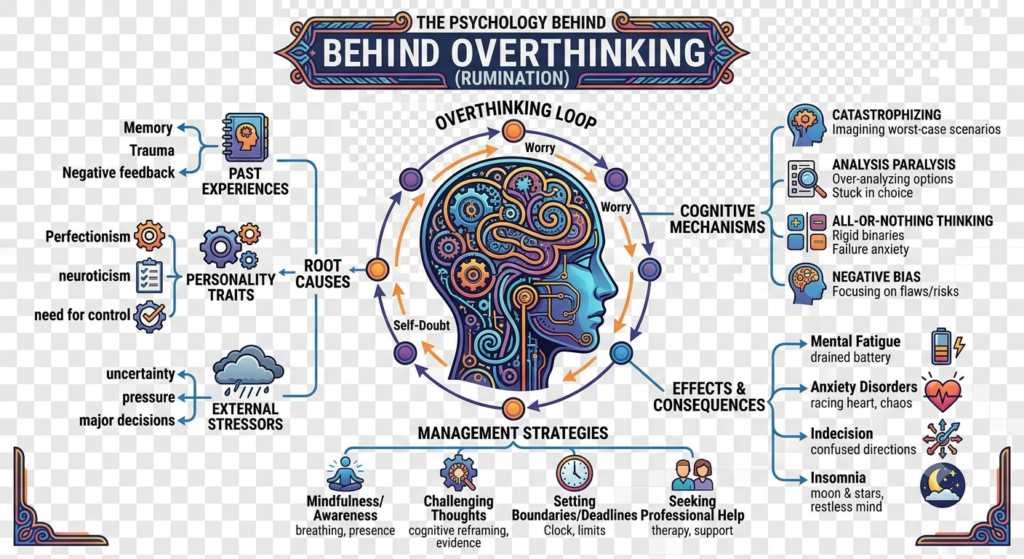
So what does overthinking psychology actually say about why this happens? Mostly, it comes down to two types.
Rumination (Past-Focused Thinking)
Rumination looks backward — why did I say that, I should’ve done it differently.
Worry (Future-Focused Thinking)
Worry, meanwhile, looks forward — what if this goes badly, what if they’re upset now.
Different direction. Same engine, though. A mind that simply won’t let go.
| Type | Focus | Typical Thought |
|---|---|---|
| Rumination | Past | Why did this happen |
| Worry | Future | What if it goes wrong |
Most people aren’t purely one type. You might ruminate over something from work in the morning, and by evening, you’re worrying about tomorrow. That’s just how it moves not a straight line, more like bouncing between things until it finally sticks somewhere.
What separates ordinary thinking from overthinking, therefore, isn’t the topic. It’s whether it ever resolves. Reflection ends. Overthinking, in contrast, doesn’t.
Why the Brain Gets Stuck in Overthinking
This bit surprises people, usually. Overthinking isn’t a willpower thing. Rather, it’s closer to a habit and there’s neuroscience behind why.
Neuroplasticity Makes Overthinking a Habit
Repeated thoughts strengthen the pathways behind them. This is neuroplasticity. As a result, your brain gets efficient at whatever it does most, even if that’s worrying. So the more you ruminate, the easier ruminating gets. It’s a groove, deepening a little more each time you walk it.
The Default Mode Network Keeps the Loop Going
There’s also the default mode network active during inward, self-focused thinking. This is exactly the kind of thinking that fuels overthinking psychology at a biological level. Once it stays switched on too long, shifting focus elsewhere gets hard.
Here’s the trap, though: overthinking feels productive. It feels like one more round of analysis will finally bring certainty. It won’t. But that feeling is exactly why the loop keeps running.
Signs of Overthinking, Not Just Reflection
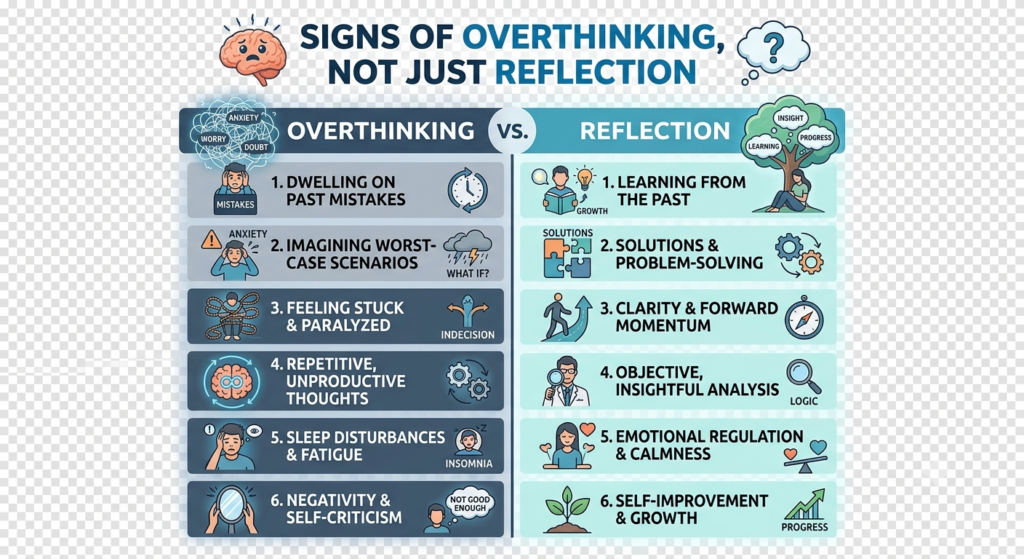
Quick check, then.
Hours instead of minutes? Ends in a decision, or nowhere? Clearer afterward, or just tired? Focused on the situation, or on blaming yourself?
| Sign | Reflection | Overthinking |
|---|---|---|
| Time | Minutes | Hours, days |
| Result | A decision | Nothing |
| After | Clear | Drained |
Generally, if tired beats clear, that’s your answer.
Root Causes Behind Overthinking Psychology
Rarely comes from nowhere. Usually, there’s a root.
- Perfectionism: fear of the wrong choice.
- Old criticism or trauma: always on edge, watching yourself.
- Big transitions: new job, breakup, new city.
- Trouble with uncertainty: needing to know outcomes before they happen.
- High expectations, yours or someone else’s: overanalyzing so nobody’s disappointed.
Some people overthink because they genuinely care about the people around them. Others hit it during life shifts divorce, career change when the future suddenly stops feeling predictable. Either way, it shows up right when certainty is hardest to find.
What Overthinking Actually Costs You
Not just uncomfortable. In fact, it’s measurable.
It’s linked to higher anxiety, low mood, and burnout. Consequently, it shows up physically too headaches, bad sleep, fatigue.
Overthinking Reduces Mental Flexibility
There’s a 2023 study, BPS Global Open Science, that found chronic overthinkers show less mental flexibility. In other words, they get stuck in loops instead of adjusting. That same rigidity turns small things into threats a late reply “means” someone’s upset, even when it doesn’t mean anything at all.
Overthinking Affects Relationships and Presence
There’s also a cost people miss. You’re present, physically, with someone. Yet half your head is somewhere else an old worry, a new one. Ironic, really. The more you overthink to avoid messing things up with people. The more you end up missing what’s happening right there in front of you.
Breaking the Cycle of Overthinking
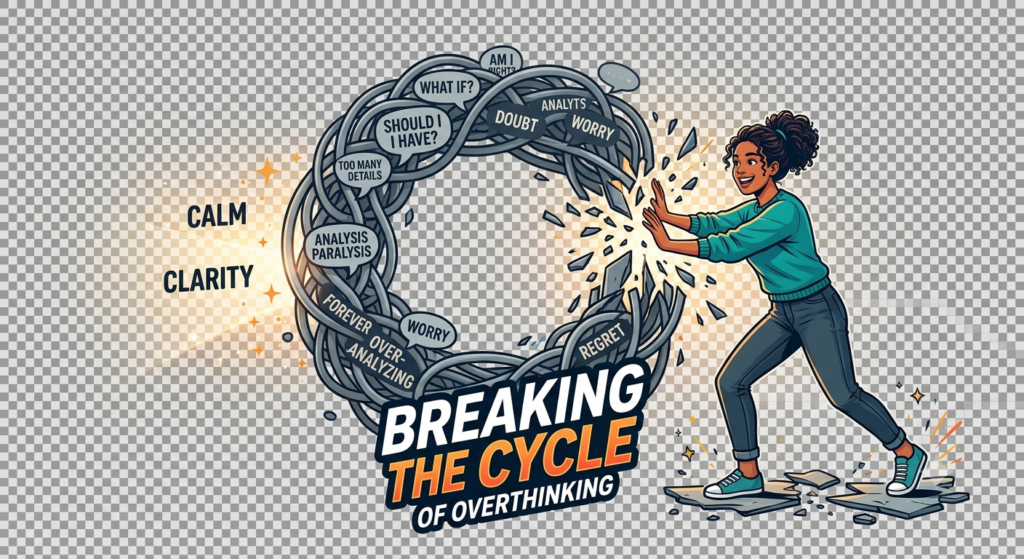
No single fix, unfortunately. Instead, it’s small habits, repeated, until they stick.
- Recognize and Name the Thought Pattern: Name it first. Just “I’m overthinking right now” creates a gap. Small, but that’s where change starts.
- Set a Time Limit for Worry: Ten minutes, worry on purpose. Once the timer’s up, redirect. Sounds too simple, yet it works anyway, because it lets your brain stop chasing closure it won’t find.
- Redirect Your Mind with Physical Activity: Move next. Walk, workout, anything physical. This pulls you back into your body, and out of the loop.
- Write Your Thoughts in a Journal: Also, write it out. Vague thoughts, once on paper, get easier to look at and easier to release, too.
- Talk to Someone You Trust: Finally, talk to someone. Overthinkers tend to assume their thoughts are airtight. A second opinion cracks that open fast.
- Practice These Habits Consistently: None of it erases overthinking completely. Nothing really does. But used often enough, it shrinks from something running your day into something you manage.
When to Get Help for Overthinking
Sleep’s off, Work’s suffering, Relationships too. Or it feels tangled with anxiety, depression, something older. At that point, it’s time to talk to someone licensed.
Overthinking isn’t a diagnosis by itself. Often, though, it’s a sign of something underneath. A therapist helps find that root not just manage the surface, over and over.
Exhausting, overthinking is, But not permanent. It’s a habit the brain picked up which means it’s one it can drop, too. You don’t need a perfect answer to every “what if.” Just enough space to stop asking long enough to live your life.
Research Spotlight
Mindfulness Reduced Rumination
Researchers examined adults who completed an 8-week Mindfulness-Based Stress Reduction (MBSR) program. After the program, participants showed lower levels of rumination, fewer depressive symptoms, and improved overall well-being.
Treating Rumination Directly Improved Recovery
A PubMed case report described a woman who struggled with chronic rumination for nearly 20 years. Instead of treating only the underlying diagnosis, clinicians focused directly on reducing repetitive thinking.
Frequently Asked Questions
No. Usually, it’s a symptom riding along with anxiety or depression, not a standalone diagnosis.
Not really, despite the myth. Overthinking runs on anxiety and fear of uncertainty, not IQ.
Yes, largely. Neuroplasticity and the default mode network both play a role, which is why the habit feels automatic rather than chosen.
Usually, yes. It puts vague thoughts into words, and words, in turn, are easier to examine than a loop stuck in your head.
Related, but not identical. Anxiety is broader emotional and physical. Overthinking, meanwhile, is more of a thought pattern that anxiety often fuels.
Final Thought
Exhausting, overthinking is. But not permanent. It’s a habit the brain picked up which means it’s one it can drop, too.
So, start small, Catch the loop, Set a limit, Move, Write it down.
You don’t need a perfect answer to every “what if.” Just enough space to stop asking long enough to live your life
Leave a Reply