Introduction
I’ve noticed something after years of writing and editing SEO content: the pages that flop almost never flop because the writing is bad. They flop because they answer a question nobody actually asked. Keyword research is the fix for that.
In fact, it’s just listening, really. You find out what people are typing into Google before you write a word for them. However, this isn’t the old “find high volume, low competition” trick from a decade ago.
AI Overviews eat clicks now, attention spans are shorter, and Google rewards different things than it did even two years back.That’s why, if you’ve been wondering how to do keyword research.
What Keyword Research Really Means
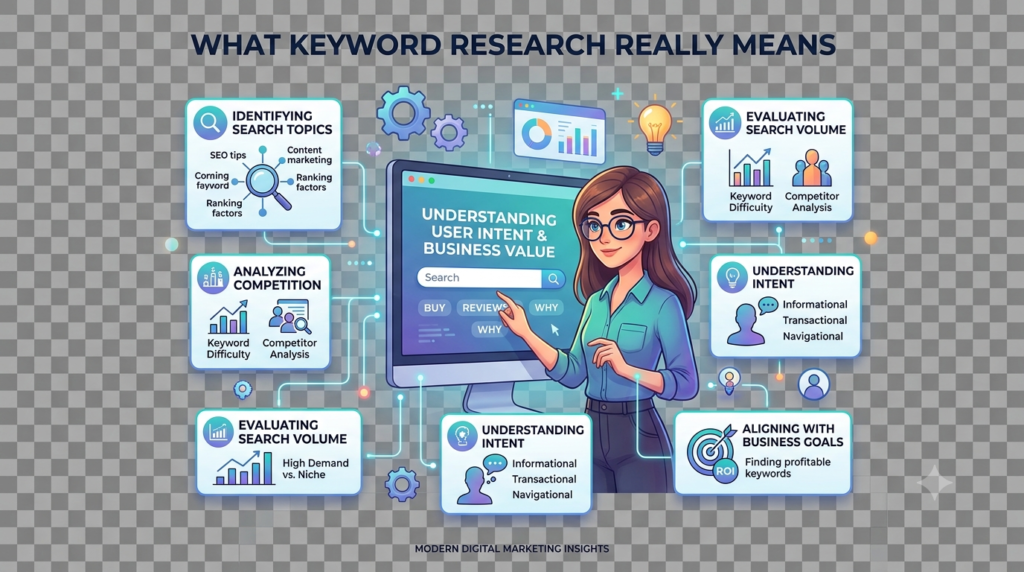
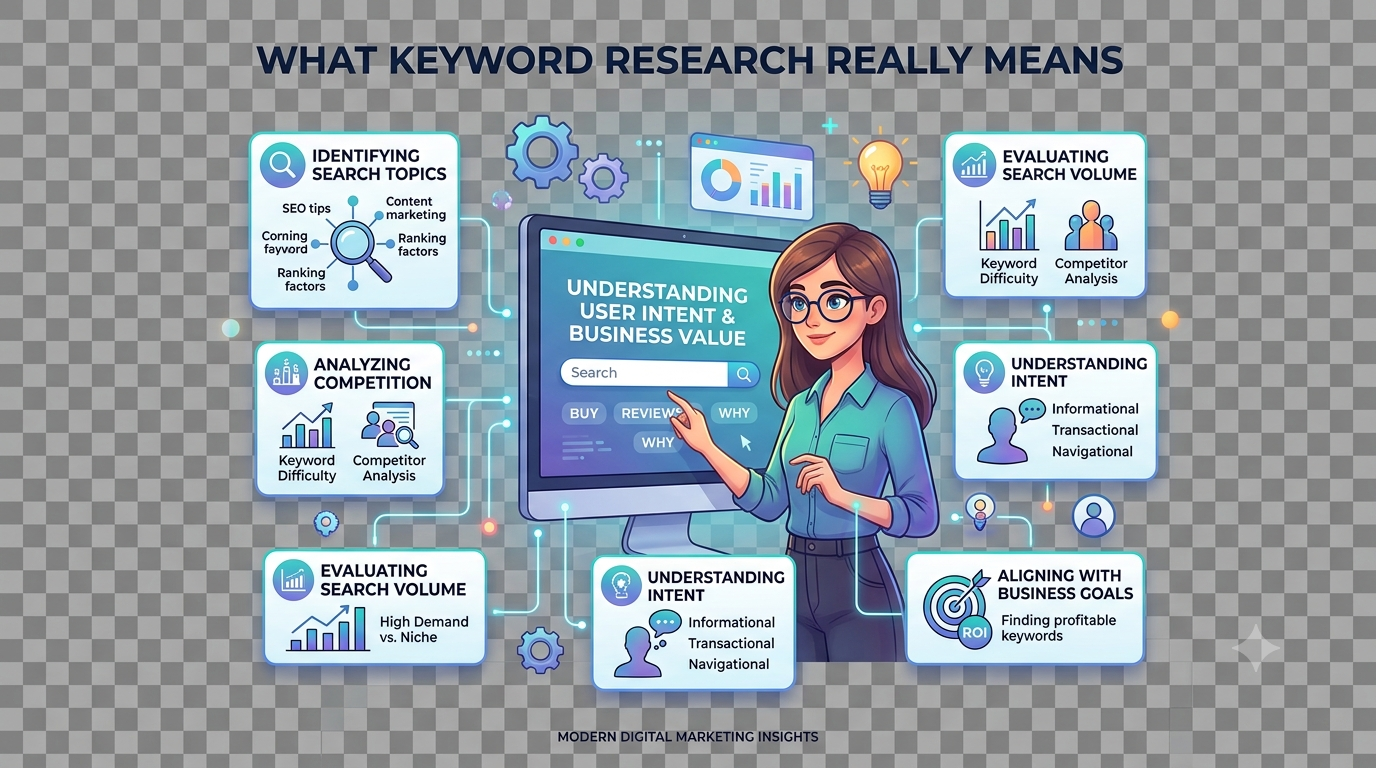
Boiled down,Simply put, keyword research is figuring out. Keyword research is figuring out the exact words real people type or say into a search engine, then shaping your content around that. Sounds easy on paper.
However, it’s no mostly because there are three separate questions bundled into one: what are people searching, why are they searching it, and can you realistically win that search.
Learning how to do keyword research properly really just means getting comfortable answering all three, every single time.Here’s a number that surprises most beginners. About 95% of all keywords get ten or fewer searches a month, per Ahrefs’ data.
Meanwhile a tiny sliver, roughly 0.16% of keywords, soaks up 60% of total search demand. Everyone’s fighting over that sliver. Instead, the real openings sit in the long, unglamorous tail nobody bothers checking.
Does It Still Matter With AI Search Around?
Fair question, honestly. After all, AI Overviews now reach now reach 1.5 billion people a month and cut click-through rates by something like 34%. Early 2026 data shows 68% of US Google searches ending with zero clicks, up from 60% two years earlier. So yes, the ground has shifted Even so, organic search still accounts.
How AI Overviews Have Changed Search
Organic search still accounts for roughly 53% of all website traffic, and Ahrefs looked at 863,000 SERPs. And found AI Overview citations still lean heavily on whatever’s already ranking in the top ten. Ranking the normal way is still, weirdly, your best shot at getting quoted by the AI too.
Why Keyword Research Still Matters
Long-tail search is where the real leverage sits nowIn addition, they convert about 2.5 times better than short, generic terms.
How to Do Keyword Research: The Actual Process, Step by Step
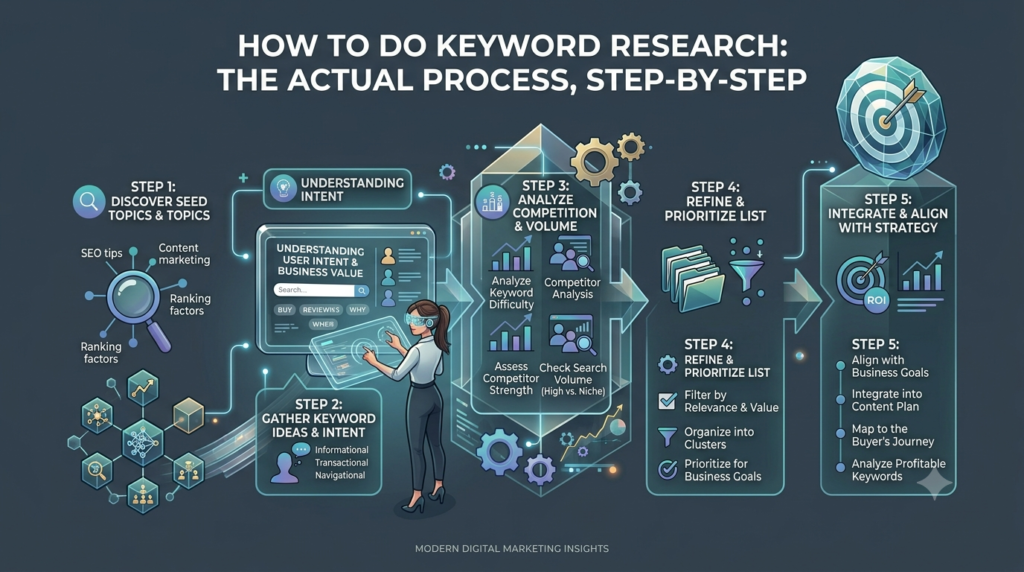
Here’s roughly how experienced SEOs go about it. It’s not a rigid formula, more of a habit you build over time.
Step 1 — Seed Keywords First
To begin with, pick three to five broad obvious terms tied to your business. Sell hiking boots? Your seeds might be “hiking boots,” “trail shoes,” “waterproof boots.” Don’t agonize over this partInstead, focus on coverage not precision. Precision comes later.
Step 2 — Expand the List
Drop those seeds into a keyword tool and you’ll get back hundreds of related phrases and questions. There’s also a manual trick Ahrefs recommends: Google your seed term, find a competitor ranking well, plug their domain into something like Site Explorer.
You will see which keywords actually bring them traffic. Do this for two or three competitors and your list grows fast, without much guessing on your end.One thing worth knowing: don’t trust a single tool blindly.
Difficulty scores swing a lot between platforms. Semrush often reads 10 to 15% higher than Ahrefs for the exact same keyword.
Step 3 — Check Search Intent
This is the step almost everyone skips, and it’s the one that matters most. If a keyword’s intent doesn’t line up with what your page can genuinely deliver, drop it. High search volume doesn’t rescue a mismatched keyword.
Search intent usually breaks into four types.
| Intent Type | What the Searcher Wants | Example Query |
|---|---|---|
| Informational | An answer or explanation | “how does keyword research work” |
| Commercial | Comparing options before buying | “best keyword research tools” |
| Transactional | Ready to act, usually buy | “buy Ahrefs subscription” |
| Navigational | A specific website or page | “Ahrefs login” |
Search your target keyword yourself before writing a single sentence. If the top results are mostly how-to guides, write a how-to guide.
Google’s already telling you what format wins. Ahrefs saw this firsthand their own “backlink checker” page jumped 516% in traffic within six months, just from adding the free tool people expected to find there.
Step 4 — Weigh Volume, Difficulty, and Value Together
No single number tells the whole story here. A keyword with huge volume and brutal difficulty might be unwinnable for a small site. A keyword with tiny volume but strong buying intent can outperform ten “easy” keywords put together.
Ahrefs frames it well: keyword research is a balancing act between traffic potential, difficulty, business value, and intent, not a hunt for whatever’s “easy.” Plenty of people chase easy-but-irrelevant keywords and end up with traffic that doesn’t pay the bills.
Step 5 — Cluster, Don’t Chase
Modern keyword work revolves around topics, not isolated terms. The sites pulling in the most organic traffic build out full topical coverage instead of picking off keywords one at a time.
Group keywords that share intent under a single, well-built page rather than writing five thin posts for five variations of the same idea. One solid page will naturally rank for dozens of related terms on its own. Chasing keywords individually just wastes effort.
Step 6 — Map and Prioritize
Before building anything, decide what you’re actually optimizing for: rankings, traffic, or revenue. The answer changes your priority list. Rankings favor topical coverage and closing competitor gaps.
Traffic favors high-volume terms even if commercial intent is weak. Revenue favors transactional, bottom-of-funnel keywords.Put it all in a plain spreadsheet: keyword, intent, volume, difficulty, priority, assigned page. That’s what actually turns research into something you can act on.
Free vs. Paid Tools
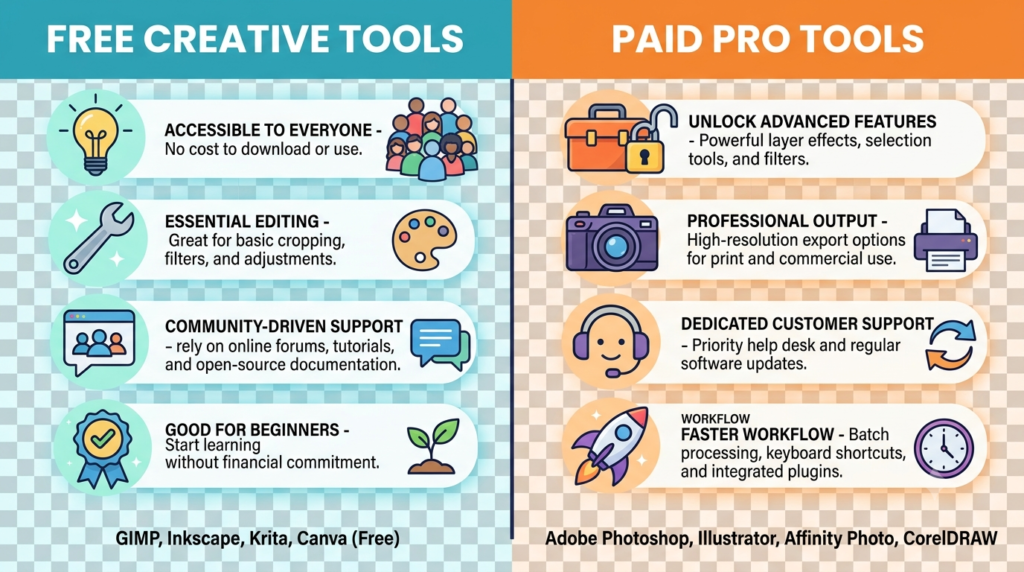
You don’t need a big budget to start. Google Search Console works best once your site already has content, since it shows real queries and real clicks straight from Google. Google Keyword Planner suits brand-new sites needing a baseline volume check.
If you’re figuring out how to do keyword research on a tight budget. This is genuinely where I’d start before spending a rupee on anything else. Paid tools start earning their keep once you need competitor gap analysis or sharper difficulty scoring at scale.
| Tool | Best For | Free Option | Paid, Starting At |
|---|---|---|---|
| Google Keyword Planner | Baseline volume checks | Yes, free with Google Ads account | Free |
| Google Search Console | Sites with existing content | Yes, unlimited | Free |
| Ahrefs | Competitor and backlink research | Limited keyword generator | ~$107/month |
| Semrush | All-round SEO teams | Limited daily queries | ~$139.95/month |
| Moz Keyword Explorer | Teams already using Moz | 3 searches/day | ~$49/month |
| Mangools KWFinder | Budget niche sites | 5 searches/day | ~$29.90/month |
| Ubersuggest | Beginners, solopreneurs | 3 searches/day | $12–$40/month |
Mistakes People Keep Making
None of these are exotic. They’re the same handful of traps, over and over, and honestly. Half of learning how to do keyword research well is just avoiding them consistently.
| Mistake | Why It Backfires | Fix |
|---|---|---|
| Chasing volume over intent | Ranking #1 for a term that never converts is a hollow win | Filter every keyword through intent first |
| Trusting one tool | Volume and difficulty numbers shift a lot between platforms | Cross-check at least two tools plus Search Console |
| Skipping the actual SERP | Tool data pulls focus away from what’s really ranking | Check the top 10 manually before committing |
| Trusting KD scores blindly | A “15” difficulty score isn’t a promise of a ranking | Look at who’s ranking and how well they cover it |
| One page per keyword | Wastes effort instead of building depth | Cluster related keywords into one strong page |
| Publish and forget | Search behavior shifts, old content decays | Review keyword performance every quarter |
| Keyword stuffing | Search engines catch it easily now | Write naturally, fit keywords where they belong |
A Few Habits Worth Copying
Pull your own Search Console data before doing anything else. Odds are you already rank for keywords you don’t know about, sitting one small tweak away from page one.
Read the actual SERP, not just the tool’s summary. It tells you the content type Google’s already rewarding for that query. Score keywords by business value, not raw volume. A 200-search term that converts beats a 5,000-search term that doesn’t.
Use “People Also Ask” and autocomplete as free research tools. They hand you the exact follow-up questions your content should answer. Refresh old content on a schedule instead of abandoning it.
A quarterly update often outperforms writing something brand new. Keep an eye on question-based queries specifically. Nearly 58% of them now trigger an AI Overview, so it helps to balance them with deeper comparison content that summaries handle less completely.
Real Case Studies
HubSpot Topic Clusters
HubSpot’s early dominance in inbound marketing came from mapping whole topics instead of chasing keywords one by one. They built pillar pages, backed by internally linked cluster pages, addressing nearly every question a buyer might have.
Ahrefs Fixing Intent, Not Just Words
Ahrefs’ own “backlink checker” page was underperforming, despite being a core product page. Every competitor ranking above them was an actual free tool, not a description of one. So Ahrefs rebuilt the page around real free-tool functionality.
DreamBox Breaking the Branded-Traffic Ceiling
DreamBox, an online K-12 learning platform, leaned too hard on branded search. They expanded a math content subdirectory from 44 pages to 183, shifting toward non-branded, informational content.
Traffic grew 733% in three months flat, and non-branded search became 92% of total organic traffic.
FAQs
What is keyword research in simple terms? Finding out what people actually type into search engines, then using that to guide what you write.
No fixed number. Usually one primary keyword plus several closely related secondary and long-tail terms that share the same intent.
Yes. AI Overview citations still lean heavily on pages already ranking in the top 10, so strong keyword targeting still counts.
Keyword research finds the terms. Search intent tells you why people search them and what kind of content actually satisfies that search.
Start free with Search Console and Keyword Planner. Move to paid tools once you need deeper competitor analysis.
Conclusion
Keyword research isn’t the boring step before the real work starts. It is the real work, because it’s the only part where you’re actually listening instead of guessing. Start from seeds, filter hard by intent, weigh volume against difficulty and value, cluster instead of scattering, and don’t abandon what you’ve already built.
Do that consistently and the traffic follows. Not because you outsmarted an algorithm, but because you understood the person on the other end of the search bar better than the next result did.
Next time you sit down to write, skip the blank page. Open a keyword tool, search your topic, and read the top 10 results before typing a single sentence. That’s really the whole secret behind how to do keyword research like someone who’s been doing it for years.
Leave a Reply