
Introduction
Someone asks this in an SEO forum roughly every other week. Is AI content vs human content still even a real debate? Does Google just treat them the same now? Fair question. Teams are stretched thin, budgets keep shrinking. There’s a tool sitting right there promising to turn a two-day writing job into twenty minutes.
So people want a straight answer. Here’s the thing there isn’t one, not a clean one, anyway. It depends entirely on what you’re actually asking the content to do for you. This isn’t going to be a “writers are doomed” post, and it’s not going to be a “AI could never” pep talk either. Both of those takes are lazy.
I want to delve into the actual SERPs on which each strategy actually performs well right now. What is often postponed when it has been used for a while.
What “Performs Better” Even Means Here
Before comparing anything, it’s worth stopping to ask what “performs” is supposed to mean. Rankings? Time on page? Whether someone actually buys the thing? Trust? A page can sit at position one and still convince nobody of anything.
So really, when people ask which one performs better. They’re usually asking three separate questions at once: does it rank, does it get read, and does it get believed? AI content and human content don’t score the same on all three. That’s the part most hot takes conveniently skip.
Does Google Penalize AI Content?
Not directly, no; Google’s been pretty clear that it doesn’t care who or what typed the words. It cares whether the content is helpful, original, and actually shows expertise. That’s the whole basis of the “helpful content” guidance. It applies the same whether a person wrote it or a model did.
What Google does go after is low-effort, churned-out content built to game rankings. A lot of that happens to be AI-written, sure, that doesn’t mean that it’s a matter of AI. Because it’s thin, repeats what 10 other articles already said, and copies the same structure used by everyone else. The tool isn’t the problem, the absence of an actual idea is.
Where AI Content Genuinely Wins

I’ll just say this plainly, because a lot of writers won’t: AI has real strengths here. Pretending otherwise doesn’t do anyone any favors.
- Speed. Drafts that used to eat a whole afternoon can be roughed out in minutes. Which leaves more time for the part that actually matters editing and fact-checking.
- Consistency. It doesn’t get tired by the fortieth article in a batch. Tone stays level even when a human writer would start phoning it in.
- Research help. Genuinely useful for outlines, chewing through dense source material. A rough first pass at what competitors are already doing.
- Scale. Product descriptions, location pages, anything where the format barely changes AI can grind through volume that would wear a person down fast.
If what you need is high volume with almost no nuance required, AI’s usually the smarter tool for the job. Nobody’s out here wanting a heartfelt personal essay about a phone charger.
Where Human Content Still Has the Edge
Here’s where it flips, the second content needs actual judgment. A real point of view, or lived experience instead of an average of everything already published, AI starts to wobble.
Humans still win at:
- Original insight. Someone who’s actually done the thing brings details a model can’t invent the mistake nobody mentions in the tutorial. The workaround that never made it into any documentation.
- Emotional nuance. Reassuring a nervous reader, handling a sensitive topic with care. Timing a joke that all requires reading a room, and there’s no room for AI to read.
- Catching what’s new. Models are trained up to a cutoff. A person researching today can spot something that happened after that cutoff without missing a beat.
- E-E-A-T signals. Google’s own guidelines specifically call out experience, not just expertise. Someone who’s actually lived through the topic shows it in ways generic phrasing just can’t fake convincingly.
Honestly, I notice this most scrolling through Reddit threads. People clock it within a couple of sentences when something feels assembled instead of lived. It’s rarely a grammar issue.I don’t think the details are quite genuine, though it’s more that they’re too perfect, too generic.
AI Content vs Human Content: A Side-by-Side Look

| Factor | AI-Generated Content | Human-Written Content |
|---|---|---|
| Production speed | Fast | Slower, depends on how deep the research goes |
| Cost per piece | Lower | Higher |
| Original insight | Limited to training data | Can pull from real, firsthand experience |
| Consistency at scale | High | Varies writer to writer |
| Emotional nuance | Weak | Strong |
| Risk of factual slip-ups | Moderate to high without a human check | Lower, assuming solid research |
| Best use case | High-volume, structured pages | Anything trust-driven or expertise-heavy |
| Long-term SEO ceiling | Capped without human editing | Higher, when the research is real |
Neither column “wins” outright, and honestly, that’s the whole point. This table’s answering “what’s this content actually for,” not “which one’s smarter.”
What Most Good Teams Are Quietly Doing
In practice, the teams doing this well aren’t picking a side at all. They’re using AI where a human touch doesn’t add much, and saving real human effort for the parts that need it.
A pretty typical setup: AI drafts a rough pass, based on research the writer’s already pulled together. The writer then rewrites it, drops in real examples, and checks every claim. And adds the kind of specific detail that only shows up when someone actually knows the topic.
It goes out under a human byline because the human did the part that actually matters, which is deciding what’s true and what a reader genuinely needs. It’s not really a compromise, it’s just efficient.
Just like when you’re editing a shot in Lightroom you don’t say to yourself, “Why did I take this shot? I need to keep it as is. The judgment still belongs to the person.
What This Means If You’re Publishing Right Now
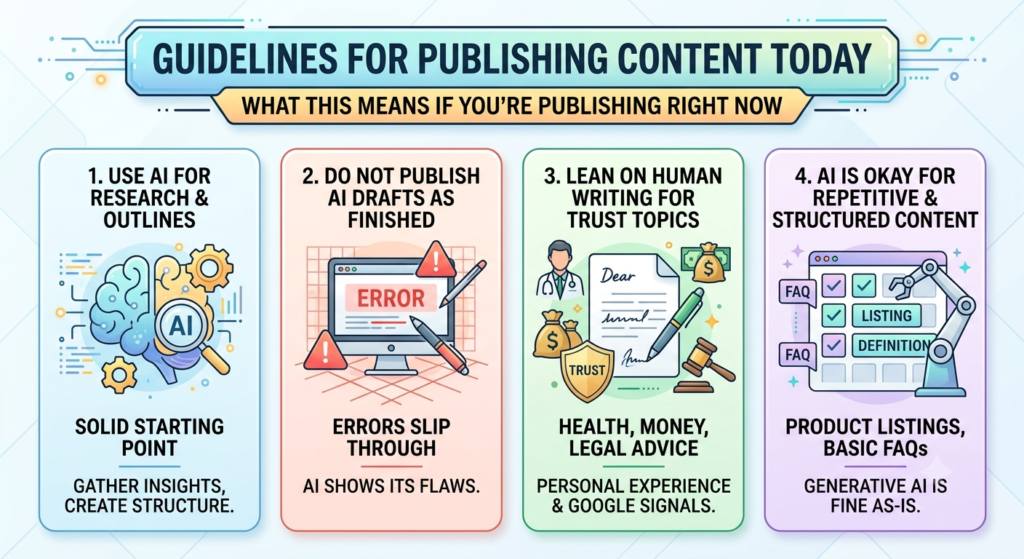
If you’re figuring out how to handle content on your own site today, a few things tend to hold up:
- Use AI freely for research, outlines, and structure it’s a solid starting point, no argument there.
- Don’t publish an AI draft as the finished piece. Errors slip through more often than people expect, and it shows.
- For anything touching trust health, money, legal advice, personal experience lean hard into human writing. That’s exactly where Google’s quality signals matter most.
- For repetitive, structured stuff product listings, basic FAQs, definitions AI-assisted content is usually fine as-is.
The mistake isn’t using AI. The mistake is treating it like it can replace the part of the job that actually requires judgment.
Research Spotlight
Bankrate
Bankrate is a financial publisher that leverages AI to make content production easier, while still upholding good editorial practices. All articles created with AI undergo human editing and validation by AI experts and subject-matter experts, guaranteeing accuracy and quality.
The company uses AI to generate pages of the financial glossary and informational articles. But everything is thoroughly checked by human editors and experts before it is posted.
CNET
The CNET fiascos are a warning about the risks of relying on AI without human oversight and review. In 2023, the technology publication was leveraged to produce a series of personal finance articles using AI.
CNET has had to concede that it has needed to make some changes to its content production strategy, using AI to assist in creating content.
Frequently Asked Questions
Is it bad for Google to have AI content?
Not for being AI-generated, specifically. It penalizes low-quality, unoriginal, unhelpful content full stop, regardless of who or what produced it. The tool was never the issue.
Is it possible to get AI content to rank on Google?
Yes, particularly if it has been well-researched and edited by someone who was a human being and knows the searcher’s intent. There are plenty of AI-generated content that perform well, but that is only when they’re used as a basis, not an endpoint.
Is it always better to have human-written content for SEO?
Not always depends heavily on the topic. For high-trust subjects like health or finance, human expertise tends to win out long-term. For simple, structured content, the gap barely shows up.
How can I tell if something’s AI-generated?
Getting harder by the month, honestly, and most detection tools aren’t reliable enough to lean on. A better tell is whether the content has specific, checkable detail suggesting real research.
If I use AI to write something, how can I let people know about it?
There isn’t a one-size-fits-all answer, but transparency generally leads to trust, particularly in fields where trust is rooted in credibility. Some of these publishers flag AI-assisted articles as they would do with sponsored articles.
The Practical Takeaway
The debate of AI content vs human content was not a competition between the two, so much as a discussion of whether either or both types were effective. It’s all about the correct tools for the job.AI’s genuinely strong at speed and structure.
Humans are still the ones bringing judgment, real experience, and the kind of trust search engines are actively trying to reward these days. The smart move isn’t choosing a side it’s knowing which one to reach for, and when it’s worth combining both.
Leave a Reply