Introduction
I checked my bank statement last month and just stared at the grocery line for a second. Same store, same-ish cart, and somehow $60 more than last year. If that sounds familiar, you’re not imagining it you’re not bad with money either.
Smart grocery shopping has quietly turned into a real skill you have to learn on purpose. Not something that just happens because you’ve been buying groceries your whole life.
Here’s the blunt version: the average U.S. household now spends over $500 a month on food at home. Food-at-home prices have climbed roughly 25-29% since 2020.That’s not a small bump.
So this guide isn’t going to tell you to clip forty coupons or give up coffee. It’s going to walk through what actually moves the needle the boring, unglamorous habits that add up to real savings.
Why Smart Grocery Shopping Matters More Right Now
Prices aren’t crashing back down, unfortunately. They’re expected to creep up another 2-3% this year. A few categories coffee, cocoa, imported produce are climbing faster because of tariffs. Annoying, but not the whole story.
Here’s the part that actually surprised me when I first read it. The USDA estimates American households waste 30-40% of the food they buy.
Not “let it sit too long in the fridge once in a while.” Nearly a third to nearly half. One joint USDA/EPA report puts a dollar figure on it: about $728 wasted per person, per year roughly $14 a week, thrown out before it’s ever eaten.
For a family of four, that’s close to $2,900 a year. Basically a used car’s down payment, sitting in the trash.
| Metric | 2026 Figure | Source |
|---|---|---|
| Average monthly grocery spend (household) | ~$520 | BLS Consumer Expenditure Survey |
| Grocery price increase since 2020 | ~26-29% | USDA / WealthVieu |
| Food wasted annually per household | 30-40% of purchases | USDA |
| Annual cost of food waste per person | $728 | USDA/EPA joint report |
| Savings from meal planning + lists | 20-30% off grocery bill | USDA |
So no, smart grocery shopping isn’t about eating less or eating worse. It’s about noticing where the money is actually leaking, because most of it is leaking somewhere you’re not looking.
Step 1: Plan Before You Ever Touch a Cart

Every real guide to smart grocery shopping starts in the same unglamorous place your own kitchen, not the store aisle. Open the fridge. Check the pantry. See what’s about to turn.
Takes maybe five minutes, and it’s honestly the single biggest lever you have. Because it stops you from buying a third jar of something you already own three of.
The USDA backs this up with numbers: meal planning plus a written list can cut a grocery bill by 20-30%. On a $500 monthly budget, that’s $100-$150 back in your pocket. Every month. Without cutting a single meal you actually enjoy.
A rhythm that tends to work, at least for me and for most people I’ve talked to about this:
- Pick 2-3 dinners built around what’s already in your kitchen, not a Pinterest board
- Repeat one or two breakfasts nobody needs a new breakfast idea every day
- Build lunches out of dinner leftovers instead of separate ingredients
- Write the list by store section, not by whatever pops into your head
Repetition sounds boring on paper. In practice it’s just efficient, and it kills off the decision fatigue that leads to standing in an aisle at 6pm grabbing whatever looks easy.
Step 2: Build a List That Works With the Store, Not Against It
A list only helps if you follow it once you’re actually inside the store. Organize by section produce, dairy, pantry, freezer, household so. You’re moving through once instead of doubling back for the one thing you forgot near the entrance.
This matters more than most people give it credit for. Stores design end-caps and checkout-line displays specifically to get you to grab something you didn’t plan for. A tight list is basically your only real defense against that.
If you shop online, you get an extra edge almost by accident. You can see a running total in real time, and you’re not walking past a wall of chips designed to catch your eye.
That combination tends to cut impulse spending by roughly 15-25% compared to shopping in person. If your regular store offers free pickup, it’s worth trying for a month just to see the difference in your total.
Step 3: Learn Unit Pricing Not the Sticker Price

This is the one people skip most, and it’s honestly the one that saves the most money over a year. The number on the shelf tag isn’t the real price. The real price is the tiny print underneath cost per ounce, per pound, per 100 sheets, whatever unit applies.
Companies have gotten quieter about raising prices outright and louder about shrinking the box instead “shrinkflation,” if you want the term for it. A bigger package isn’t automatically the better deal anymore. Sometimes it’s just… bigger.
| Product | Sticker Price | Size | Unit Price | Better Deal? |
|---|---|---|---|---|
| Brand A cereal | $4.99 | 12 oz | $0.42/oz | No |
| Brand B cereal | $5.49 | 18 oz | $0.31/oz | Yes |
| Store brand oats | $3.29 | 42 oz | $0.08/oz | Yes |
| National brand oats | $5.99 | 42 oz | $0.14/oz | No |
Quick rule I use now: if the “bulk” size isn’t at least 10% cheaper per unit, it’s not a deal. It’s just extra stuff taking up pantry space.
Step 4: Give Store Brands an Actual Chance
Store brands used to have a bit of a reputation problem cheap, bland. The option you picked only when you were really scraping by. That’s mostly gone now.
Consumer Reports found that 64% of U.S. shoppers now prefer store-brand products for pantry staples. Price gaps between private labels and name brands range anywhere from 5% to 72%.
Keep the name brand for the few things where you genuinely taste a difference. Coffee, maybe. Everything else, give the store brand a fair shot before ruling it out.
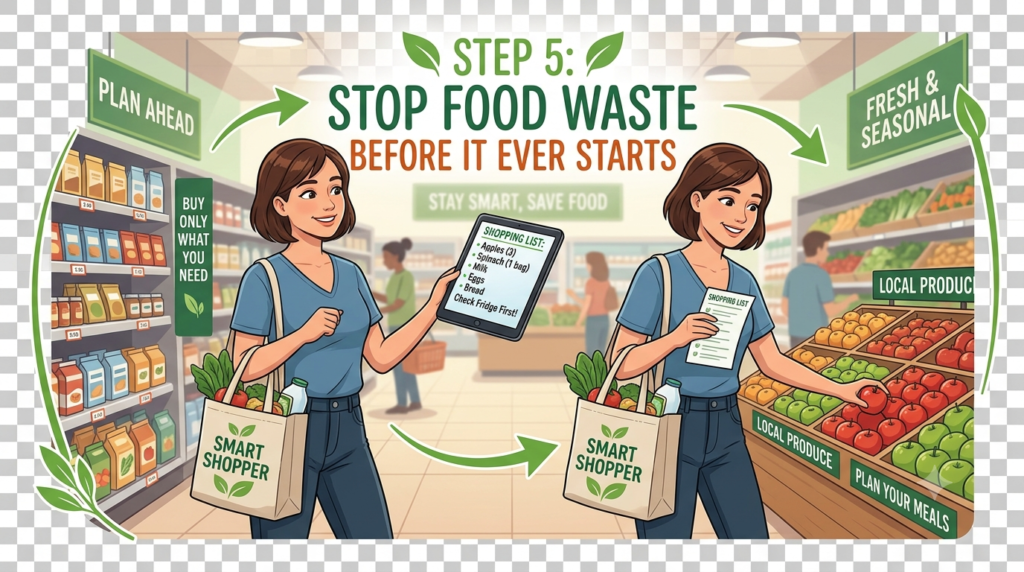
Step 5: Stop Food Waste Before It Ever Starts
Smart grocery shopping doesn’t end at the register. What happens in your fridge over the next week matters just as much as what you bought. Even the most careful households waste close to 9% of their food. The national average sits above 30%.
A handful of habits close most of that gap without much extra effort:
| Habit | Why It Works |
|---|---|
| First In, First Out (FIFO) | Older items get used before newer ones spoil |
| Freeze before the “use by” date | Locks in freshness instead of losing it |
| Learn what date labels actually mean | “Best by” is a quality guess, not a safety cutoff |
| Keep a “use this soon” shelf | Makes forgotten food visible instead of buried behind the ketchup |
| Cook once, eat twice | Double a soup or stew recipe and freeze half |
| Repurpose scraps | Vegetable ends into broth, overripe fruit into a smoothie |
Additional Smart Grocery Shopping Tips
A few extra habits that don’t fit neatly into a “step,” but genuinely help:
- Set a “buy price” for your top 15 items. Coffee, chicken, cereal, detergent whatever you buy on repeat. Write down what you consider a fair price, and only stock up when it hits that number, not just when a sign says SALE.
- Take one photo per aisle on a normal shopping day. That becomes your reference for what “normal” pricing actually looks like, so a “deal” sign doesn’t fool you next time.
- Join the loyalty program at your main store. Kroger, Safeway, Target — most digital coupons only apply if you clip them in the app beforehand. Skipping this step is basically leaving free money on the table.
- Shop the same store rhythm, not random days. Markdowns tend to follow a schedule knowing your store’s rough pattern helps you catch discounted meat and bakery items before they’re gone.
- Don’t shop hungry. It sounds like a cliché because it’s true — hunger makes almost everything in the store look like a good idea.
- Cap trips at once or twice a week. Extra unplanned trips tend to add 15-20% in impulse spending each time, just from being back in the building.
Common Smart Grocery Shopping Mistakes
Even careful shoppers fall into a few of these. Worth a quick self-check.
| Mistake | Fix |
|---|---|
| Shopping while hungry | Eat something small first — hunger inflates the whole cart |
| Shopping without any list | Even a rough, half-finished list cuts impulse buys a lot |
| Buying bulk on perishables | Save bulk buying for shelf-stable items you actually finish |
| Ignoring unit price | Always check cost per ounce or pound, not just the sticker |
| Multiple unplanned trips a week | Each extra trip tends to add 15-20% in impulse spending |
Real Life Examples
Ramsey Solutions – Average Cost of Groceries
According to Ramsey Solutions Average Cost of Groceries, food is one of the biggest monthly household expenses for most families. Instead of shopping without a plan, many budget-conscious households reduce unnecessary spending by creating weekly meal plans.
Consumer Reports Grocery Shopping Tips
Consumer Reports Grocery Shopping Tips recommends planning meals before shopping and always taking a grocery list. Their research explains that shoppers who prepare in advance are less likely to buy unnecessary items and are more likely to stay within their budget.
Frequently Asked Questions
Does smart grocery shopping really save that much money?
Pretty much, yes. Stack meal planning, list-based shopping, and store-brand swaps together, and most households land somewhere around $100-$200 saved a month, based on USDA and consumer research.
Is buying in bulk always smart?
No, and this trips people up constantly. Bulk only pays off on shelf-stable staples you’ll actually use rice, pasta, canned goods. On perishables, it usually just turns into waste with extra steps.
What’s the fastest habit to start with?
Checking the fridge and pantry before you write your list. Smallest step, biggest immediate payoff, and it takes about five minutes.
Final Thoughts
None of this is one big overhaul you do in a weekend. It’s five small habits, stacked on top of each other: plan first, list by section. Check the unit price, give store brands a real shot, and actually eat what you buy before it spoils.
None of it takes extra time at the register most of the work happens before you even leave the house.
Pick one habit and try it this week. Add the next once the first one feels automatic. That’s really all smart grocery shopping ends up being a quiet little system running in the background of a normal week. Saving you money you’d otherwise never notice slipping away.