Category: Business

  • How China Became the World’s Manufacturing Powerhouse

    How China Became the World’s Manufacturing Powerhouse

    Introduction

    Quick fact that still stops people mid-sentence: in 1978, Shenzhen was a fishing village of maybe 30,000 people, barely a paved road in sight. Today it’s home to over 17 million people, Huawei’s headquarters, Tencent’s headquarters, and a skyline.

    That looks like nobody involved ever heard the word “budget.” That’s not really a metaphor for China’s rise. That’s just… China’s rise, condensed into one city. It wasn’t inevitable either plenty of countries tried something similar and never got anywhere close.

    It took decades of risky policy bets, a massive pool of cheap labor, brutal competition between provinces. A government willing to gamble hard on exports, often over the objections of its own advisors. So how’d it actually happen? Let’s walk through it.

    From Isolation to Opening Up
    Before 1978, China ran on central planning under Mao Zedong, and, well, it wasn’t going great. Factories existed. But they made things for the state, not for anyone outside it. Growth was slow and shaky, shadowed by famine and political chaos.

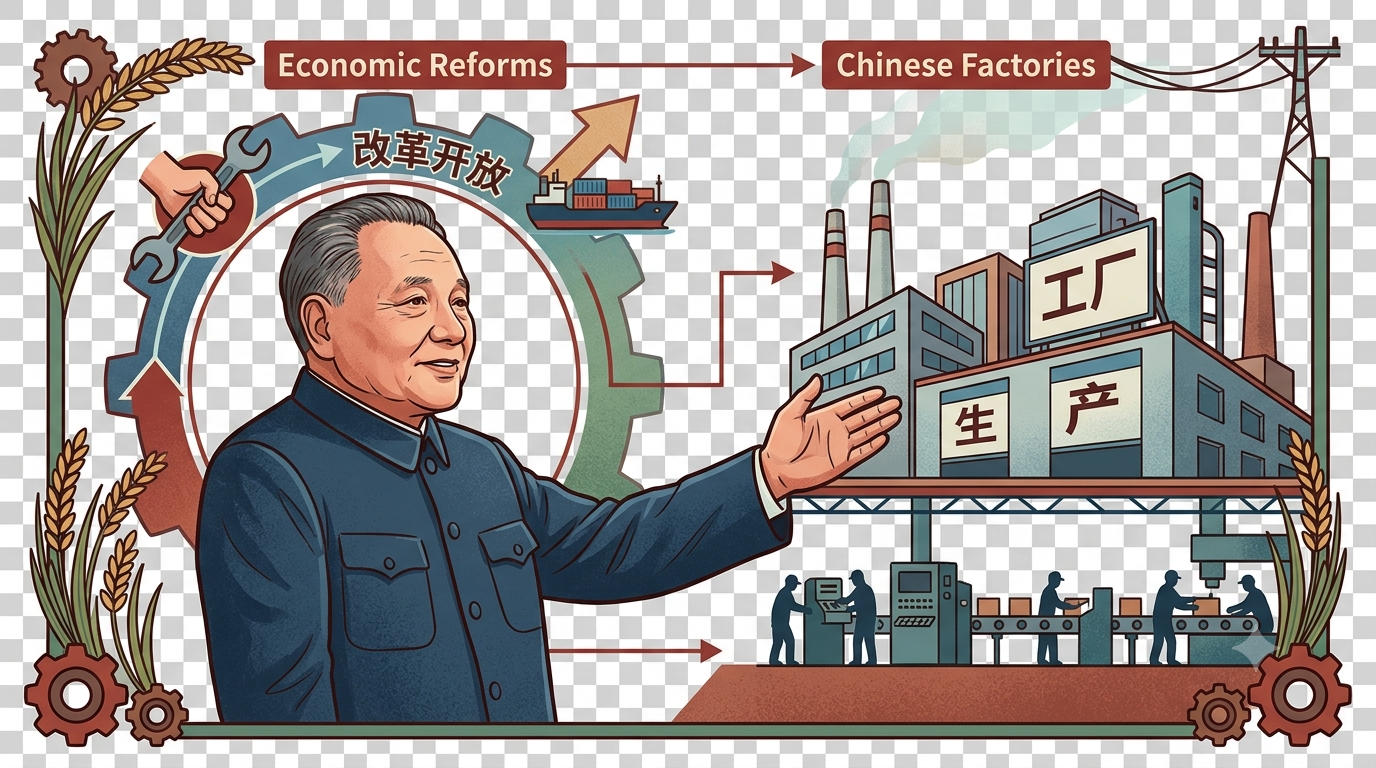
    Meanwhile Japan and South Korea kept pulling further ahead next door. Then Deng Xiaoping took over, and things moved fast. He pushed “reform and opening up,” a phrase you’ll still find stamped across Chinese government documents today.

    His logic was blunt, almost stubbornly so: China needed foreign money, foreign machines, foreign buyers Kor it was going to stay poor. That one controversial call is where this whole story really starts.

    The Shenzhen Experiment

    In 1980, Shenzhen got picked as China’s first Special Economic Zone. Think of it as a sandbox where the usual rules just… didn’t apply. Tax breaks, loose regulation, dirt-cheap land, all dangled in front of any foreign company willing to take the leap.

    Investors from Hong Kong went first, since they knew the area and the risk felt manageable. A decade later, unrecognizable. A Fishing village turned into a full-blown manufacturing boomtown, cranking out toys, textiles,and cheap electronics for containers headed overseas.

    Migrant workers poured in from the countryside chasing wages that beat farming by a mile, even if the shifts were long and grinding. More zones followed Zhuhai, Shantou, Xiamen each one basically a test run.

    If it worked, Beijing copied the homework elsewhere. Shenzhen wasn’t just a lucky city that got in early. It was the proof everyone else needed.

    Cheap Labor Met Massive Scale
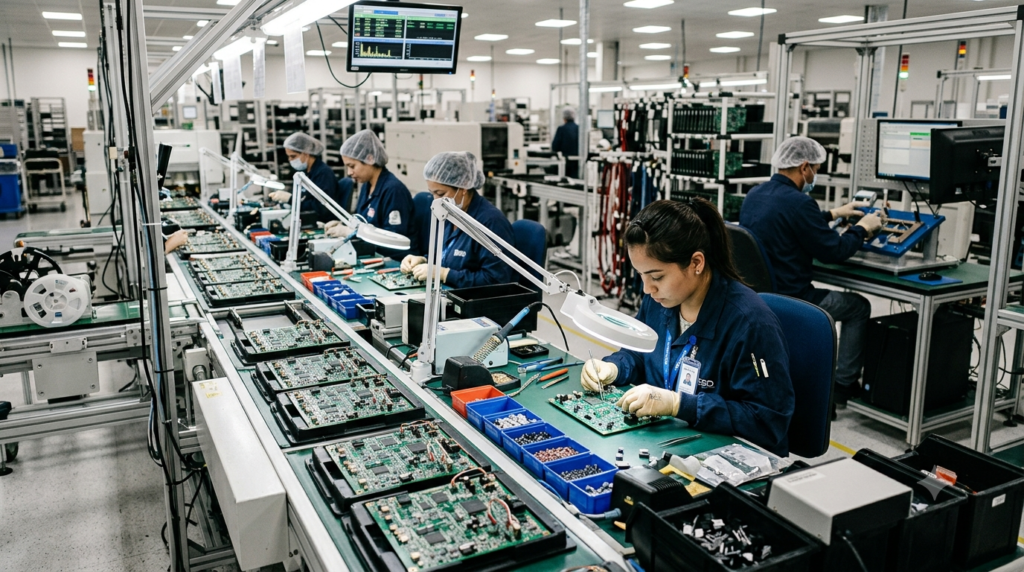
    Everyone points at wages first, and yeah, they mattered. Chinese factory workers in the 80s and 90s earned a sliver of what workers cost in the US or Japan. But that’s not the full story plenty of countries had cheap labor back then too. None of them turned into anything close to a manufacturing giant.

    What actually set China apart was scale, and not the kind anyone really planned out on paper. Something like hundreds of millions of people moved from farms to factories over thirty years. The largest human migration ever recorded, not a close second.

    That handed factory owners a strange kind of superpower: hire 50,000 workers this month, double it next year if orders spike. And somehow still find enough hands willing to show up. Foxconn’s the example everyone reaches for, and honestly, it earns it.

    At its peak, the Longhua campus in Shenzhen held around 300,000 workers under one roof. Not really a factory anymore at that point more like its own city, dorms and canteens and a bus loop included.

    Building the Infrastructure to Match

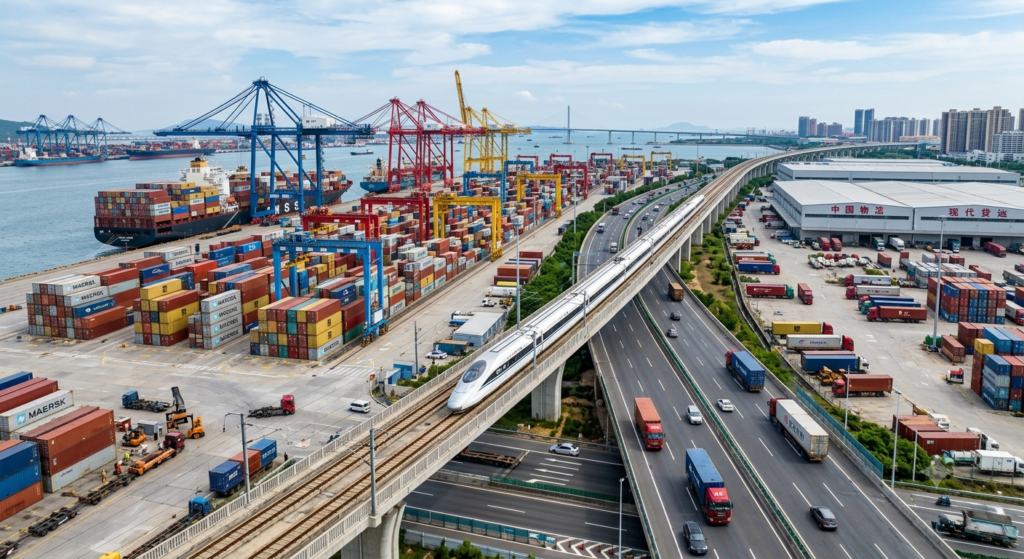
    You can’t run a factory on cheap labor alone, though. You need power that doesn’t randomly cut out mid-shift, roads that survive a rainy season, ports that load ships around the clock without choking up. China threw serious money at all three, and it didn’t do it halfway.

    From the 90s through the 2010s, China built highways, high-speed rail, and container ports faster than any country had managed before. Shanghai’s port now moves more cargo than any other on the planet, and it’s genuinely not close.

    Power lines pushed inland too, which mattered once coastal wages climbed and factories needed somewhere cheaper to relocate to. None of this happened by chance, either. Five-year plans set hard spending targets, and local officials basically raced each other to hit them.

    A factory owner in Guangdong could count on the lights staying on, the roads staying open, a port close by stuff manufacturers in a lot of other developing countries still can’t count on, even now.

    Foreign Investment and Technology Transfer
    Foreign companies couldn’t just show up and build a factory on their on. For years, the law required a local partner first, no exceptions. General Motors couldn’t sell one car in China without a joint-venture partner. Same deal for most foreign automakers and electronics brands, no matter how big the name was back home.

    That rule did something pretty sneaky, depending how you want to look at it. It funneled technology and know-how straight into Chinese hands, factory by factory. Engineers trained by German or Japanese firms went off and started their own companies.

    Suppliers who once bolted parts together for a foreign automaker eventually built entire vehicles solo. Critics call it forced tech transfer, and fair enough, that’s an accurate label. Beijing calls it mutual benefit.

    CountryManufacturing Output (2023, USD trillion)Share of Global Manufacturing
    China$4.98T~29%
    United States$2.50T~15%
    Japan$0.95T~6%
    Germany$0.81T~5%
    India$0.47T~3%

    From Cheap Goods to High-Tech Exports

    For years, “Made in China” meant plastic toys, throwaway electronics, fast fashion that stamp on the bottom of a cheap product. That reputation hung around way longer than it should’ve, honestly. The world was slow to catch up to what was actually happening on the ground.

    China now builds more electric vehicles than anywhere else. It’s not close. BYD outsells Tesla in global EV volume now a sentence that would’ve sounded like a joke ten years ago, but here we are.

    Chinese firms also control most of the solar panel supply chain, from raw silicon to the panel sitting on someone’s roof. Even in semiconductors, an industry the US has fought hard to keep out of Chinese reach, domestic firms are closing the gap quicker than most people expected.

    None of this happened by accident, that much’s clear. Beijing funneled subsidies into strategic sectors through programs like “Made in China 2025,” trying to climb the value chain instead of staying the world’s cheap assembly line forever.

    What China Actually Makes Today
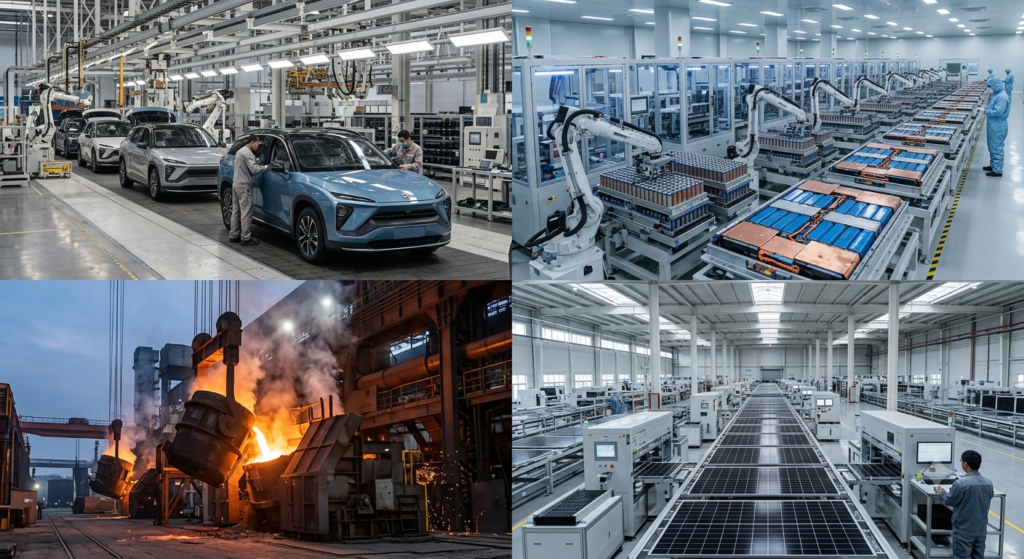
    SectorChina’s Global Market Share (approx.)
    Electric vehicles~60% of global production
    Solar panels~80% of global supply chain
    Smartphones (assembly)~65% of global output
    Steel~54% of global production
    Lithium-ion batteries~75% of global capacity

    The Cracks in the Model

    None of this came free, and let’s not pretend otherwise. Early factory conditions were rough long hours, cramped dorms, not much recourse if you complained. Things have gotten better as wages rose and labor laws tightened.

    But harsh conditions still show up in headlines now and then, especially around fast fashion and electronics. Pollution was the other big cost, and it was a heavy one. Cities like Linfen, and stretches of Hebei province, got infamous for smog thick enough to blot out the sun at noon.

    China’s since poured serious money into clean energy partly, you’d honestly have to say mostly, to clean up a mess its own manufacturing boom created in the first place. There’s a newer headache too. Rising wages are nudging some factories toward Vietnam, Bangladesh, Mexico. T

    ariffs from ongoing trade tension with the US are squeezing margins further. China isn’t losing its manufacturing crown anytime soon not even close but it’s no longer the cheapest seat at the table, and everyone in the business already knows it.

    What Comes Next

    This story’s far from over. But the shape of it is shifting under everyone’s feet. The next chapter probably won’t be about who can pay workers the least anymore. It’ll be about who can automate fastest, who controls the supply chains for batteries and chips.

    Who owns the tech running the next generation of factories. Shenzhen went from fishing village to tech capital in one generation flat. Whatever’s next for Chinese manufacturing, I wouldn’t bet on it taking much longer than that either.

    Rsearch Spotlight

    Foxconn’s Shenzhen Manufacturing Campus

    Foxconn set up one of the world’s largest electronics manufacturing bases in Shenzhen. Which was able to employ hundreds of thousands of workers when production was at its peak.

    The plant was a great asset to firms such as Apple and proved China’s capacity to produce sophisticated goods on an unprecedented scale.

    China’s Solar Panel Industry

    Bloomberg was established in 1995 as a manufacturer of rechargeable batteries, but the company diversified into the EV sector through extensive research and innovation and a focus on local production.

    With China’s clean energy goals, the company has grown to be one of the largest EV manufacturers globally, and recently outpaced Tesla in terms of the number of EVs sold worldwide.

    People Also Ask

    Why China has become the world’s manufacturing powerhouse?

    By successfully merging the reforms, low costs, foreign investments, infrastructure development, export-oriented policies and the rapid innovation of industry, China has become the world’s biggest manufacturing economy.


    What significance did Shenzhen have for the success of China’s economy?

    Shenzhen was the first Special Economic Zone in China, which led foreign investment and was also a trial zone for market-oriented reforms that were later implemented nationwide.

    Is one of the key factors in the growth of manufacturing in China its low-cost workforce?

    No, labor was cheap, but China also benefited from huge infrastructure investments. A well-managed supply chain, talented employees, government assistance and technological innovation.

    What are the industries that China is leading today?

    China is the world leader in EVs, solar, lithium-ion batteries, steel, consumer electronics and a host of other high-tech manufacturing industries.

    What are the problems of manufacturing industry in China?

    Some of the key challenges include labor cost, environmental considerations, trade conflicts, diversification of supply chains and the competition from India, Vietnam and Mexico.

    Conclusion


    China’s ascension to the status of manufacturing giant is not due to any one policy or lucky break. It was a result of many years of economic reform, tremendous investment in infrastructure, export-oriented economic growth.

    And being flexible with the changing global markets. Besides being a pioneer in shipping low-cost products. China has also been stepping up the manufacturing value chain, from developing Special Economic Zone.

    Shenzhen to leading the world in electric vehicles, batteries, and solar technology. However, the trip has not been easy. Competition with other nations, such as Vietnam, India and Mexico, and rising wages, environmental awareness, and trade tensions are changing global manufacturing.


  • How to Start an E-commerce Busines

    How to Start an E-commerce Busines

    Introduction

    I got a text message from a buddy on this one last month. Okay, how the hell do people make money selling stuff online, like where can I even start. I believe I have encountered this a dozen, if not more times during the years.

    Well, since I’m not going to retype it here’s the entire thing written correctly. Let’s start with a joke that we’ve heard many times before, and before anyone, “ecommerce is too saturated now.” I can comprehend what they are saying when they say it.

    It’s not 2015 anymore, where you can create a simple Shopify shop, put a few Facebook ads up and have orders roll in just luckily enough. That era’s gone, but the market itself? Still growing.

    Global online sales are expected to land somewhere around $6.9 trillion in 2026 roughly a fifth of all retail spending on the planet. That’s not a shrinking pie. It’s just a more crowded one, which means you need to be smarter about how you cut your slice.

    Okay, But Is It Actually Worth Doing Right Now?

    Here’s the thing that still surprises people: you genuinely don’t need much to start. A laptop and a free weekend can get a real, working store live. What’s changed isn’t the opportunity it’s the shopper. Almost half of online transactions today are made using a phone.

    So if your website seems even slightly cumbersome on mobile, you’re losing out on customers before they have a chance to see your homepage. I am humbled to remember this number that I learnt first: approximately 70% of shopping carts are abandoned.

    I don’t write this to give you a scare. It’s a general rule, most people never even plan, and just start building. And that is usually the reason that things fizzle out around month.

    Step 1: Figure Out How You’re Actually Going to Sell

    You are going to need to decide the way products are going to be transported from where to the customer hands before using a logo manufacturer or theme.

    Dropshipping – You list the product and the supplier ships the product directly to the customer. You never touch the box.Cheap to start (the global dropshipping market’s now worth north of $470 billion, so clearly plenty of people make it work).

    Holding your own inventory: more control, better margins usually, but you’re tying up real cash in stock sitting in a box. Somewhere before you even know if it’ll sell. Not great if you’re starting on a tight budget.

    Print-on-demand: nothing gets made until somebody actually buys it. No inventory sitting around. A lot of people with a design idea in their head funny shirts, niche art. That kind of thing start here because the downside risk is basically nothing.

    Dropshipping suits someone testing an idea without much money behind them. Holding inventory makes more sense once you’ve got some capital and want fatter margins. Print-on-demand fits anyone leaning on a design or a specific niche rather than a physical product they’re sourcing themselves.

    Step 2: Actually Do the Niche Research (People Skip This Constantly)

    This is, hands down, where I watch most first-time stores go wrong. They go wrong before they’ve even launched, they just don’t know it yet. The pattern’s always the same. Someone sees a product blowing up on TikTok, builds a whole store around it that weekend.

    Then three months later can’t figure out why nobody’s buying. Usually it’s because they never actually asked whether there was real, lasting demand they just chased a moment. Do this instead. Go read what people actually complain about.

    Reddit threads, Quora questions, the one-star reviews on a competitor’s Amazon listing people will tell you, unprompted, exactly. What’s annoying them about the options already out there.

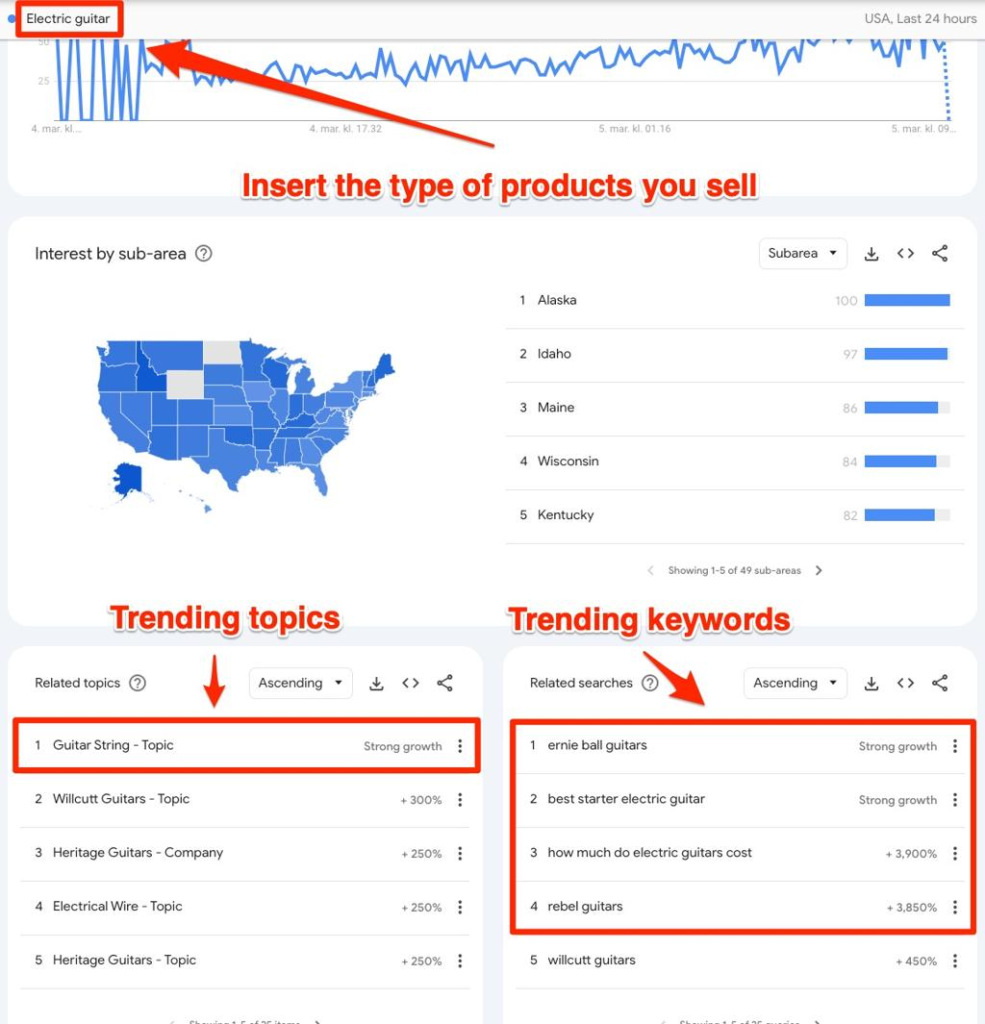
    That’s free research sitting right there, and almost nobody bothers to collect it. Google Trends is also a good place to check – you don’t want to be trailing a trend that hit its peak 6 months ago. There’s a quick test I actually do use: If I can explain in one sentence why this is for me.

    Step 3: Find Suppliers You Can Trust (Not Just the Cheapest One)

    Once you know what you’re selling, sourcing is next, and honestly this is where a lot of quality headaches start because people rush it to save two weeks. For dropshipping, AliExpress, Spocket, and CJ Dropshipping are the usual first stops.

    Don’t just grab whichever supplier has the lowest price read the reviews, and order a sample for yourself before it goes live on your store. You should know exactly what’s landing on your customer’s doorstep.

    If you’re holding inventory, Alibaba connects you straight to manufacturers, but the same rule applies: order a small batch first. I’ve heard enough stories of people ordering a huge first run only to find a chunk of it defective, and by then the money’s already gone.

    Step 4: Write Something That Counts as a Business Plan

    Not forty pages, nobody’s asking for that. Just be honest with yourself about four things what you’re selling, who it’s actually for. What it costs you versus what you’ll charge. Roughly how you plan to land your first hundred customers.

    Sounds obvious when it’s written out like this. Most people still skip it. And it shows stores with even a rough written plan tend to outperform the ones running purely on vibes. Partly because writing it down forces you to notice the gaps before your money does.

    Choosing a Platform: Shopify, WooCommerce, or BigCommerce

    Beginners spend way too much time agonizing over this decision. I get it. It feels like the “real” first step. But truthfully, your platform rarely decides whether the store works out. Still, worth getting reasonably right so you’re not fighting your own tools every day.

    Shopify’s the easiest on-ramp for most people everything’s built in, and the app store covers pretty much. Whatever you’ll need down the line. BigCommerce gives you more built-in muscle if you already know you’re planning to scale without stacking on a dozen extra apps.

    WooCommerce makes sense if you’re already comfortable in WordPress and want more hands-on control over everything.

    Domain, Branding, and Actually Designing the Thing

    Grab a domain short enough that you could say it out loud to someone at a party without spelling it twice. Branding doesn’t need a $2,000 designer on day one it needs to look and feel the same whether someone’s on your site or scrolling your Instagram.

    And please, resist the flashiest, most animated theme in the store. A plain, fast, mobile-friendly site will out-convert a “pretty” one that takes six seconds to load, every time, no exceptions I’ve ever seen.

    Step 6: Payments and Shipping Boring, But This Is Where Money Leaks

    Give people more than one way to pay. Card processing plus something like PayPal or Apple Pay payment friction at checkout genuinely kills sales, it’s not a minor detail. For shipping, pick your approach early: flat-rate, “free” baked into your prices, or real-time carrier rates passed straight through.

    Whatever you choose, actually run the math against your margins before you launch. I’ve watched more than one store quietly lose money for months because nobody sat down and did that math on day one.

    Step 7: Have Your Marketing Sorted Before Launch, Not After

    Traffic doesn’t just show up because your store technically exists somewhere on the internet. You need at least one or two channels ready before you flip the switch, not a vague plan to “figure it out later.” Basic SEO real product descriptions instead of one lazy sentence, decent titles.

    A site that loads fast pays off slowly, but it’s free traffic over time. Short-form video is increasingly where people first discover products now. Even if the actual purchase happens back on your site later.

    Email is still one of the highest-performing channels out there, especially for chasing down abandoned carts. Which, remember, is about 70% of them. Paid ads on Meta, Google, or TikTok can speed things up considerably. But only once you actually know your numbers. Otherwise you’re just paying money to guess.

    Legal Stuff, Taxes, Budgeting Nobody’s Favorite Part

    Register a proper business structure, usually an LLC or your local equivalent, mainly for liability protection. Check what licenses your specific niche requires. Figure out your sales tax situation based on where you have “nexus,” which varies by state and country.

    So check actual government sources rather than trusting a blog post including this one, to be fair. And keep business money and personal money in separate accounts from the very start. Future-you, sitting down at tax time, will genuinely thank present-you for this one small habit.

    Mistakes That Quietly Kill New Stores

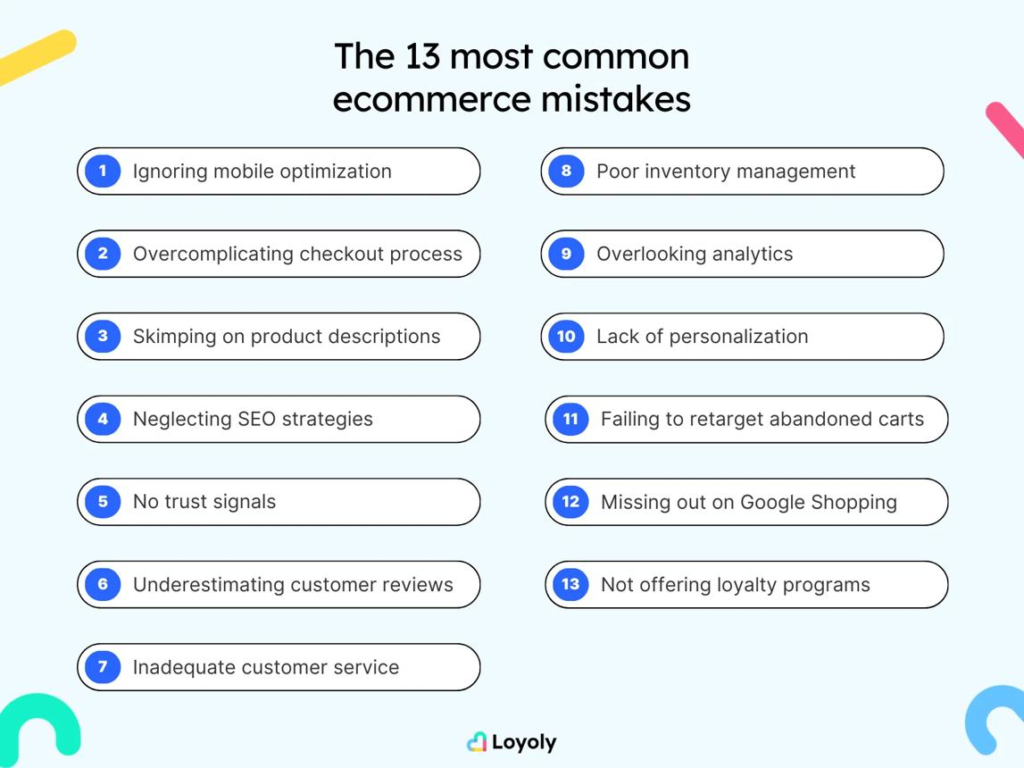
    Skipping niche research and just going with a gut feeling. Guessing at pricing instead of testing it against real costs and what competitors charge. Building a site that looks fine on a laptop but falls apart on a phone. Product pages with one blurry photo and two lines of description.

    Launching with zero marketing plan and hoping social proof just… appears. And one that doesn’t fit neatly into a list: cash flow. Plenty of stores look successful on paper because orders are coming in.

    While quietly losing money underneath because nobody’s actually tracking margins closely enough. Revenue and profit are not the same thing, and mixing them up is how otherwise decent stores run out of runway without seeing it coming.

    Research Spotlight

    Gymshark – From a Garage Startup to a Global Fitness Brand

    Gymshark’s inception was in 2012 when founder Ben Francis began a business out of his parents’ garage while working to delivery pizzas.

    Rather than using costly advertising, they marketed through fitness influencers on YouTube and Instagram, which helped them to earn trust and reach their target audience.

    Beardbrand – Solving a Niche Problem


    Founded in 2012 by its CEO and founder, Eric Bandholz, Beardbrand was established when Bandholz realized there was a lack of products and good marketing for beards. Beardbrand didn’t go up against the big grooming companies, instead they went with education on YouTube, blogs and email marketing.

    Final Thoughts

    None of this is complicated in theory. Pick a niche, source it properly, choose a platform that actually fits how you work. And market it consistently instead of in random bursts. What separates the stores still standing a year from now from the roughly 90% that quietly vanish isn’t luck.

    Real research instead of guesswork. Honest pricing. Treating marketing as part of the business from day one instead of something you’ll “get to eventually.” You don’t need everything perfect before you launch, nobody has that.

    FAQs

    How much money do I actually need to start an e-commerce business?

    Somewhere between $300 and $1,500 covers most beginners platform fee, a domain, a few product samples, and a small marketing budget to get going.

    Is dropshipping still worth it in 2026?

    Yes, but margins are thin, so it works best when paired with real branding and consistent marketing rather than just listing random trending products and hoping.

    Shopify, WooCommerce, or BigCommerce which one for a beginner?

    Shopify, for most people, purely because it’s the least friction to get started. WooCommerce if you already know WordPress well.

    How long before I actually see sales?

    Realistically, a few months of steady effort. Anyone promising overnight results is selling you something else entirely.

    What actually kills most new e-commerce stores?

    Weak niche research and no real marketing plan, closely followed by nobody watching cash flow until it’s already a problem.