
Introduction
A West Point cadet who has a score on a 12-questionnaire which is one standard deviation higher. It has a 60 percent greater chance of surviving Beast Barracks than a cadet with a higher SAT score. Just more likely, in a program built to break people down through exhaustion.
The questionnaire didn’t measure how smart anyone was. It measured whether they kept showing up after a bad day. That finding, from psychologist Angela Duckworth’s decade-long study of over 11,000 cadets.
Pokes a hole in a story most of us grew up believing that success comes down to being smarter or more talented than the next person. The actual research on high achievers points somewhere less flattering, more useful: habits. Small, boring things that quietly stack up over years.
Here are seven of them, pulled from peer-reviewed research and real case studies. No motivational posters involved.
Why This Actually Matters Right Now
Quick bit of context, Gallup’s latest report, “The State of the Global Workplace,” revealed that employee engagement has fallen to 20 percent – a decrease from 23 percent in 2022. This marks the first time since Gallup started tracking employee engagement that it dropped for two consecutive years.
It has already led to losses of over $10 trillion in productivity for the global economy in 2024. In such conditions, the importance of building one’s personal habits cannot be underestimated. A decent level of habit formation puts an individual in the top 20 percent of their peers who have not given up yet.
1. They Run on Systems, Not Willpower

Duke University researchers found that around 40% of what people do every day isn’t a conscious decision. It’s automatic, triggered by some cue, running while the “thinking” brain is off doing something else. Later work by psychologist Wendy Wood pushed that number closer to 45%. Successful people don’t fight this, they use it.
Take Stanford’s BJ Fogg, who taught himself a daily push-up habit by hooking it to something. He already did without thinking every bathroom trip became the cue for two push-ups. Years later, he was up to 40-80 a day, never once needing to “feel motivated.”
The lesson here is not to do PUSH-UPS. The lesson to be learned is that if you’re attempting something you have to have the willpower to do on a daily basis, you’re surely going to fail. Do it as something that you already do, and there is no decision to make.
2. They Set Goals Specific Enough to Actually Fail At
“Just do your best” feels supportive, it’s also nearly impossible to fail, which is exactly the problem. Edwin Locke and Gary Latham spent decades on this close to 1,000 studies between 1968 and 2019. Kept landing on the same conclusion: specific, difficult goals beat vague ones every time.
In some of Locke’s earliest experiments, people given hard, specific targets outperformed people given the easiest goals by more than 250%. “Get better at sales” gives your brain nothing to grab onto.
“Close 12 qualified deals by end of Q2” gives it a number, a deadline. A way to know uncomfortably clearly whether you’re on track. Successful people aren’t more comfortable failing. They’re just willing to define failure precisely enough to see it coming.
3. They Run a Nightly Review

The field experiment was carried out by the Harvard Business School professor Francesca Gino. Her colleagues at HEC Paris and UNC were at an international call center, where the employees were trained for 16 days. The scientists divided the participants into two groups: one group was asked to think about their situation.
And then talk about it for five minutes with one of the other scientists in their group. The other group received no explicit instructions, one group just did the training. A second spent 15 minutes each evening writing about what they’d learned.
A third of the reflection group wrote, and then discussed their work plans with their colleague for five minutes. As a result, the reflection group outperformed the non-reflection group by 22.8 percent on the final test. The group that reflected and shared did even better.
Nothing about the training changed. The only difference was fifteen quiet minutes turning raw experience into something the brain could hold onto. Most of us treat being busy as proof of progress. This suggests the opposite stopping to think about what just happened is often what makes the next attempt better.
4. They Treat Sleep Like Leverage, Not a Luxury

Sleep scientist Matthew Walker, director of the Center for Human Sleep Science at UC Berkeley, is investigating the consequences of shortened sleep. But he has found that the effects go beyond simple fatigue.
Earlier fMRI research out of Harvard Medical School found sleep-deprived participants showed a noticeable drop in hippocampal activity. The part of the brain that lays down new memories even when they seemed alert on the surface.
The problem wasn’t attention, it was the memory system quietly failing to record anything. A separate study found sleep-deprived participants asked to memorize new material performed about 40% worse than people who’d slept normally.
Worth sitting with if you’re the type to sacrifice sleep first whenever a deadline gets close. You’re not buying extra productive hours. You’re borrowing against tomorrow’s ability to remember, at a steep interest rate.
5. They Choose Effort Over “I’m Just Not a Numbers Person”
Stanford psychologist Carol Dweck’s growth mindset research the idea that believing your abilities can develop through effort changes. How you handle setbacks gets accused of being oversimplified. Dweck herself has pushed back on watered-down versions of her work.
In one study, researchers assigned a short online growth mindset course to a random subset of ninth graders in 76 different US public high schools. They compared them to a control group that did an unrelated lesson.
Students who took the course, whether they were lower or higher achieving than the control group. On average got better grades and took harder classes than the control group students. In practice, this can look like a difference in the type of language.
That successful people use when reflecting on failures or shortcomings in their own performance. Instead of saying something like “that didn’t work, I’m just no good at this”, a person with a growth mindset will say something like “that didn’t work, what’s a better way to do this”.Sounds tiny.
Over years, it’s the difference between trying the harder version of the next task and quietly avoiding it.
6. They Already Decided They Won’t Quit

Back to West Point, Duckworth’s team tracked cadets across nine entering classes over a decade. Measuring “grit” as sustained passion for a goal plus the willingness to keep grinding when it gets hard. Their analysis in the Proceedings of the National Academy of Sciences found grit.
Physical ability was a better predictor of who graduated from Beast Barracks than raw cognitive ability, even though intelligence still best predicted academic GPA. That’s not “intelligence doesn’t matter.” It’s that intelligence predicts different outcomes than perseverance does. Most long, hard goals are won or lost in the perseverance column.
Successful people rarely look tougher than everyone else in the moment. What’s different is they made the call to keep going before the hard day showed up, instead of talking themselves into it in real time, when willpower’s already running on empty.
7. They Guard Their Attention on Purpose
This one ties everything else together, and it’s the hardest to hold onto in 2026. Notifications, open-plan offices, a workplace culture where, per Gallup’s own numbers, even managers have lost their “engagement premium” over the people they lead. All of it pulls one direction: toward reacting instead of choosing.
Successful people push back with small, deliberate friction. Phone in another room during focused work. One task list instead of six competing ones.
A hard stop on email past a certain hour. None of it looks dramatic. But it protects the conditions the other six habits need, because none of them hold up if attention is sliced into fifteen pieces all day.
A Few Things This Isn’t Saying
This research doesn’t say willpower is useless just limited, better spent designing systems than fighting the same battle daily. It doesn’t say talent doesn’t matter Duckworth’s own data shows cognitive ability still predicts academic performance. And it doesn’t say grit or growth mindset are magic fixes.
Dweck has said mindset work needs a supportive environment, not a replacement for one. None of this is easy to keep up, either, reflection takes time most calendars don’t have. Sleep competes directly with ambition in a culture that still rewards looking exhausted.
Specific goals feel riskier because you can visibly miss them. And grit, pushed too far, can look like refusing to change course when the evidence says you should. None of this is effortless, the research just shows, with real numbers, that it’s worth doing anyway.
Practical Takeaways
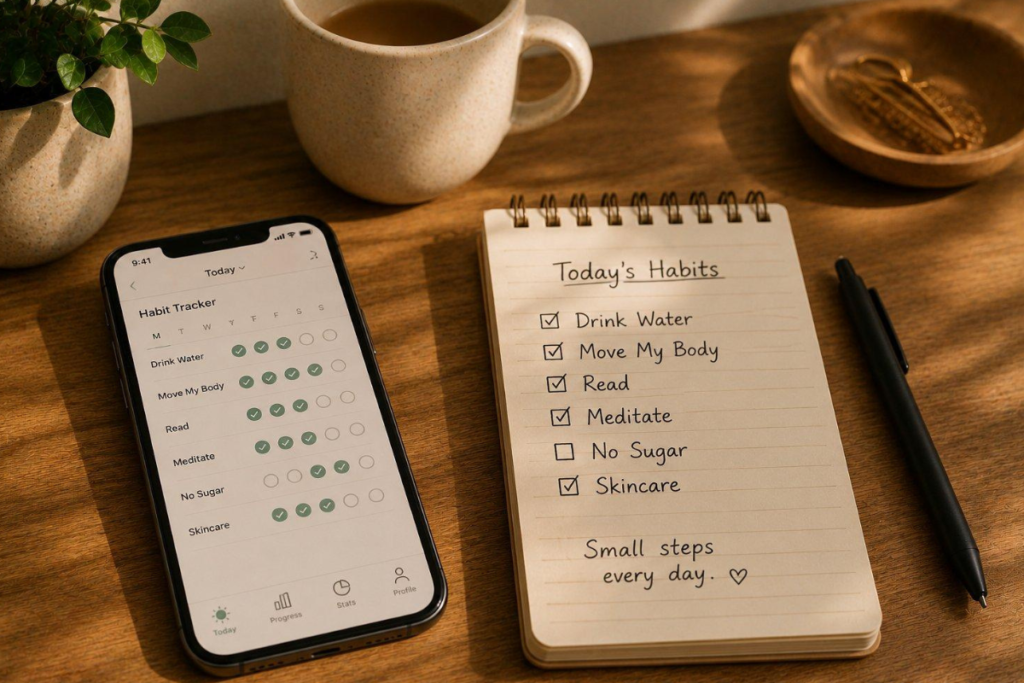
Pick one habit, not seven, one, attach it to something you already do daily. Give it a specific, measurable target instead of a vague intention. Write a quick review of your day, even a short one. Protect the sleep and attention everything else depends on. And expect setbacks decide now that one bad day doesn’t mean quitting.
Where This Is Headed
As remote and hybrid work stick around and engagement keeps sliding at the organizational level. The gap between people running on deliberate systems and people running on willpower alone will only widen. Workplaces are giving people less structure by default, not more. That makes building your own worth a lot more than it used to be.
Research Spotlight
West Point Military Academy – Why Grit Beat SAT Scores
Thousands of students come here to the United States Military Academy yearly. Many of them have good SAT scores, good grades, and good leadership experience. But one of the most difficult aspects of their education is not the classroom it’s Beast Barracks.
A rigorous six-week military training session that challenges cadets to the highest degree! Over the past decade, psychologist Angela Duckworth has spent over 11,000 hours studying cadets to determine why some make it to the end, and others walk away. Believe it or not, SAT scores were not the most significant factor for success.
Conclusion
None of these seven habits are secret. What’s notable is how ordinary they look from the outside. How consistently the data backs them up once researchers actually measured what high performers do differently.
Success, according to the evidence, has less to do with any single dramatic trait and a lot more to do with what gets repeated on the days nobody’s watching.
FAQ
Is grit more important than intelligence for success?
Not exactly, Duckworth’s West Point research found intelligence best predicts academic performance. While grit and physical ability better predict who persists through extreme challenges. They predict different things.
Does having a growth mindset really make a difference in performance or is it an exaggeration?
Large, randomized studies, including one conducted in 76 high schools across the United States. It demonstrates real gains in grades as a result of growth-mindset interventions, but Dweck cautions against overly simplistic forms of the concept.
How much does sleep really affect performance?
Sleep loss has been shown to affect the hippocampus during learning, as well as to be measurable on memory performance and to have other effects on decision making.
What is the one habit that all successful people have in common, according to studies?
One of the most researched areas is the practice of setting goals. It has been found in close to a thousand studies over half a century that goals that are specific and challenging are superior to general goals.
Can these habits work in a low-engagement workplace?
Yes, and arguably they matter more there. Personal systems for reflection, rest, and focus don’t depend on organizational support to function, which matters given how far workplace engagement has fallen.
Leave a Reply